
In New York City, the sidewalk in front of a property is the owner’s responsibility, not the city’s. The Department of Transportation can inspect a sidewalk, issue a violation notice for defective flags, and expect the owner to make the repair — and an owner who ignores a notice can find the city doing the work and billing for it. That is why the first thing our concrete repair and installation contractors do on a Harlem sidewalk job is read the flags the way an inspector would.
The defects we see most are lifted flags where tree roots have pushed a corner up, cracked and settled sections outside the older apartment houses, and spalled surfaces where years of salt and freeze-thaw have eaten the top layer. A lifted flag is a trip hazard and a liability at the same time: a pedestrian who falls can hold the adjoining owner responsible. Where a DOT violation has already been issued, the work has to cure the specific defects the notice lists, and then pass a re-inspection — which is why we photograph each flag before and after, and keep the scope tied to what the notice actually requires.
Not every defective flag needs full replacement. A small lift can sometimes be ground down to remove the trip edge; a cracked but stable flag can be patched; a flag that has settled badly or broken through usually needs to come out and be replaced as part of our sidewalk repair and replacement work. We say which is which before quoting, flag by flag, and we explain the choice in writing — because a cheap grind on a flag that will keep moving is not a saving. The areas we serve are listed on our service areas page, and every job is quoted by Star Construction INC after an on-site inspection.
Between the sidewalk and the front door, Harlem’s steps and areaways take the weather first and the foot traffic second. Stone treads wear, joints open, cheek walls crack, and a stoop that has settled a fraction pulls away from the building and starts admitting water at the joint. These are small structures with outsized consequences: a rocking tread is a trip hazard, and a failed areaway lets water straight into the cellar.
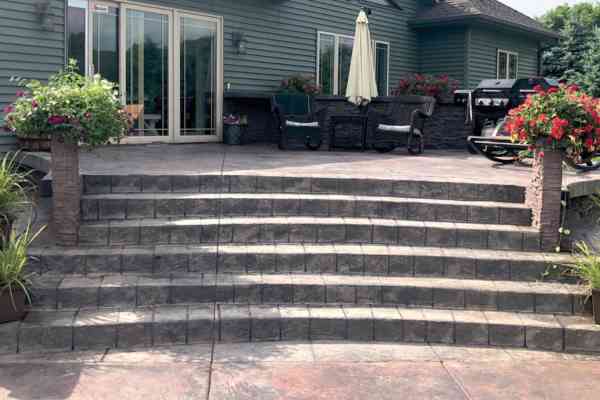
Our concrete steps and staircases work starts with the footing — a stoop rebuilt on a shallow or broken footing will settle again. Where the structure is sound, repointing, tread repair and new rail fixings restore it; where it has moved beyond that, we rebuild in kind, matched to the brownstone and brick around it.

Not every damaged slab needs to come out, and not every slab is worth saving. The honest decision turns on three questions: is the base still sound, is the damage still local, and will the repair outlast the next few winters? A sound base with surface wear can be ground smooth or given a new wearing surface — our concrete resurfacing and repairs work covers exactly that ground. A slab that has lost its base, heaved badly, or cracked through in a pattern that keeps moving is finished, and patching it is throwing money at a surface that will fail again.
The same judgement applies beyond the sidewalk: rear yards and garden paths deserve the same honesty, and our concrete patios and walkways work follows the same rule — repair where repair will hold, replace where it will not, and say which is which before quoting. That is the whole of our approach in Harlem: inspect first, measure honestly, and recommend the smaller job whenever the smaller job is genuinely enough.
Our clients value the consistency, structural precision, and long-term performance we deliver on every project, from initial planning through final execution.

 Jav V
Trustindex verifies that the original source of the review is Google.
Got my bathroom remodel Team was professional on time Thank you Ever fernando Perez saldañaCrear Word
 LUIS CAYOi hire them for my home project. and everyting went smoothly. no delays
 Shahid IqbalVery reliable contractor. They did exactly what they promised and the quality was excellent. Would definitely recommend.
Contact us now to discuss your project and receive a no-obligation quote from our experts.
Every project is handled through a defined process that ensures accuracy, efficiency, and long-term structural performance from start to finish.
We begin by reviewing site conditions, understanding project objectives, and identifying structural requirements to establish a clear and practical direction before any work begins.
A detailed execution plan is developed, including material selection, sequencing of work, and coordination of labor to maintain consistency and avoid delays during construction.
Work is carried out using proven installation methods, with attention to structural integrity, proper reinforcement, and adherence to safety and quality standards.
A final walkthrough is conducted to verify workmanship, resolve any outstanding details, and ensure the completed project meets performance expectations and durability standards.
Below the pavement, Harlem’s foundations and cellar floors have carried brownstones and apartment houses for a century or more — stone and brick foundations on the older rows, poured concrete on the later buildings. They move, they crack, and they let water in; the skill is knowing which of those things is ordinary age and which is a warning. Our concrete slabs and foundations work starts with that reading, because a foundation repair quoted without it is a guess, and guesses in a cellar get expensive.
Fine, hairline cracks in a poured concrete wall or floor are usually shrinkage from curing, and in a century-old building they have often been there for decades without moving. We measure them, photograph them, and tell you honestly when the right answer is simply to watch them across a season rather than pay for a repair.
A crack that steps through mortar joints, widens along its length, or appears with sticking doors and sloping floors is telling a different story — movement, not age. Those cracks get a closer inspection, and where the movement looks structural we say so plainly and recommend the right specialist rather than dressing it up as a concrete patch.
Damp in a Harlem cellar usually enters at the wall-floor joint, through porous concrete, or where outside grading sends water against the wall. A coating smeared over a wet wall traps the water behind it and peels within a season. We trace the water’s path first — grading, gutters, drainage — and only then seal or repair the concrete itself.
Some foundations have moved beyond patching: a wall bowing inward, a floor heaved by water pressure, a section that has lost its bearing. That work belongs to structural specialists, and we say so rather than selling a cosmetic repair that will fail. An honest referral costs us a job and saves you a much bigger one.
In New York City, the property owner is responsible for maintaining the sidewalk adjoining their property — not the city. That means repairing or replacing defective flags, and the owner can be liable for injuries caused by a defect. The city inspects sidewalks and issues DOT violation notices where defects are found; the owner then has a deadline to make the repairs and arrange a dismissal inspection. We inspect the flags, photograph the defects and quote the repair or replacement before any work begins.
It depends on the crack. Fine, hairline cracks in poured concrete are often shrinkage from curing and are usually stable, but they should be measured and watched across a season to confirm they are not moving. Cracks that step through joints, widen along their length, or appear alongside sticking doors or sloping floors suggest movement and deserve a closer look — sometimes by a structural specialist — before any repair is quoted. Honest assessment comes before patching.
Both, depending on condition. A slab with surface wear, minor cracking or a small lifted corner can often be ground, patched or partially replaced. A slab that has settled badly, broken into pieces, or lost the support underneath it usually needs full replacement — patching it would fail again quickly. We say which one your concrete needs after measuring and photographing it, not before.
A new sidewalk can usually be walked on within 24 to 48 hours, once the concrete has set enough to bear foot traffic without marking. Driving on it takes longer — typically about a week, depending on the mix and the weather. Curing time varies with temperature and slab thickness, so we give a specific time for your pour before we leave the site.
Sidewalk construction and replacement work in New York City generally involves DOT permits, and the exact requirements depend on the scope of the work and whether a violation notice is involved. We handle the permit side of the job as part of the project and confirm what applies before work starts, so there are no surprises once the crew arrives.