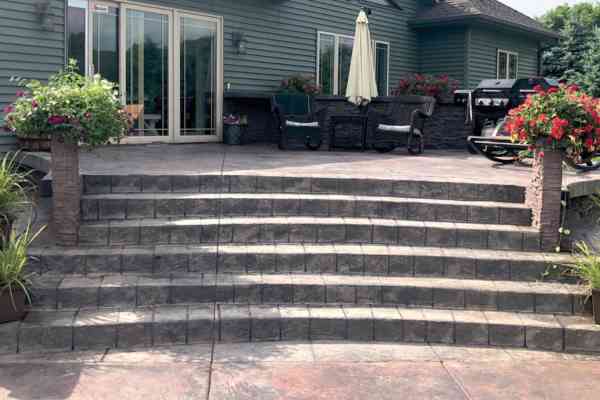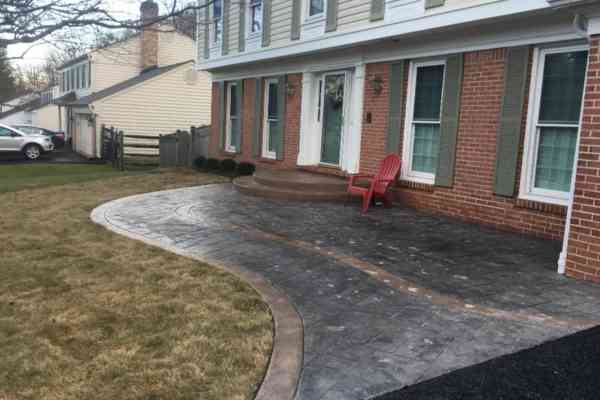

Concrete at Manor scale is not a patchwork of small pours. The driveways run long from the street to the garage, the front walks run under a canopy that has had a century to grow, and the entrance steps and garden terraces were built as part of the house itself. Our concrete repair and installation contractors in New York begin every Manor job the same way: walking every slab with the homeowner, marking what has lifted, what has settled and what has simply aged, before any price is named.
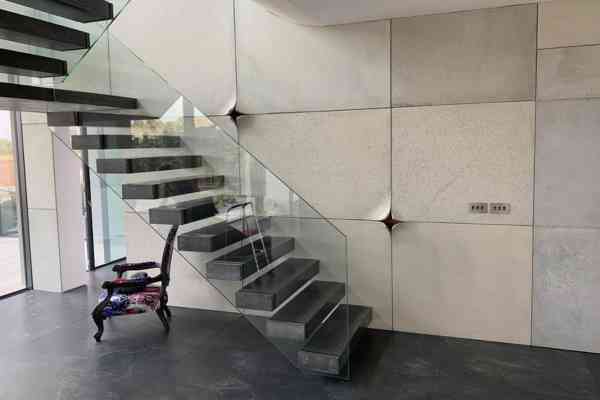
The work itself covers the whole run: concrete driveway installation and aprons graded to the street, concrete patios and walkways that drain away from the house, concrete steps and staircases rebuilt to a comfortable, even rise, and concrete resurfacing and crack repairs where the slab is sound enough to save. Where entrance steps meet stonework, our masonry contractors in Pelham Manor handle the stone cheeks and walls alongside, so the step and the wall read as one entrance rather than two jobs.
Whether the answer is a repair or a replacement, the sequence is the same: assess first, explain second, and quote only after both. Star Construction INC has poured and repaired concrete across the New York area since 2018. Request a free, no-obligation estimate and we will walk every slab with you and explain which is which.
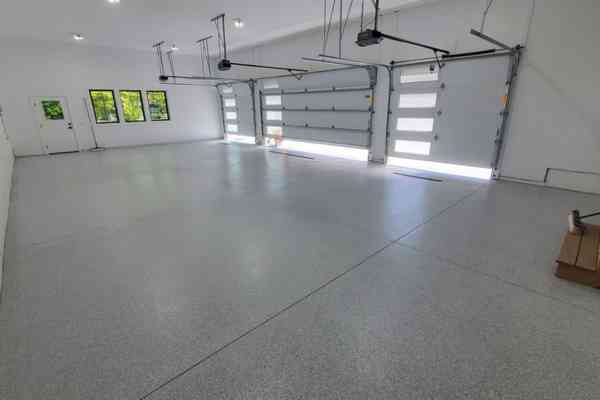
Concrete repair and installation in Pelham Manor means working with the flatwork the village actually has: long driveways and aprons, front walks and entrance steps, patios and garden terraces, and the garage floors and concrete slabs and foundations beneath the additions and outbuildings. A repair replaces what has failed — a lifted walk slab, a spalled step nose, a cracked patio section — while an installation removes the failed work and pours new: base compacted, joints cut where the slab needs to move, and a finish that sheds water instead of holding it.
The details decide the life of the pour. Joints must be cut at the right spacing so the slab cracks where it is told to, not where it pleases; the base must drain, because a slab sitting in water will heave with the first hard freeze; and the finish must suit the use — a broom finish for walks that stay walkable in wet weather, a smoother finish where garden furniture will sit. Our sidewalk construction and repairs and stamped and decorative concrete work follows the same discipline, whatever the surface.
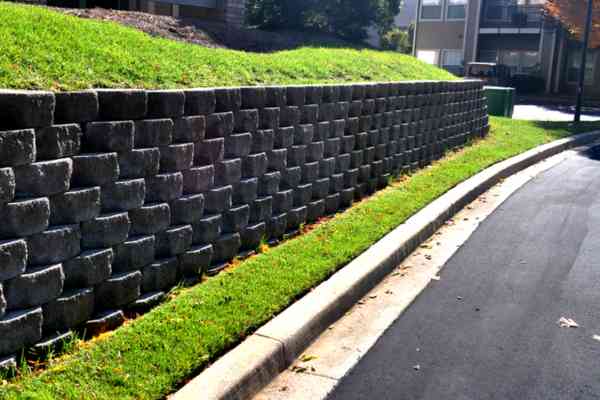
Where the ground itself has to be held, retaining walls and curbs keep the terraces and beds in place, and garage floor concrete gives the Manor’s long driveways their working end. Whatever the element, the standard is the same: water managed, joints honored, and a slab that will still be level in ten winters’ time.

If your Manor concrete is showing its age — a walk slab lifted by a root, a driveway apron that has settled at the street, steps whose noses are spalling — start with an assessment rather than a quote. Our concrete contractors in Pelham Manor will walk every slab with you, explain what can be lifted, ground or patched honestly, and name plainly what has reached the age where replacement is the cheaper sentence.
You can see the full range of areas we serve on our service areas page, and the parent service description at concrete repair and installation contractors in New York. Star Construction INC has poured and repaired concrete across the New York area since 2018 — request a free, no-obligation estimate and we will assess first and quote second.
Our clients value the consistency, structural precision, and long-term performance we deliver on every project, from initial planning through final execution.

 Jav V
Trustindex verifies that the original source of the review is Google.
Got my bathroom remodel Team was professional on time Thank you Ever fernando Perez saldañaCrear Word
 LUIS CAYOi hire them for my home project. and everyting went smoothly. no delays
 Shahid IqbalVery reliable contractor. They did exactly what they promised and the quality was excellent. Would definitely recommend.
Contact us now to discuss your project and receive a no-obligation quote from our experts.
Every project is handled through a defined process that ensures accuracy, efficiency, and long-term structural performance from start to finish.
We begin by reviewing site conditions, understanding project objectives, and identifying structural requirements to establish a clear and practical direction before any work begins.
A detailed execution plan is developed, including material selection, sequencing of work, and coordination of labor to maintain consistency and avoid delays during construction.
Work is carried out using proven installation methods, with attention to structural integrity, proper reinforcement, and adherence to safety and quality standards.
A final walkthrough is conducted to verify workmanship, resolve any outstanding details, and ensure the completed project meets performance expectations and durability standards.
A Manor’s concrete is judged by the winters it survives and the walks it keeps level. The sections below are what that standard looks like, slab by slab.
Manor lots are generous, and their driveways are long — a full run from the street to the garage, often with an apron at the road edge and a turning area the original builders never imagined needing. The failures on a long driveway are the same as on a short one, just spread over more concrete: settlement where the base was never compacted properly, scaling where water has sat and frozen, and an apron that has dropped at the street line. The fix starts with the grade: water sent to the street, never toward the house, and joints cut so the long run can move without cracking where it pleases.
Under the Manor’s canopy, the front walk is a negotiation between concrete and roots. A maple or oak lifts a slab a quarter inch at a time until the edge becomes a trip; shade keeps the surface damp, and damp grows the algae that makes a shaded walk slick. The honest fixes, in order of intervention: grind the raised edge where the lift is small, lift and re-bed the slab where the root allows it, and replace the section where the root has won or the slab has cracked through. A walk that can be saved should be saved — but a walk that trips visitors will not be saved by grinding alone, and we will say so.
The Manor’s back gardens are rooms in their own right, and their concrete terraces carry the same expectations as the front walks: level underfoot, drained away from the house, and jointed so seasonal movement does not crack them across the middle. A terrace that ponds water against the foundation is a terrace that will heave; a terrace that drains to the garden, with its joints honored and its edges restrained, will outlast the furniture placed on it. Where the garden steps down, the terrace and its retaining edges are built as one piece, so the levels read as designed rather than accumulated.
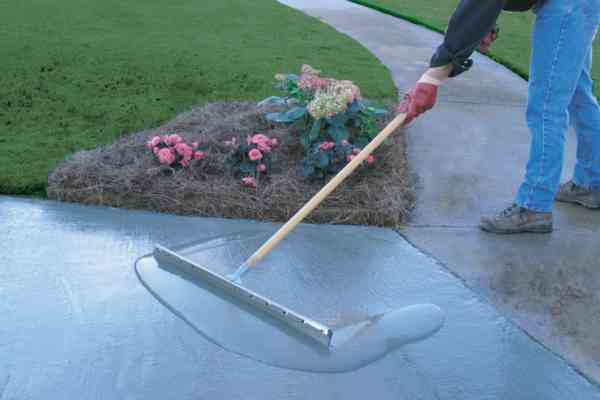
Not every cracked slab needs replacing, and not every slab that can be patched should be. The judgment is made slab by slab: a settled section with a sound base can be lifted and re-bedded, a surface that has scaled can be resurfaced, but a slab that has cracked through, lost its base or heaved repeatedly has reached the age where replacement is the cheaper sentence. Winter is the test that settles most of these calls — freeze-thaw damage widens every weakness a little more each year, so a repair that ignores drainage will fail again by spring. We will tell you which slabs are which, and why, before quoting either.
Three options, in order of intervention. Where the lift is small — a quarter inch or so — the raised edge can be ground down to remove the trip. Where the slab is otherwise sound, it can be lifted and re-bedded on a corrected base, with the root managed rather than cut where the tree allows it. Where the slab has cracked through, or the root has won the space beneath it, the section should be replaced. The cost depends on how many slabs are involved and which of the three fixes each one needs.
Often, yes, when the base is sound and the damage is surface-deep: scaling, minor cracking and a worn finish can be covered by a bonded resurfacing layer that gives the driveway a new wearing surface. It is not the answer when slabs have settled unevenly, cracked through or lost their base — resurfacing over movement only hides it until the next winter. The cost depends on the driveway’s length and how much of it is sound enough to resurface.
Yes, with precautions. Small repairs and emergency work go ahead in winter using cold-weather mixes and protection from frost while the concrete cures. Full pours are best scheduled for milder weather, since a slab that freezes before it has cured will scale and weaken — but a repair that stops water getting in is never worth postponing until spring. The cost depends on the area and the protection the weather demands.
Yes — new concrete should be sealed once it has cured, and resealed every few years after that. Sealer keeps water, salts and stains out of the surface, which is what stops the freeze-thaw scaling that shortens a driveway’s life. Shaded, damp walks and the Sound-side streets benefit most. The cost depends on the area to be sealed.
Work wholly on the lot — a walk, a patio, a driveway section — is usually simpler, while work in or near the public right-of-way, and any change to grades or drainage that affects the street, generally needs village coordination. We confirm the village’s current requirements for your job before work is scheduled.