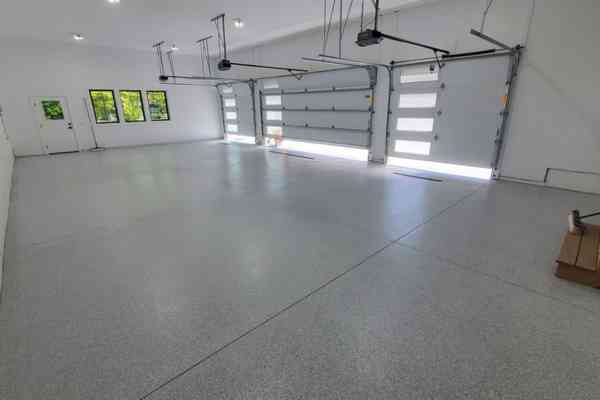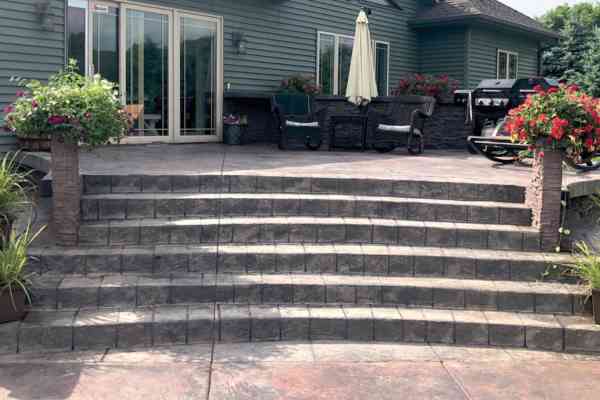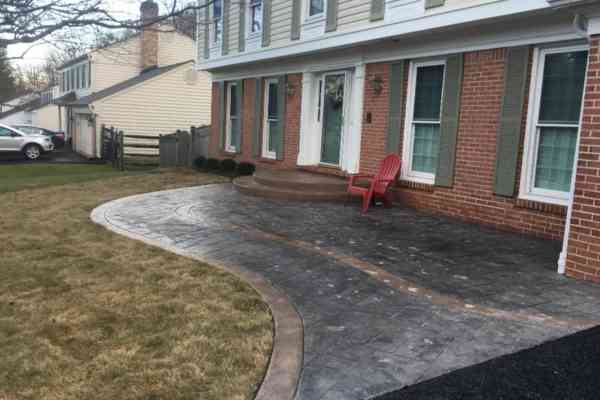

Concrete work in Village of Pelham is flatwork under a canopy, and it should be judged slab by slab. Driveways, front walks, stoops and patios here share the same pressures: tree roots that lift a slab a fraction at a time, shade that keeps surfaces damp, and freeze-thaw winters that scale a pour that was never given the base or the joints it needed. Our concrete repair contractors in New York approach, adapted here house by house, therefore starts with an assessment on foot: which slabs are sound, which can be repaired honestly, and which have reached the age where replacement is the cheaper sentence.
That assessment covers the whole of a Pelham lot’s concrete. A concrete driveway installation is judged on its base, its drainage and its joints, not just on its surface; a sidewalk repair is judged on whether the lift is a single slab or a root problem that will return; concrete patios and walkways are judged on how water leaves them; and concrete steps and staircases are judged on tread, riser and footing together, because a step that looks sound on top can be failing underneath.
Where a stoop is stone or brick rather than poured concrete, or where a concrete stoop meets a masonry cheek wall, the masonry is part of the same judgement: a new concrete tread will not hold against brick that is spalled or a joint that is open, so our masonry contractors in Village of Pelham scope is discussed alongside the concrete scope, and the sequence is planned so the masonry is sound before the concrete is tied into it. Concrete resurfacing and repairs are quoted in the same way, only where the base slab is sound enough to carry them.
Concrete repair is the correction of a specific slab problem: grinding a lip that trips, lifting a settled slab back to grade, patching a spall, sealing a crack that is still tight, or replacing a single section that has broken beyond patching. Concrete installation is the replacement of the whole area — excavation, base, formwork, reinforcement where specified, pouring, jointing and curing — when the existing concrete has failed across too many slabs, or its base has failed beneath it, for repair to be honest.
On a Pelham lot the two are often mixed in one quote. A driveway may need one section replaced and the rest ground and sealed; a front walk may need lifting at the root and replacement at the stoop; a patio may need resurfacing on a sound base and replacement where the base has washed out. The distinction is made slab by slab, after walking the area, and it is the distinction this page is built around.

If you are looking for concrete contractors in Village of Pelham, request a free, no-obligation estimate from Star Construction INC and we will walk every slab with you — driveway, walk, stoop and patio — and explain which slabs can be repaired, which should be lifted or ground, and which should be replaced. The estimate will separate those judgements slab by slab, so you are not asked to pay for replacement where repair is honest, or to pay for repair where replacement is cheaper in the end.
Star Construction INC has worked on homes since 2018, and our team also serves other parts of Westchester County — see all the service areas we cover. Whether the job is a single lifted walk slab or a full driveway, the scope will state the base, the joints and the finish, in plain terms, before work begins.
Our clients value the consistency, structural precision, and long-term performance we deliver on every project, from initial planning through final execution.

 Jav V
Trustindex verifies that the original source of the review is Google.
Got my bathroom remodel Team was professional on time Thank you Ever fernando Perez saldañaCrear Word
 LUIS CAYOi hire them for my home project. and everyting went smoothly. no delays
 Shahid IqbalVery reliable contractor. They did exactly what they promised and the quality was excellent. Would definitely recommend.
Contact us now to discuss your project and receive a no-obligation quote from our experts.
Every project is handled through a defined process that ensures accuracy, efficiency, and long-term structural performance from start to finish.
We begin by reviewing site conditions, understanding project objectives, and identifying structural requirements to establish a clear and practical direction before any work begins.
A detailed execution plan is developed, including material selection, sequencing of work, and coordination of labor to maintain consistency and avoid delays during construction.
Work is carried out using proven installation methods, with attention to structural integrity, proper reinforcement, and adherence to safety and quality standards.
A final walkthrough is conducted to verify workmanship, resolve any outstanding details, and ensure the completed project meets performance expectations and durability standards.
Choosing a concrete contractor for a Pelham lot is choosing a slab-by-slab standard. The concrete that survives Westchester winters is concrete with a sound base, joints in the right places and drainage that carries water away, and the concrete that fails is usually concrete that was shorted on one of those three. The sections below describe how we judge each part of a Pelham lot’s concrete, so you can see why a slab is ground in one place, lifted in another, and replaced in a third.
Pelham lots are not large, and their driveways carry a lot of work in a small area: the apron at the street, the parking area itself, and the path to the garage, often on a slope that sends water in one direction or another. The first judgement on any driveway is therefore drainage. Water that runs toward the street, as it should, keeps the base dry; water that ponds against the house, at the garage threshold or in a low section will soften the base and, in winter, lift and crack the slab from beneath. A driveway that is re-poured without fixing its drainage will fail in the same place again.
The apron deserves separate attention, because it sits where the lot meets the street and where village coordination may be needed if work reaches into or near the public right-of-way. The scope should state clearly where the private driveway ends and the public area begins, and what, if anything, needs to be checked with the village before that section is touched. On the lot itself, the work is judged on base, thickness, joints and finish: a driveway with a sound base and joints cut at the right spacing will outlast a thicker pour on a poor base, and the estimate should say which base and jointing are included.
Surface condition tells the rest of the story. Fine cracking, scaling and spalling are often repairable on a sound base; widespread settlement, a broken-up field or a base that has washed out is not. The section that follows, on repair versus replacement, applies that judgement slab by slab, and it is why a driveway quote should never be a single price for the whole area without saying which slabs are being repaired and which are being replaced.
A front walk under Pelham’s canopy rarely fails all at once. A root lifts one slab a quarter inch, then a half inch, then enough to trip on, while the slabs on either side stay sound. The honest fixes, in order of cost and disruption, are these. First, grinding: where the lip is small and the slab is otherwise sound, the raised edge can be ground down to a safe, even transition. It does not fix the root, but it removes the trip hazard at low cost, and it is the right answer where the lift is minor and stable.
Second, lifting: where a slab has settled or been lifted as a whole and is still intact, it can be lifted back to grade by injecting material beneath it, in general terms a mudjacking-style lift. The slab is drilled, material is pumped underneath, and the slab is raised to meet its neighbours. It works where the slab is unbroken and the base can be filled; it does not work where the slab is cracked through, and it will not hold if the root that lifted it is still growing into the same space.
Third, section replacement: where the slab is cracked, broken or repeatedly lifted, the section is removed, the root is dealt with in consultation with the tree’s owner where necessary, the base is rebuilt, and a new section is poured with joints that allow for future movement. A stoop step that has settled is judged the same way: a single settled tread may be lifted, but a stoop whose footing has failed is replaced. The estimate should say which of these three is proposed for each slab, and why, rather than quoting a single treatment for the whole walk.
Back garden concrete in Pelham is usually a patio, a path and a set of steps to the garden, all of which live in shade for much of the day. Shade keeps a patio damp, and a damp patio grows algae and moss that make it slick underfoot, while the same shade hides cracking and settlement until the slabs have moved enough to pond water. A patio is therefore judged first on drainage and slipperiness, and only second on its surface finish: water that runs away from the house and off the patio, and a surface that can be cleaned and sealed, will outlast a decorative finish that ponds.
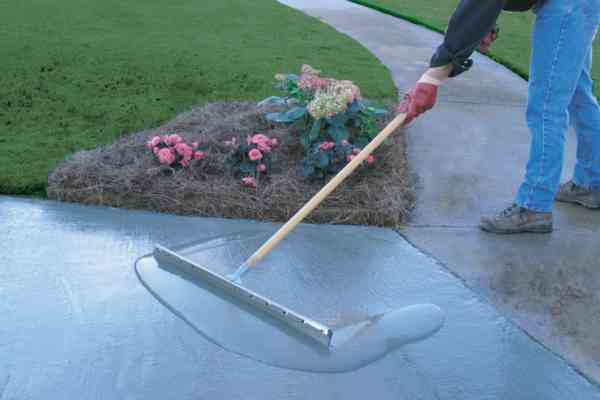
Resurfacing is often the right answer for a patio whose base is sound but whose surface is worn, stained or lightly scaled. A new wearing layer, properly bonded and jointed, gives a sound base a fresh life at lower cost than replacement, and it can change the colour and texture without changing the levels. Where the base has washed out, where slabs have settled unevenly or where drainage runs toward the house, resurfacing only covers the problem, and replacement with a corrected base and fall is the honest answer.
Garden steps and paths are judged the same way as front steps, with one extra consideration: they are often built over soil that moves more than the front of the lot, so their footings and base matter more, not less. A path that heaves every winter is a base problem, not a surface problem, and the scope should say so.
Settlement, scaling and cracking are three different failures, and they call for three different answers. Settlement — a slab that has sunk or tilted because its base has washed out or compacted unevenly — is a base problem: the slab may be lifted if it is intact, or replaced if it is broken, but sealing the surface will not fix it. Scaling — the top layer flaking away — is usually a winter and finishing problem: water that entered the surface froze, expanded and lifted it, a process described in our guide to freeze-thaw masonry damage, and it is repairable only where the damage is shallow and the base is sound.
Cracking is judged by width, pattern and movement. A tight, stable hairline crack can be sealed and monitored; a crack that is widening, a crack that runs across a slab in a pattern that suggests the base has failed, or a section that is broken into pieces, is a replacement section, not a patch. The cost in every case depends on scope: the area, the base work, the finish and whether drainage must be corrected at the same time.
The rule that ties the three together is simple: repair where the base is sound and the damage is shallow, lift where the slab is intact but out of grade, and replace where the base or the slab itself has failed. A quote that follows that rule, slab by slab, is one you can check against the slabs themselves.
Three honest options, in order of cost and disruption. First, grinding: where the lip is small and the slab is otherwise sound, the raised edge is ground down to a safe, even transition. It removes the trip hazard at low cost, but it does not fix the root, so it is the right answer only where the lift is minor and stable. Second, lifting: where the slab is intact but out of grade, it can be lifted back to level by injecting material beneath it, in general terms a mudjacking-style lift. It works where the slab is unbroken; it will not hold if the root is still growing into the same space. Third, section replacement: where the slab is cracked, broken or repeatedly lifted, the section is removed, the root is dealt with in consultation with the tree’s owner where necessary, the base is rebuilt, and a new section is poured with joints that allow for future movement. The cost depends on which option fits each slab, and the estimate should say which is proposed and why.
It depends on what is being done, and cold weather changes the answer for pouring versus repair. Small repairs — grinding a lip, patching a spall, sealing a crack, lifting a single slab — can usually be done in winter, provided the surface is dry and the repair material is suited to the temperature. Emergency work, such as making a walk safe after a heave, should not wait for spring.
Pouring new concrete in winter is a different matter. Fresh concrete must be protected from freezing while it cures, and a pour made in hard frost without protection will be weak and will scale early. A winter pour therefore needs planning — a mild window, insulated blankets, and a mix and curing method suited to the temperature — and it costs more to protect than a spring pour. Where the work can wait for milder weather without a safety risk, waiting is usually the honest advice, and the cost of any winter work depends on the scope and the protection required.
Yes, in most cases — sealing is cheap protection for a surface that spends its life outdoors. A sealer slows water and de-icing salt from entering the concrete, which is the main defence against the scaling and surface wear that Westchester winters cause. It also makes the surface easier to clean and keeps stains from soaking in, which matters on a driveway that sees cars, leaves and lawn treatments.
New concrete should be allowed to cure before it is sealed — the exact wait depends on the sealer and the mix, so it should follow the product’s guidance rather than a fixed date on the calendar. After that, resealing every two to three years is a sensible rhythm for exposed driveways and walks in this climate, and more often where the surface is heavily used or heavily salted. A sealer does not repair a slab that is already cracked or settled, and the cost of sealing depends on the area and the product chosen.
As a guide rather than a promise, a well-built concrete driveway in this climate commonly serves for several decades — many homeowners see twenty-five to thirty years or more from a driveway that was given a sound base, proper joints and reasonable care. That range is guidance only, because the driveway’s life is decided by more than its age.
The factors that shorten it are the familiar ones: a thin or poorly compacted base, too few control joints, heavy vehicles on a slab poured for cars, and winters where de-icing salt and freeze-thaw work on an unsealed surface. The factors that lengthen it are equally plain: a well-drained base, joints cut at sensible spacing, prompt repair of cracks before water reaches the base, and resealing every few years. A driveway that is cracking at the joints or settling in patches may still have years of serviceable life left after targeted repairs, while one that is broadly scaled or broken across its slabs is usually past the point where patching is money well spent.
It depends on where the work sits. Work wholly on the lot — a new patio, a walk replacement or a driveway repour that stays within the property — is usually the simpler case, and often needs no village permit at all, though it is always worth confirming before work starts. Work that touches or crosses the public right-of-way is different: a sidewalk replacement, a new or widened driveway apron, or any work in the village’s sidewalk or curb area generally needs coordination with the village, and may need a permit or an approved contractor arrangement before it begins.
The practical rule is to settle the question before the first slab is broken. We check which side of the line the work falls on, and where village coordination is needed we build it into the schedule rather than discovering it after the crew arrives. The cost of the work itself depends on its scope; any village fees or coordination requirements are part of the honest estimate, not a surprise later.