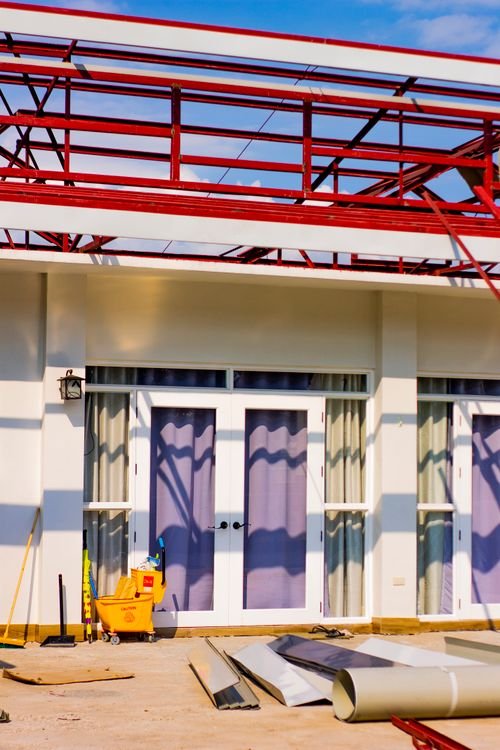

The exterior of a Harlem building is not one surface but a system of layers, and they fail together. Brownstone over brick on the residential rows, brick and terra cotta on the avenue apartment houses, pressed-metal cornices crowning both — each layer sheds water to the next, and each layer depends on the joints between them. A cornice seam opened a fraction of an inch, a lintel joint washed out, a sill cracked at its bearing: any one of them lets water behind the face, and water behind the face travels — down through the wall, sideways along a floor line — until it shows up inside as a stain or blown plaster, rooms away from the hole it came through.
That is why our exterior repair and renovation contractors start every Harlem job with a whole-envelope survey, not a single defect. We walk the elevations from the sidewalk and, where access allows, from the roof, and read the layers in order: cornice and coping first, then the field of the wall, then the openings — windows, lintels, sills — and finally the base, where splashback and sidewalk salts do their quiet work. The survey separates what is cosmetic from what is weatherproofing and from what is quietly structural, and the quote follows that order of priority, not the order of what is easiest to see.
Owners of the neighbourhood’s taller buildings also live by the city’s facade inspection cycle, and the repair list that follows a Local Law 11 inspection is, in practice, an envelope repair list: the same pointing, the same cornice work, the same waterproofing, on a five-year professional calendar. Whether the building is a six-storey apartment house or a three-storey brownstone, the discipline is the same — fix the envelope at its small failures before the weather makes them large ones. Star Construction INC has worked on homes across the New York area since 2018; the areas we cover are listed on our service areas page.
Waterproofing a Harlem elevation is not a coating smeared over the problem. The wall keeps water out through a sequence of details, and the sequence has to be complete: sound pointing that sheds rain at the face, flashings that throw water clear at every change of plane, sealant at the joints that actually move, and a surface that breathes where it should and repels where it must. Miss one link and water finds the gap; fix the links and the wall largely looks after itself.
The entry points are small and consistent. Window perimeters and sill bearings, where the frame meets the masonry; cornice and coping joints, where the top of the wall meets the sky; the base of the wall, where splashback and sidewalk salts do their work; and any place a later addition — a sign, a conduit, a fire escape fixing — has pierced the face without being sealed properly. Our survey walks these points in order, and the repair list follows the same order: the worst entries first, because water behind the face does not wait for the cosmetic work to catch up.
Pointing is waterproofing, not decoration. A wall whose joints are sound sheds most weather before it ever reaches the substrate, which is why repointing is often the single most effective waterproofing step on a brownstone or brick elevation. Where the surface itself needs protection, waterproofing and sealants are chosen for the material — breathable treatments for brownstone and brick, elastomeric sealants for moving joints — and never applied over a dirty or unsound face. That is why a proper job begins with cleaning: our power washing and surface cleaning work is done at pressures the material can tolerate, because a facade blasted clean at the cost of its surface is a facade damaged, not prepared.

The details that crown a Harlem row are the first things a passer-by admires and the first things the weather attacks. Pressed-metal cornices, brownstone lintels and sills, terra cotta window surrounds: each is a joint in the envelope, and each joint that opens lets water into the wall behind it. A cornice seam that has lost its sealant rusts from the inside out; a lintel that has cracked at its bearing lets the course above it settle; a sill with no drip lets water run down the face instead of clear of it. These are small failures with long shadows, and they are the ones a survey looks for first, because they are cheap to cure and expensive to ignore.
Cornice and trim work deserves its own budget line on a Harlem building, not a footnote to the masonry. Metalwork is stabilised, patched and repainted in place where it is sound; where a section has rusted through, it is replaced to match the profile rather than simplified away, because the profile is what makes the row. The same discipline applies to stone: a cracked lintel is not painted over but assessed for bearing and movement, and a spalled sill is replaced with a stone that matches in colour and, more importantly, in weathering behaviour. Our cornice and trim repair work treats these details as envelope, not ornament, and the same standard runs through our facade repair and restoration work on the buildings that wear them.
There is one more reason to treat the details seriously: what hangs over the sidewalk. A loose cornice section, a terra cotta unit working free of its fixings, a length of coping shifting at the roofline — each is a safety matter as well as a cosmetic one, and the buildings that front busy avenues have no margin for delay. The survey therefore ends where it began, at the top of the building, with a list ordered by risk: anything loose or falling first, anything admitting water second, anything merely tired third. Paint and finish follow the repairs, not the other way round, and on a row of brownstones the painted metalwork of the cornice is often what ties the whole elevation together — a reminder that the details were never decoration added to the building, but the building’s own signature.
Our clients value the consistency, structural precision, and long-term performance we deliver on every project, from initial planning through final execution.

 Jav V
Trustindex verifies that the original source of the review is Google.
Got my bathroom remodel Team was professional on time Thank you Ever fernando Perez saldañaCrear Word
 LUIS CAYOi hire them for my home project. and everyting went smoothly. no delays
 Shahid IqbalVery reliable contractor. They did exactly what they promised and the quality was excellent. Would definitely recommend.
Contact us now to discuss your project and receive a no-obligation quote from our experts.
Every project is handled through a defined process that ensures accuracy, efficiency, and long-term structural performance from start to finish.
We begin by reviewing site conditions, understanding project objectives, and identifying structural requirements to establish a clear and practical direction before any work begins.
A detailed execution plan is developed, including material selection, sequencing of work, and coordination of labor to maintain consistency and avoid delays during construction.
Work is carried out using proven installation methods, with attention to structural integrity, proper reinforcement, and adherence to safety and quality standards.
A final walkthrough is conducted to verify workmanship, resolve any outstanding details, and ensure the completed project meets performance expectations and durability standards.
Three surfaces make up most of a Harlem elevation, and each has its own failure mode. Brownstone is a soft, porous sandstone that was never meant to be sealed behind hard modern mortar or blasted clean; brick is a harder skin whose mortar joints are the sacrificial layer, wearing back over a century of freeze and thaw; stucco is a cement skin that hairlines over movement and admits water at every crack. Our masonry contractors in Harlem treat them as different materials with different repairs — because the repair that saves one will damage another. The brick and stucco work below follows that rule on every elevation.
Brownstone fails when it is treated like granite. Hard Portland mortar traps moisture behind the face, and the face spalls; aggressive cleaning strips the surface and opens the pores further. The correct repair is gentle: mortar matched to the original in strength and colour, deteriorated stone cut out and replaced in kind or patched with a compatible repair mortar, and cleaning that stops at sound material. That is the discipline behind proper brownstone restoration, and it is the only approach that leaves a brownstone facade looking like itself a decade later.
On the avenue apartment houses, the brick itself usually outlasts its joints. Recessed, sandy mortar lets water into the wall, and water in the wall freezes, spalls brick faces and stains interiors. Repointing — cutting out failed mortar to a proper depth and replacing it with a matched mix — is the single most effective repair on these buildings, and it is far cheaper than the brick replacement that follows years of neglect. Where brick has already spalled, matching units are cut in so the repair disappears into the elevation, the standard our facade repair and restoration work is held to.
Stucco on Harlem’s buildings — often over older masonry, sometimes as a later resurfacing — cracks for honest reasons: building movement, failed sealant at a joint, water trapped behind the skin. A hairline sealed early is a maintenance item; a crack left open admits water that loosens the stucco from its substrate, and the repair grows from a patch to a panel. We read the crack before patching it: movement cracks get flexible sealant and monitoring, water cracks get their source fixed first, and texture and aggregate are matched so the patch does not telegraph through the paint.
The avenue buildings wear their age in their ornament: terra cotta panels and trim, pressed-metal cornices and window surrounds. Terra cotta spalls when water enters through failed joints and freezes; pressed metal rusts from its seams and fixings inward. Both are repairable — terra cotta units can be replaced or repaired in place, and metalwork can be stabilised, patched and repainted — but both punish delay, because a loose ornament over a sidewalk is a safety matter as well as a cosmetic one. Our cornice and trim repair work treats these details as part of the envelope, not decoration added to it.
Look for cracked or spalled masonry, mortar joints that have gone soft, sandy or recessed, staining beneath sills and copings, paint peeling from masonry, and any cornice or trim section that has loosened. Inside, water stains on the room side of an exterior wall — especially near the top of the wall — usually mean the envelope has already been letting water in for some time. Loose material above a sidewalk should be dealt with promptly, as a safety matter as well as a repair.
Gently, and on the stone’s own terms. Brownstone is a soft, porous stone: cleaning should stop at sound material, never strip the surface, and repointing must use a mortar matched to the original in strength and colour — hard Portland mortar traps moisture and spalls the face. Deteriorated stone is cut out and replaced in kind or patched with a compatible repair mortar, sealant at moving joints is kept renewed, and gutters, flashings and copings are kept shedding water clear of the face. A regular walk-around catches the small failures before they become facade work.
Often, yes. Where the metal is sound, the work is stabilisation in place: rust treated, seams re-sealed, damaged sections patched and the whole run repainted. Where rust has eaten through the metal or fixings have failed, the affected sections are replaced to match the original profile, so the cornice reads as one piece from the street. A cornice that is loose or shedding pieces over a sidewalk is a safety matter and should be secured promptly; the cost depends on how much of the run is affected, which is why a close inspection comes before any quote.
Some of it, yes. Surveys, emergency stabilisation and securing loose material can be done in any season, and some repairs proceed in mild spells. But mortar, coatings and sealants need temperature windows to cure properly, and pointing done in a freeze will not last — so winter work is planned around the forecast, and some jobs are honestly better scheduled for spring. Urgent safety items are never left waiting for the weather.
It depends on the work. Structural exterior work in New York City generally involves Department of Buildings permits, and the exact requirements depend on the scope of the job. Buildings in historic districts can also need Landmarks approval for visible exterior changes, and taller buildings live under the city’s facade inspection cycle. We confirm what applies before work starts, so approvals are in place rather than discovered mid-job.