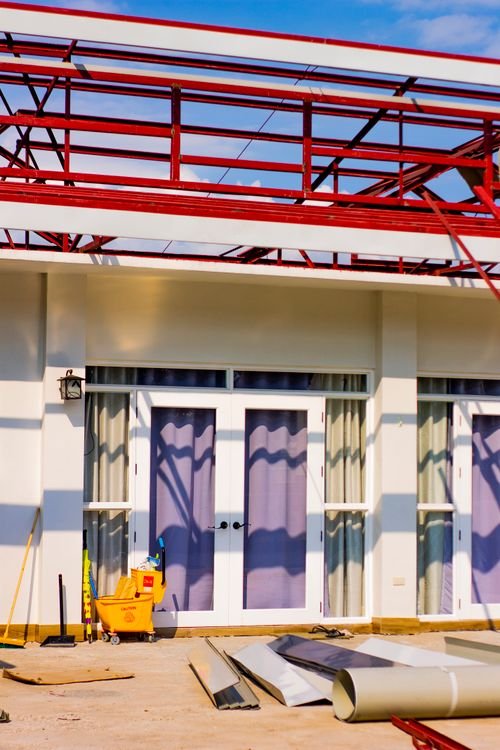

Our exterior repair and renovation contractors work on the whole outer envelope of a Queens building — siding and trim, porches and entry stairs, gutters and flashing, and the paint film that ties them together. A house exterior is not a collection of separate jobs; it is one system, and water that gets past one layer will test the next. That is why we start with a walk around the whole building, not a single elevation, and why a scope for one problem often touches its neighbors.
Where the work crosses into masonry — a brick front that needs repointing, a stucco wall that needs its coats rebuilt — our masonry contractors in Queens take that part of the scope, so the exterior work and the masonry work stay in one plan, sequenced in the right order rather than patched in the wrong one.
Exterior repair and renovation covers the work that keeps a building’s outside weather-tight and sound: replacing failed siding boards and rotted trim, rebuilding soft porch floors and steps, resealing and repainting surfaces whose protective film has broken down, and correcting the gutters, flashing and drainage details that let water in. It is distinct from cosmetic touch-ups because it starts with the water path — find where the water is getting in, stop it there, then repair the damage it left behind.
On Queens buildings the scope often runs wider than one trade. A facade repair and restoration may be needed where brick or stone fronts have deteriorated, and siding installation and repair covers the clapboard, shingle and panel siding that wraps so many of the borough’s houses. The honest sequence is always the same: stop the water, repair the structure, then finish the surface.

If your Queens home’s exterior is showing its age — peeling paint, soft trim, a porch that has seen better decades — Star Construction INC can help. Request a free, no-obligation estimate and we will walk the elevations with you, explain what needs doing first and what can wait, and put the work in an order that makes sense. See the areas we serve on our service areas page.
Our clients value the consistency, structural precision, and long-term performance we deliver on every project, from initial planning through final execution.

 Jav V
Trustindex verifies that the original source of the review is Google.
Got my bathroom remodel Team was professional on time Thank you Ever fernando Perez saldañaCrear Word
 LUIS CAYOi hire them for my home project. and everyting went smoothly. no delays
 Shahid IqbalVery reliable contractor. They did exactly what they promised and the quality was excellent. Would definitely recommend.
Contact us now to discuss your project and receive a no-obligation quote from our experts.
Every project is handled through a defined process that ensures accuracy, efficiency, and long-term structural performance from start to finish.
We begin by reviewing site conditions, understanding project objectives, and identifying structural requirements to establish a clear and practical direction before any work begins.
A detailed execution plan is developed, including material selection, sequencing of work, and coordination of labor to maintain consistency and avoid delays during construction.
Work is carried out using proven installation methods, with attention to structural integrity, proper reinforcement, and adherence to safety and quality standards.
A final walkthrough is conducted to verify workmanship, resolve any outstanding details, and ensure the completed project meets performance expectations and durability standards.
An exterior renovation pays back in ways that go beyond how the house looks from the street. The visible improvement matters, but the real value is in the layers underneath: a weather-tight envelope that keeps water out of the structure, surfaces that hold their finish longer, and repairs sequenced so each one protects the next. These are the four areas where Queens exteriors most often need that work.
Siding and trim are the first line of defense and the first thing to show wear. Boards split along the sun side, trim rots at the water lines where gutters overflow or splash-back keeps the base wet, and paint that has lost its film lets moisture into the wood beneath. Repair here means replacing what is actually failed rather than covering it: boards matched to the existing profile, trim cut to the original shape, and a paint system that seals the repair instead of hiding it. Done properly, the skin of the house keeps water out for years instead of one season.
Queens porches were built as rooms — places to sit, to greet, to watch the street — and they take more weather than any other part of the house. Floors soften where splash-back keeps them wet, columns settle, railings loosen, and porch roofs develop the same flashing problems as any roof. The question on every porch is repair or rebuild, and the honest answer depends on what is underneath: a sound frame with a tired floor is a repair; a frame that has lost its bearing is a rebuild, and saying so early saves the cost of patching it twice.
Most exterior damage in Queens starts with water that was never given a way out. Gutters that overflow dump water onto trim and foundations; flashing that has opened a quarter inch lets water behind siding and into walls; grade that slopes toward the house sends every rain against the foundation. This is where waterproofing and sealants work earns its keep — not as a coat slapped over a problem, but as part of a corrected drainage path: gutters cleared and pitched, flashing renewed, and water at grade directed away from the building instead of into it.
On a whole front or a multi-family building, exterior work that is planned as separate jobs costs more and lasts less than work planned as one scope. Siding, masonry, roofing and painting each touch the same elevations, and the order matters: the roof line has to be sound before the siding below it is finished, and the masonry has to be repointed before it is painted over. Our roof repair and installation contractors in Queens work to the same plan, so a whole-front renovation is sequenced once, scaffolded once, and finished as a single envelope rather than three overlapping jobs.
It depends on what is soft and why. If the surface boards have rotted but the framing beneath is sound and dry, replacing the boards and correcting the drainage that kept them wet is usually enough. If the joists or posts have lost their bearing, or the rot runs through the frame, a rebuild of that section is the honest answer — patching a failed frame only buys a season and leaves the structure weaker. An inspection from underneath, where the framing can actually be seen, settles which one your porch needs, and the cost follows the scope rather than the other way around.
By working from the original, not from a catalog. Existing profiles are measured and matched — trim is milled or selected to the same shape, siding boards are matched in width, thickness and exposure — so a repair reads as part of the original house rather than a patch. Where an exact profile is no longer stocked, it is cut to order from the surviving piece. Paint color is matched to the existing finish, and the repair is primed and painted as part of the surrounding surface rather than left as a new-looking island.
The water repairs, always. Gutters and flashing that still leak will ruin new paint within a season, and rotted trim painted over is rot sealed in, not rot fixed. The order that works is: correct the water path first, replace failed boards and trim, let the repairs dry and settle, then prime and paint. Painting is the last step of an exterior repair, not the first — a coat of paint over a sound, dry, properly prepared surface lasts years longer than the same paint over a problem that is still active underneath.
Structural changes and material changes generally do — work that alters the structure, changes the building’s footprint or changes its exterior materials typically requires permits under New York City rules. Like-for-like repairs, where failed material is replaced with the same material in the same place, are usually simpler. Multi-family buildings may also need coordination with building management or a board before work begins. The scope of your project determines what is required, and that is worth confirming before work starts rather than after.
Much of it can, with limits. Carpentry, siding and trim repairs proceed in most winter weather, and emergency water repairs should not wait for spring. Paint and sealants are the constraint — they need temperatures that let them cure properly, so exterior painting is generally scheduled for milder spells, and mortar work on masonry elements is staged the same way. A winter scope usually means making the building weather-tight now and completing finish work in the first mild weather, rather than forcing a finish coat through a freeze.