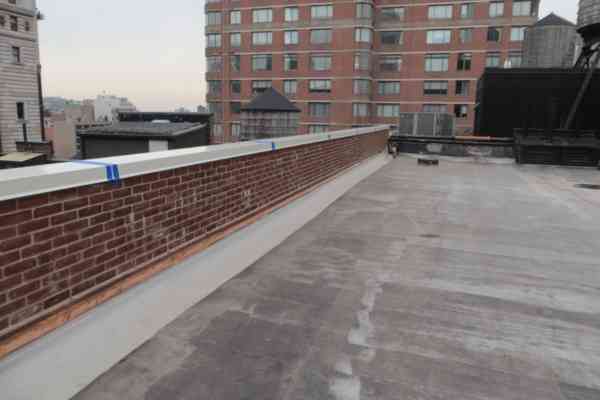

Fresh Meadows’ parapets are working walls, not decoration. The low brick parapet that caps a garden-apartment roofline, the short wall above a flat-roofed extension, the roof edge of a detached home — each one takes weather on its top, its outer face and its inner face at once, and each one fails first at the same two places: the coping that caps it and the flashing that seals it to the roof. Our parapet wall repair and installation contractors in New York start every Fresh Meadows job from the roof side, reading the coping joints, the flashing lines and the brick courses below them before quoting anything.
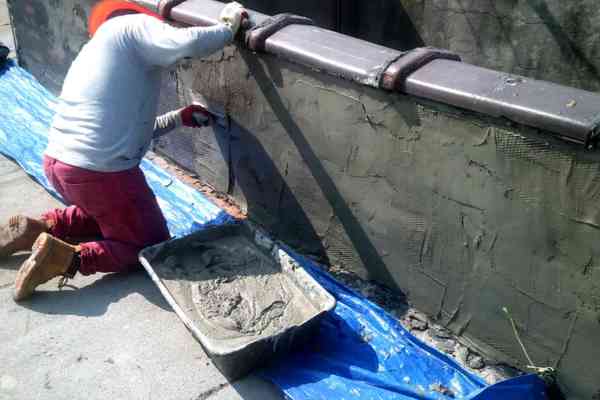
The repair follows the wall’s condition, not a template. Sound brickwork with open joints gets parapet wall repair and repointing; a failed cap gets coping stone installation and replacement; a flashing line rusted through, or sealed with caulk instead of stepped metal, gets parapet wall waterproofing and flashing installation. Where the wall has leaned, bulged or cracked through, parapet wall demolition and rebuilding is the honest answer, and brick and stone matching for parapet restoration keeps the rebuilt wall reading as the building’s own. For the neighborhood’s few taller buildings, parapet conditions can also appear on a FISP report — we carry out the repair work those reports call for, while a Qualified Exterior Wall Inspector inspects and files; our Local Law 11 contractors in Fresh Meadows page explains that split.
Request a free, no-obligation estimate and we will inspect the wall, photograph what we find, and tell you plainly whether your parapet needs repair or rebuilding.
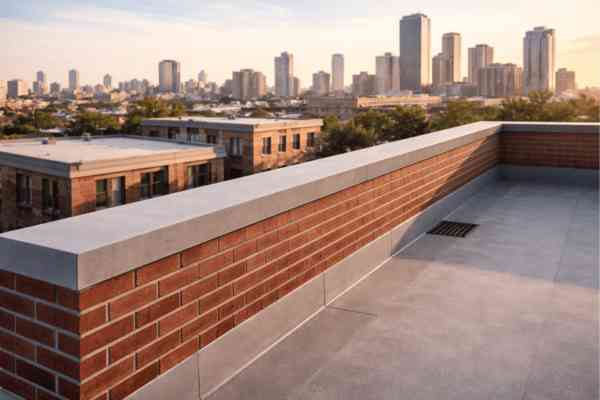
A parapet is the low wall that rises past a roofline, and its job is to protect the roof edge and the wall top at once. In Fresh Meadows that usually means a short brick wall above a garden-apartment flat roof, above a rear extension, or along the flat-roofed section of a detached home — rarely tall, but always exposed, taking rain on its cap, wind on both faces and freeze-thaw in every joint. Parapet wall repair and installation is the trade that keeps that wall sound: its cap, its flashing, its brickwork and its connection to the roof behind it, treated as one assembly rather than four separate jobs.
The scope of the trade follows the wall’s parts. Parapet wall repair and repointing renews failed joints; coping stone installation and replacement renews the cap; parapet wall waterproofing and flashing installation seals the roof-to-wall junction; sill and coping flashing repair closes the through-wall water path; crack sealing and structural gap filling handles movement joints; steel reinforcement for structural stability and parapet wall height adjustment correct bowed or undersized walls; decorative parapet wall finishes suit walls that are part of the building’s face; and annual inspection and maintenance plans keep a repaired wall ahead of the next winter. Where the wall itself is spent, parapet wall demolition and rebuilding takes it down and rebuilds it properly, course by course.

If you are searching for trusted parapet wall contractors near you in Fresh Meadows, start with the roof side. A short inspection from above tells us what the street cannot: whether the coping has moved, whether the flashing has opened, whether the brick below is sound or spent. The areas we cover are on our service areas page, and Star Construction INC has repaired and rebuilt parapets across New York since 2018. Request a free, no-obligation estimate and we will inspect the wall, photograph what we find, and explain the options before any work is quoted.
Our clients value the consistency, structural precision, and long-term performance we deliver on every project, from initial planning through final execution.

 Jav V
Trustindex verifies that the original source of the review is Google.
Got my bathroom remodel Team was professional on time Thank you Ever fernando Perez saldañaCrear Word
 LUIS CAYOi hire them for my home project. and everyting went smoothly. no delays
 Shahid IqbalVery reliable contractor. They did exactly what they promised and the quality was excellent. Would definitely recommend.
Contact us now to discuss your project and receive a no-obligation quote from our experts.
Every project is handled through a defined process that ensures accuracy, efficiency, and long-term structural performance from start to finish.
We begin by reviewing site conditions, understanding project objectives, and identifying structural requirements to establish a clear and practical direction before any work begins.
A detailed execution plan is developed, including material selection, sequencing of work, and coordination of labor to maintain consistency and avoid delays during construction.
Work is carried out using proven installation methods, with attention to structural integrity, proper reinforcement, and adherence to safety and quality standards.
A final walkthrough is conducted to verify workmanship, resolve any outstanding details, and ensure the completed project meets performance expectations and durability standards.
Reading the Roofline — Fresh Meadows’ low parapets, and what each failure asks of a repair. A parapet tells its story from the top down: the cap first, then the flashing, then the brick below. Read in that order, most Fresh Meadows parapets ask for one of four things — and the sections below take each in turn.
Start with an inventory, because Fresh Meadows’ parapets hide in plain sight. The long, low brick walls above garden-apartment flat roofs run the length of a building and are shared by every unit below them; the short parapet above a rear extension protects a kitchen or a family room; the roof edge of a detached home with a flat-roofed section carries the same detail at a smaller scale. The brickwork itself is the same craft our masonry contractors in Fresh Meadows repoint across the neighborhood, and it fails the same way — joints opened by freeze and thaw, a cap loosened by winters, flashing tired at the roof junction. Knowing which kind of parapet you have decides which repair it gets.
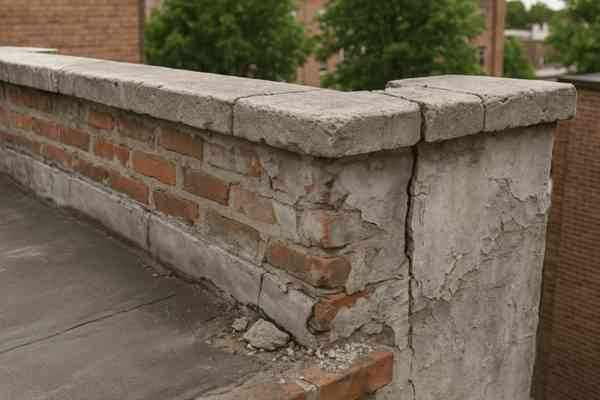
Nearly every parapet failure in Fresh Meadows comes down to these two lines. The coping — the stones or metal cap along the top — is the wall’s umbrella: once its joints open or a stone loosens, water pours into the core of the wall, where freeze-thaw widens the damage course by course. The flashing — the metal work sealing the parapet to the roof, including the through-wall flashing and the counter-flashing — is the wall’s gasket: when it rusts through, lifts, or was never stepped properly into the mortar joints, water runs behind the brick and appears as a stain far from the entry point. Coping and flashing are repaired together or not at all, because fixing one layer of a two-layer failure only moves the leak.
The judgment is in the core. A parapet whose brick is sound, whose lean is nil and whose damage is limited to open joints, a failed cap and tired flashing is a repair: repoint, recap, reflash, and the wall is good for years. A parapet that leans or bulges, that is cracked through its courses, or whose core has softened after years of water entry is a rebuild — patching it would only dress a wall that is still moving. The honest tell is simple: if the wall still stands plumb and solid once the failed layers are stripped back, repair it; if it does not, take it down and rebuild it, reusing sound brick where the match allows and matching new brick where it does not.
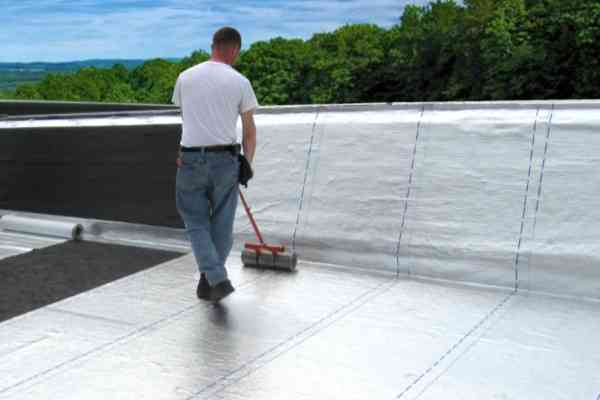
Never quote the parapet without the roof it borders. The flashing that seals the parapet is also the roof’s edge flashing, the ponding or drainage problem on the flat roof is what keeps the parapet’s base wet, and the leak that stains a top-floor ceiling is blamed on the roof until the parapet is ruled out. That is why the two scopes are quoted together wherever they meet: our roof repair and installation contractors in Fresh Meadows handle the membrane, drains and field of the flat roof, and the parapet crew handles the wall above it, so the junction between them is one contractor’s responsibility instead of two trades’ argument.
A parapet is the low wall that rises past a roofline, protecting the roof edge and the top of the wall beneath it. In Fresh Meadows, most flat roofs have one: the garden-apartment buildings, rear extensions and flat-roofed sections of detached homes all carry a short parapet, usually brick. If you can see a low wall standing above your roof edge from the street, that is your parapet — and if your home has a pitched roof with no flat sections, it likely has none, except possibly at a dormer cheek or a shared party wall.
Treat loose coping as prompt, not panic. The cap is the wall’s umbrella: once a stone moves, water enters the core of the wall, and every freeze-thaw cycle widens the damage. It should not wait out a winter, but it is usually a repair — reset and re-bed the stones, renew the joints — rather than an emergency, unless stones are actually at risk of falling to the sidewalk or roof below, in which case the area beneath should be kept clear until the cap is secured.
Yes — and it is one of the most misdiagnosed leaks in a flat-roofed building. Water that enters at the parapet cap or flashing does not fall straight down; it travels inside the wall and along the roof assembly, and it shows up as a stain on a ceiling rooms away from the wall that let it in. That is why tracing a top-floor leak starts with an inspection from the roof side — coping, flashing, brick courses — rather than patching the ceiling stain and hoping it was the roof membrane.
Rebuild when the wall itself is spent: a lean or bulge, cracks running through the courses, or a core softened by years of water entry. Repair when the wall still stands plumb and solid and the damage is limited to joints, coping and flashing — repointing, recapping and reflashing will serve it for years. A mason’s inspection from the roof side settles which side of the line a wall is on, and a straight answer there is worth more than a cheap patch on a wall that is still moving.
In general New York City terms, like-for-like parapet repairs — repointing, recapping, renewing flashing — usually proceed without a Department of Buildings permit, while rebuilding a parapet or changing its height or structure generally requires one, and work on the neighborhood’s taller buildings is coordinated with the building’s FISP filing. Costs depend on scope: a recap and reflash is a different job from a full rebuild, and an estimate should say which one it is.