
Concrete repair and installation in Fresh Meadows begins with a condition assessment, not a guess. The neighborhood’s flatwork spans generations — original pours from the post-war building years, replacements from later decades, and garden-apartment walks that carry dozens of households a day — and each generation fails differently. Our concrete repair and installation contractors in New York bring that citywide experience to Fresh Meadows conditions: street trees lifting flags, freeze and thaw opening joints, salt scaling surfaces, and aprons cracking where driveways meet the street.
Where concrete meets masonry — stoops, entry steps and the stone-edged walks of the neighborhood’s brick homes — we work closely with our masonry contractors in Fresh Meadows, so a stoop rebuild and a walk replacement arrive as one matched job rather than two competing ones. Every project starts with that assessment, and every estimate is free and without obligation.
Concrete repair and installation is the work of keeping the flat surfaces a property depends on — driveways, sidewalks, stoops, walkways, patios and slabs — safe, level and draining the right way. Repair means grinding a lifted edge, patching a spall, resurfacing a worn surface, or replacing a single failed section. Installation means a new pour done properly from the base up: excavation, compacted sub-base, reinforcement where the load calls for it, control joints cut to manage cracking, and a finish matched to the surface’s use.
The difference between a repair that lasts and one that fails in a season is usually underneath the surface: a base that was never compacted, a joint that was never cut, or drainage that sends water under the slab instead of past it. That is why an honest assessment comes before any quote.

If you are searching for reliable concrete contractors near you in Fresh Meadows, start with an inspection, not a price over the phone. Our crews handle driveways, sidewalks, stoops, walkways, patios and slabs across the neighborhood — single-family homes, co-ops and garden-apartment complexes alike — and we explain the options in plain terms: what can be saved, what should be replaced, and what each choice costs over the life of the surface. The areas we serve cover neighborhoods across the city. At Star Construction INC, every project starts with a detailed evaluation of the surface and sub-base, and every estimate is free and without obligation.
Our clients value the consistency, structural precision, and long-term performance we deliver on every project, from initial planning through final execution.

 Jav V
Trustindex verifies that the original source of the review is Google.
Got my bathroom remodel Team was professional on time Thank you Ever fernando Perez saldañaCrear Word
 LUIS CAYOi hire them for my home project. and everyting went smoothly. no delays
 Shahid IqbalVery reliable contractor. They did exactly what they promised and the quality was excellent. Would definitely recommend.
Contact us now to discuss your project and receive a no-obligation quote from our experts.
Every project is handled through a defined process that ensures accuracy, efficiency, and long-term structural performance from start to finish.
We begin by reviewing site conditions, understanding project objectives, and identifying structural requirements to establish a clear and practical direction before any work begins.
A detailed execution plan is developed, including material selection, sequencing of work, and coordination of labor to maintain consistency and avoid delays during construction.
Work is carried out using proven installation methods, with attention to structural integrity, proper reinforcement, and adherence to safety and quality standards.
A final walkthrough is conducted to verify workmanship, resolve any outstanding details, and ensure the completed project meets performance expectations and durability standards.
Reading the Concrete — Fresh Meadows’ flatwork, and what each surface asks of a repair. A driveway is not a sidewalk, and a stoop is not a patio: each surface carries different loads, meets water differently, and fails in its own vocabulary. The four sections below take them in turn.
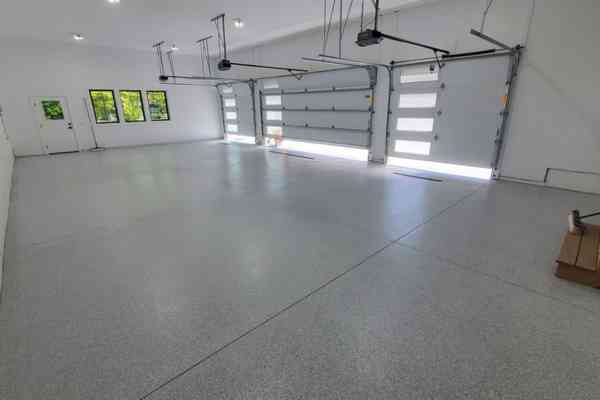
Nearly every Fresh Meadows house has a driveway, and most of those driveways end in an apron at the street — the strip that takes the car’s turning wheels, the plow’s blade and the curb’s runoff all at once. Aprons crack first and most visibly, and a driveway that drains toward the garage instead of the street announces itself in every heavy rain. Our concrete driveway installation work matches the mix, reinforcement and finish to the load the surface will carry, and where a driveway’s structure is sound but its surface is tired, concrete resurfacing and repairs can renew it without the cost of a full replacement. Grades are set so water runs to the street, not to the foundation or the garage. And where the driveway meets the garage, our garage floor concrete work renews floors that have suffered oil, salt and tire wear.
Fresh Meadows’ tree-lined streets are the neighborhood’s charm and its sidewalks’ slow problem: roots thicken season by season under the flags, lifting edges a fraction at a time until a trip edge forms. In New York City the property owner is responsible for keeping the adjoining sidewalk safe and in good repair, and when the city’s Department of Transportation finds a defective sidewalk it can issue a notice requiring repair. Our sidewalk repair and replacement work covers full flag replacement, partial replacement, and grinding where the lift is small and the slab is otherwise sound. Where a notice has already been issued, our DOT violation removal work handles the repair itself; the city re-inspects afterwards and decides on dismissal, and no outcome is promised.
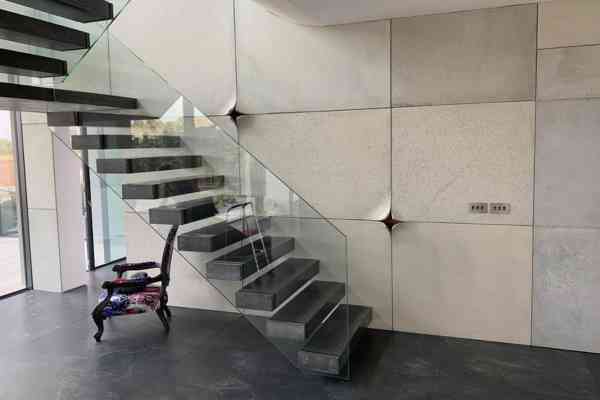
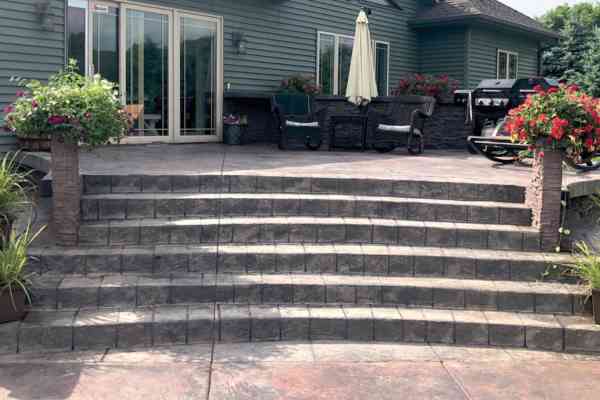
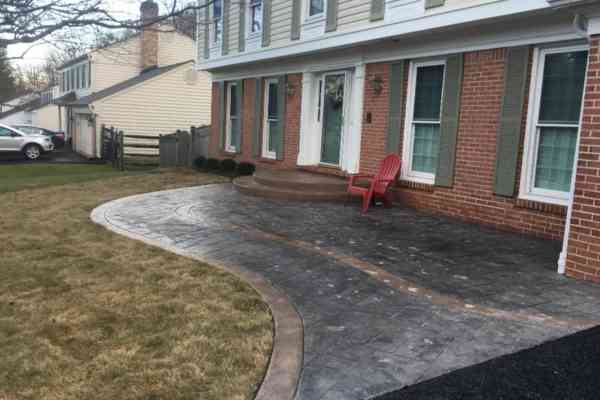
The concrete you live on is the concrete you notice: the stoop every visitor climbs, the front walk to the door, the patio behind the house. Stoops fail at the treads and nosings first — salt, water and a century of feet — and a tread that rocks or a nosing that crumbles is both a hazard and the first thing a visitor sees. Our concrete steps and staircases work rebuilds treads level and draining, and our concrete patios and walkways renew surfaces that have cracked or settled. Underneath both, concrete slabs and foundations discipline applies: the sub-base is corrected and compacted before new concrete goes down, because a new surface on a failed base inherits the failure.
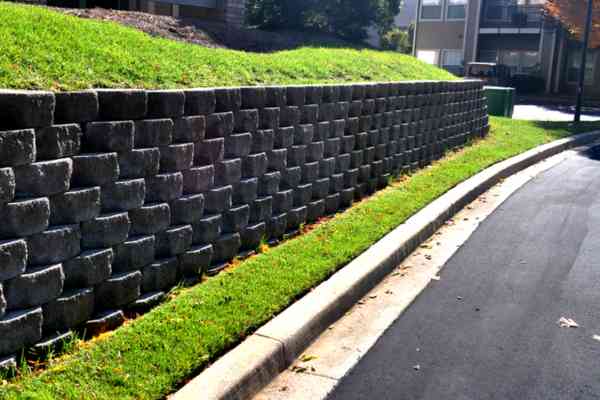
Not every damaged slab needs replacement, and not every slab is worth patching. Grinding suits a small lift on an otherwise sound flag. Patching suits a shallow spall. Resurfacing suits a surface whose structure is sound but whose finish is worn. Replacement is honest when settlement has broken the slab’s drainage, when scaling has eaten deep into the surface, or when a section has moved so far that no surface treatment restores a safe grade. Where replacement is the answer, it is also the chance to choose the finish deliberately — including stamped and decorative concrete for patios and walks — and to correct the edges of the job, with retaining walls and curbs where a grade or a street edge needs holding. Costs depend on area, thickness, access and sub-base condition, and an estimate says which category each slab falls into before work begins.
Three options, in order of size. If the lift is small and the slab is otherwise sound, grinding the raised edge back to a safe grade is the smallest honest fix. If the slab has cracked or tilted beyond grinding, the flag can be lifted and reset or replaced in sections, with the roots handled so the repair is not immediately undone. If the tree is a city street tree, work around its roots is restricted — root pruning on a city tree goes through the city, not the homeowner alone. And where a DOT notice has been issued, the repair must satisfy re-inspection; the city decides on dismissal after its own inspection. Costs depend on the number of flags, the root condition and access.
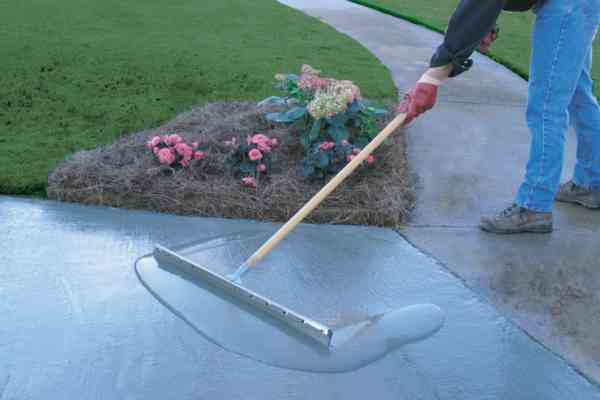
Resurfacing works when the slab underneath is structurally sound — level, supported, and free of deep cracking or settlement — but its surface is worn, stained or lightly scaled. A bonded overlay renews the finish without the cost and disruption of a full pour. It does not work when the slab has settled out of grade, when cracks run through the full depth, or when the base beneath has failed; in those cases an overlay cracks along the same lines within a season or two, and replacement is the honest answer. An inspection tells you which side of that line a driveway is on.
Yes — de-icing salt and freeze-thaw together are the main cause of scaling, the flaking and pitting of a concrete surface. Salt keeps water liquid longer into freezing weather, so the surface stays saturated when the freeze comes, and the top layer pops. Light scaling can be patched or resurfaced. Deep scaling, where the surface has lost a quarter inch or more across wide areas, usually means the wearing layer is spent and resurfacing or replacement is more honest. The best defense for new concrete is proper curing, a sound mix and keeping standing water off the surface.
A well-built concrete driveway or walk in Queens — proper base, correct thickness, control joints, good drainage — commonly serves 25 to 30 years, and often longer for walks that carry only foot traffic. What shortens that life is water under the slab, roots beneath it, heavy loads on a thin pour, and salt left standing through freeze-thaw cycles. Replacement concrete should be judged the same way: the base and the drainage decide the lifespan more than the finish does.
In general New York City terms, work wholly on private property — a driveway, a patio, a stoop on your own lot — usually proceeds without a Department of Buildings permit, though it must still meet code and property-line rules. Work on the public sidewalk, including the apron at the street, generally needs city coordination and the applicable DOT permits, and the sidewalk must be restored to the city’s standard. Like-for-like repairs are usually simpler than changes to grades, widths or the curb line. Where a project touches the street or a shared element, we confirm the requirements before work begins.