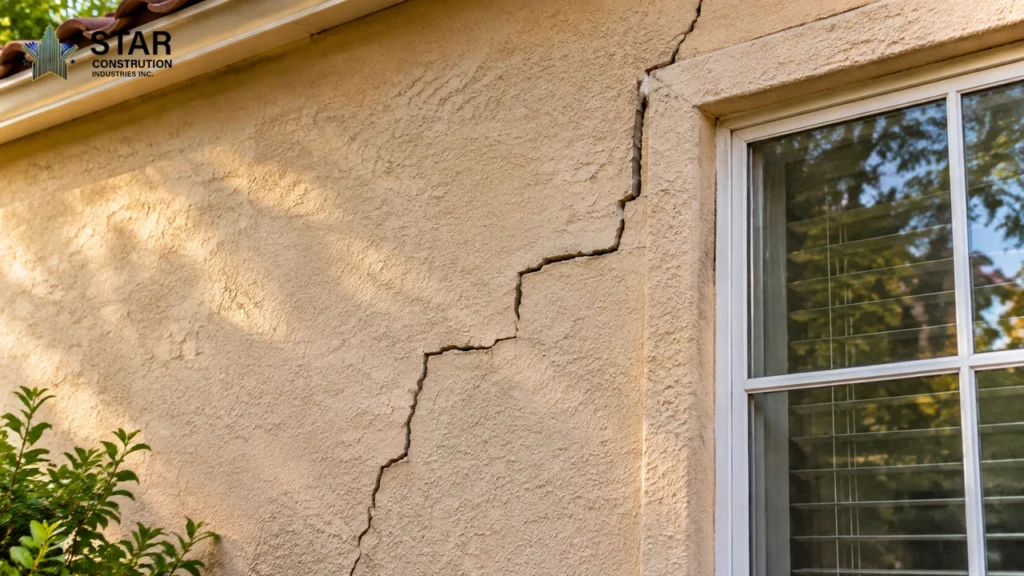
Fresh Meadows wears stucco proudly. The neighborhood’s single-family homes and garden-apartment buildings carry it on fronts, sides and garden walls, a finish that suits the area’s brick-and-stucco streets. And almost every one of those walls cracks somewhere. A new homeowner’s first spring walk around the house usually finds them: a fine line near a window corner, a web of hairlines across a sunny elevation, a longer crack stepping down from a roofline. Neither instinct is right: worry about all of them equally, or ignore all of them equally. Stucco cracks are a language, and the real question is never “is there a crack?” but “what is this crack saying?” This guide reads the common types in plain terms: which ones are the finish settling into old age, which ones are water or movement asking for attention, and what to do — and not do — about each.
Hairline and Map Cracks — Usually Cosmetic
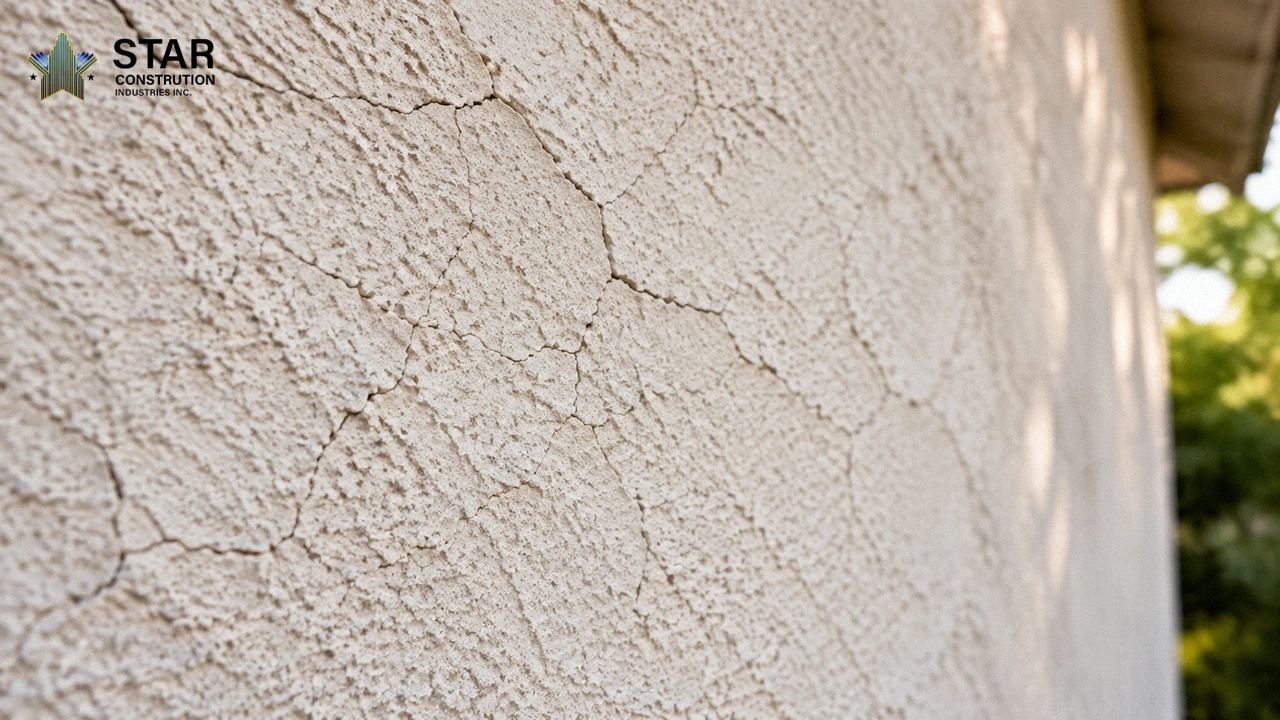
Most stucco cracks are hairlines: lines so fine you can barely get a fingernail into them, often in a loose web or map pattern across a wall. They come from the finish itself. Stucco is a cement skin, and cement shrinks as it cures; an older wall keeps making tiny peace with temperature and moisture. The result is crazing — a network of surface-only lines that do not go through the coats — and scattered hairlines at stress points. The test that matters is stability: photograph the crack, or mark its ends lightly in pencil, and look again in a season. A hairline that looks the same next spring is the wall’s character, not its failure. These cracks are worth sealing — a masonry crack filler or elastomeric sealant keeps rain out of the line — and then they can be painted over with confidence. What they do not need is panic.
One honest distinction helps here. Traditional three-coat stucco over masonry or lath behaves differently from EIFS, the synthetic system that looks like stucco but is foam beneath a thin finish coat; the two crack differently and repair differently, and a wall that is actually EIFS should be judged by its own rules — our comparison of EIFS vs stucco explains the difference. Most Fresh Meadows stucco, though, is the traditional kind: hard, thick, and forgiving of hairlines.
The Cracks That Deserve a Second Look
Some cracks change the conversation. Width is the first clue: a crack you can slide a coin’s edge into, or one that has clearly widened since you last looked, is no longer a hairline. Pattern is the second. A stepped crack that follows the joints like a staircase, or a diagonal crack running from a window or door corner toward the ground, suggests the wall is moving — settlement or a lintel deflecting — rather than the finish merely shrinking. Cracks that return after patching belong in this group too: a patch that splits again in the same place is telling you the movement behind it never stopped. So do cracks paired with other symptoms: a section of stucco that sounds hollow when tapped, or that bulges or feels loose under the hand, has lost its bond to what is behind it, and no surface patch will reattach it. Most such cracks are still local repairs, but the wall deserves a mason’s eyes before it gets a tube of sealant. Our masonry contractors in Fresh Meadows read these patterns on stucco and brick alike, and the first job is always diagnosis: what moved, and is it still moving?
Water Is the Real Question
Ask any mason what ruins stucco and the answer is not cracking — it is water. A crack is usually the symptom; water is the disease. Look around the crack, not just at it. Brown or dark staining running down from a crack, white salty bloom (efflorescence) on the surface, damp patches on the interior wall behind it, or rust staining near a window edge or a flashing line all say water is travelling through the wall, not just over it. Water gets in through the crack, sits behind the finish, and works in both directions: it loosens the stucco’s bond in freeze and thaw, and feeds interior damp. Before any repair, the water question has to be answered: where is it coming from, and has that path been closed? A patch laid over an active leak is a patch with an expiry date.
What Not to Do
Stucco repairs go wrong in a few predictable ways, and all of them are tempting. Smearing caulk over a structural crack hides it for a season and guarantees a worse surprise later, because the movement continues underneath and the caulk joint becomes a dam that traps water. Painting over active water damage is the same mistake in another costume: the paint blisters, the damp stays, and the wall behind gets worse while the front looks briefly tidy. Sealing moisture inside the wall is the quietest error — coating a damp elevation so trapped water cannot dry out, pushing damage deeper. And patching with the wrong material — a hard, rigid modern compound over a soft traditional stucco — means the failure simply moves to the edge of the repair. The rule behind all four warnings is one line: never cover a crack you have not understood.
The Repair Ladder
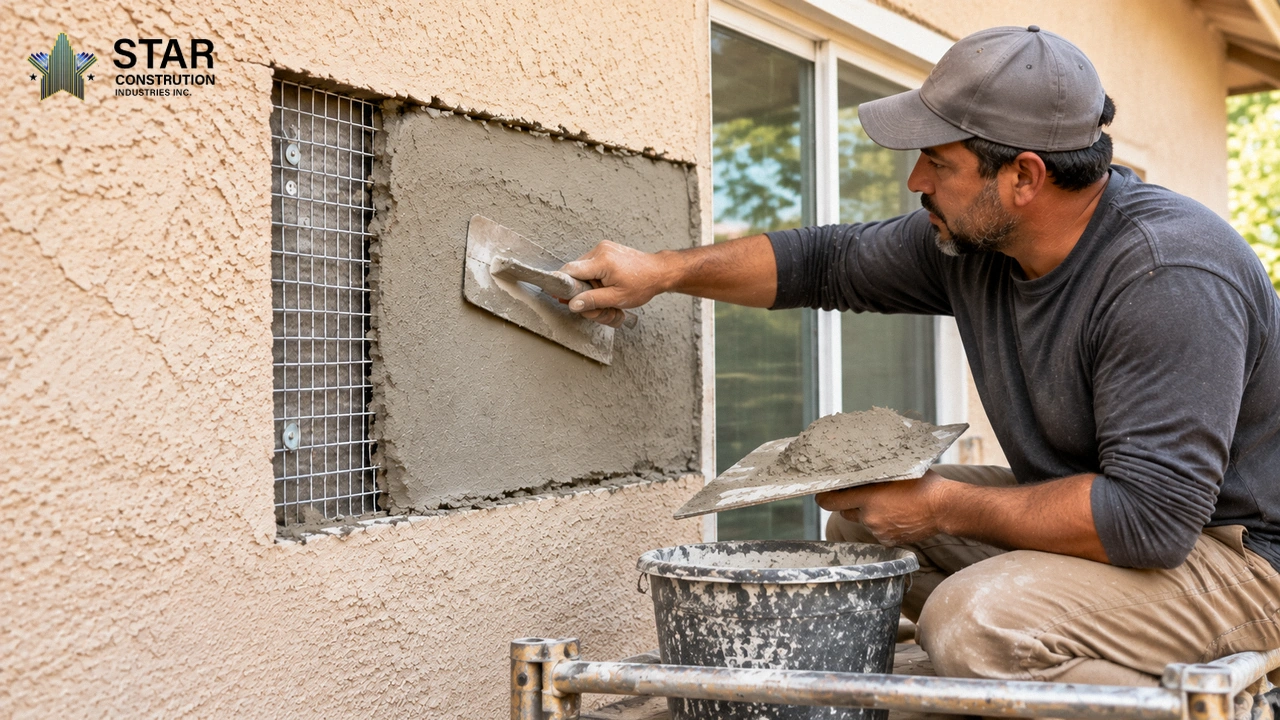
Good stucco repair climbs a ladder, and you start at the bottom rung that honestly fits. First, monitor: photograph and date a stable hairline and check it again in a season; many cracks never need more. Second, seal hairlines: clean the line, fill it with a flexible masonry sealant or crack filler, and paint when cured — a small job, and the right one for cosmetic cracking. Third, patch and re-coat: for wider or locally failed areas, cut back to sound material, rebuild the coats in layers, and match the texture — this is the standard repair for a section that has cracked but whose wall behind is sound. Fourth, cut out and rebuild: where stucco has debonded, bulged or failed across a whole elevation, the coats come off and go back on properly, with the flashing and water paths fixed first. Every rung above the first starts with the same precondition: fix the water source — the gutter, the flashing, the window seal — before the finish goes back on. Costs climb the ladder with it, in relative terms: sealing is a small job, patching a section moderate, rebuilding an elevation substantially larger — which is why catching a crack at the sealing stage is worth more than any saving on the rebuild. Our brick and stucco contractors in Fresh Meadows work this ladder in order and will tell you which rung your wall is actually on.
Walk your stucco walls once a year — spring is the honest season, after winter has done its work — and bring a pencil and a camera rather than a caulk gun. Mark what you find, and act on the cracks that move, widen or bring water with them. Star Construction INC has repaired stucco across Queens since January 2018; request a free, no-obligation estimate and we will read your walls and tell you plainly which cracks are character and which ones are talking. The areas we cover are on our service areas page.

Frequently Asked Questions
Can I just paint over hairline stucco cracks?
Paint alone is not a repair — it bridges nothing and will crack again along the same line. Seal stable hairlines first with a flexible masonry crack filler, let it cure, and then paint. If the crack is growing or returns after sealing, painting over it only hides the signal.
How wide is too wide for a stucco crack?
As a rule of thumb, hairlines you can barely see — roughly the thickness of a credit card edge or less — are usually cosmetic if they are stable. Cracks wider than that, cracks that are growing, stepped or diagonal, or cracks with staining or hollow sounds behind them deserve a mason’s assessment before they are patched.
My stucco crack came back after patching — why?
Because the patch treated the line, not the cause. A crack that reopens in the same place is being driven by movement or by water that is still getting in. Until the movement or the water path is dealt with, every patch is temporary — the honest fix starts with finding what reopened it.
Does a stucco crack mean water is inside the wall?
Not necessarily. Most hairline cracks are shrinkage and never let meaningful water in. But a crack is an opening, and staining, efflorescence, interior damp or a hollow sound near it are signs water is using it. A dry, stable hairline on a well-flashed wall is a different story from the same crack under a leaking gutter.
How long should sound stucco last?
Traditional stucco is a long-life finish — a well-built wall that is kept sealed, with its flashings and gutters maintained, commonly serves for many decades. What shortens its life is not age but water: unsealed cracks and failed water paths let freeze and thaw work the finish apart.