
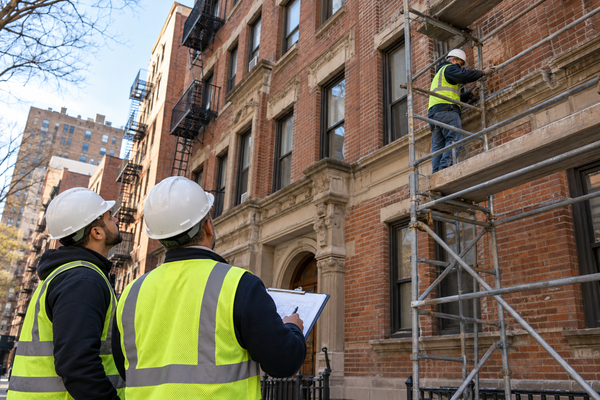
Star Construction INC is the repair contractor behind the inspection report. Under New York City’s Local Law 11 — the Facade Inspection & Safety Program (FISP) — a licensed engineer or architect known as a QEWI examines the facades of buildings over six stories and files a report with the Department of Buildings. When that report comes back SWARMP or UNSAFE, it is a contractor who does the work it calls for, and that is where we come in. We carry out local law 11 facade repair in NYC condition by condition: the cracked masonry, failed mortar, loose terra cotta, corroded lintels and leaking joints your report lists, repaired and documented so the building returns to a safe standing. Cycle 10 is already running, and Sub-cycle 10A buildings — block numbers ending in 4, 5, 6 or 9 — face a filing deadline of 21 February 2027, which makes repair time shorter than most owners expect. Since 2018 we have served building owners, property managers and co-op and condo boards across New York with one accountable team, free estimates and a written, no-obligation quote before any work begins. If your building already has its report, the fastest next step is a repair scope priced against it — that is exactly what our facade repair and restoration contractors in New York team prepares for you. We coordinate with your QEWI throughout the job and install the sidewalk sheds and public protection the work requires.
Most FISP repair scopes combine several trades under one programme, and Star Construction covers them with its own crews: masonry contractors in New York for brick and stone replacement, repointing teams for failed mortar, waterproofing for leaking joints and parapet crews for the appurtenances inspectors examine first. Because the same team prices and performs the whole list, nothing in your report waits on a second contractor — the QEWI’s conditions are worked in a planned sequence, photographed as they are completed, and handed back as one documented package.
Many of the buildings in the FISP cycle are co-ops, condos and landmarked properties, where repair work has to satisfy a board as well as the DOB. We plan landmarked-facade repairs around Landmarks Preservation Commission requirements for matched materials and methods, and we keep managers and boards updated with the same written scope the quote was priced from — what is being repaired, in what order, and when it finishes.
Local Law 11 of 1998, run today as the Facade Inspection & Safety Program (FISP), requires the owners of New York City buildings taller than six stories to have every exterior wall and its appurtenances — parapets, balconies, cornices, railings and fire escapes — critically examined once every five years. Only a Qualified Exterior Wall Inspector (QEWI), a licensed professional engineer or registered architect approved by the DOB, may perform the inspection and file the technical report through DOB NOW: Safety. Each elevation is rated SAFE, SWARMP or UNSAFE. A SWARMP rating — Safe With a Repair and Maintenance Program — means the building is safe today but the listed conditions must be repaired inside the timeframe the QEWI sets; left unrepaired, they must be reported as UNSAFE in the next cycle, and Cycle 9A SWARMP conditions become UNSAFE automatically on 21 February 2027. An UNSAFE rating is more urgent: public protection goes up immediately, every unsafe condition must be repaired within 90 days of the report filing, and an amended report follows within two weeks of the correction. In plain terms, the inspector finds and reports — a contractor repairs. Star Construction is that contractor.
Cycle 10 runs from 21 February 2025 to 20 February 2030, and your building’s place in it is set by the last digit of its tax block number. Blocks ending in 4, 5, 6 or 9 file in Sub-cycle 10A, closing 21 February 2027; blocks ending in 0, 7 or 8 file in 10B, closing 21 February 2028; and blocks ending in 1, 2 or 3 file in 10C, closing 21 February 2029. Owners whose Cycle 9 report was never filed can ask the DOB about filing an initial report early — but the repairs a report calls for still have to be done, and they are cheapest before a deadline turns them into an emergency. The conditions inspectors flag most — spalling brick, cracked terra cotta, corroded lintels, open mortar joints — are the same ones walked through in our facade repair guide for New York buildings.

Every successful build begins with proper evaluation, planning, and method selection to ensure structural stability and long-term performance.
Cracked, spalled and displaced brick or stone named in a FISP report is cut out and replaced with matched materials, so the elevation reads as one facade again.
Failed mortar joints — the most common SWARMP item — are ground out and repointed to keep water out of the wall before the damage spreads.
Loose or leaning parapets, coping and cornice elements are rebuilt or secured, covering the appurtenances inspectors examine most closely.
Corroded steel lintels are repaired or replaced and loose facade elements re-anchored, addressing the conditions behind many UNSAFE ratings.
Failed sealant joints and coatings are renewed so repaired elevations stay watertight through New York's freeze-thaw cycles.
Cracked terra cotta and stone units are repaired, pinned or replaced in kind — including the LPC-aware methods landmarked facades require.
Most owners find us at one of three moments: a fresh report with a list of conditions, a SWARMP deadline closing in, or an UNSAFE finding that starts the 90-day clock. Waiting is the expensive option — late filing runs $1,000 per month, failure to file $5,000 per year, uncorrected SWARMP conditions draw a $2,000 penalty, and unsafe facade conditions can bring ECB penalties of up to $25,000, on top of a sidewalk shed standing at the building’s expense until repairs are signed off. Cycle 10 filing windows run by block number: Sub-cycle 10A (blocks ending 4, 5, 6, 9) closes 21 February 2027; 10B (0, 7, 8) closes 21 February 2028; 10C (1, 2, 3) closes 21 February 2029. If your report also flags the parapet, our parapet wall repair and installation contractors in New York handle that scope under the same programme. Send us the report — we review it, walk the building, and price the full repair scope in writing, free and with no obligation.
When you send the report, send the full FISP document rather than a summary — the condition list, the QEWI’s repair timeframes and any photos. That is what lets us price the complete scope in one written quote instead of discovering conditions mid-job. If the report also calls for wider exterior repair and renovation work beyond the listed conditions, we fold it into the same programme and the same schedule, and owners across the areas we serve get the same single-team approach. You can reach the team through our contact page or the number at the top of this page.
Our clients value the consistency, structural precision, and long-term performance we deliver on every project, from initial planning through final execution.

 Jav V
Trustindex verifies that the original source of the review is Google.
Got my bathroom remodel Team was professional on time Thank you Ever fernando Perez saldañaCrear Word
 LUIS CAYOi hire them for my home project. and everyting went smoothly. no delays
 Shahid IqbalVery reliable contractor. They did exactly what they promised and the quality was excellent. Would definitely recommend.
Contact us now to discuss your project and receive a no-obligation quote from our experts.
Every project is handled through a defined process that ensures accuracy, efficiency, and long-term structural performance from start to finish.
We begin by reviewing site conditions, understanding project objectives, and identifying structural requirements to establish a clear and practical direction before any work begins.
A detailed execution plan is developed, including material selection, sequencing of work, and coordination of labor to maintain consistency and avoid delays during construction.
Work is carried out using proven installation methods, with attention to structural integrity, proper reinforcement, and adherence to safety and quality standards.
A final walkthrough is conducted to verify workmanship, resolve any outstanding details, and ensure the completed project meets performance expectations and durability standards.
Choosing the right repair contractor matters because a FISP deadline does not move. Star Construction matches its repair scope to your report condition by condition, so every item your QEWI listed is priced, planned and completed — nothing extra sold, nothing flagged left behind. You receive a written, no-obligation quote before any work begins, and the schedule is planned backwards from your FISP deadline, whether that is the 90-day UNSAFE window or a SWARMP date months away. One accountable team has served New York building owners, managers and boards since 2018, and estimates and site evaluations of the flagged conditions are free. When the work is done, our QEWI coordination and full repair documentation support the amended filing that returns your building to a safe standing.
Share your QEWI’s report and we review every listed condition, then walk the building with you. The review and site evaluation are free.
You receive a condition-by-condition repair scope with a written, no-obligation quote before any work begins — no surprises later.
Repairs are sequenced against your DOB window — the 90-day UNSAFE clock or your SWARMP deadline. We install the sidewalk shed and public protection an UNSAFE finding requires and handle the permits, so the building is protected and compliant from day one.
Every flagged condition is repaired, and you receive a complete record of the finished work, so your QEWI has what the amended filing requires and the building returns to a safe standing.
Local Law 11 — the Facade Inspection & Safety Program (FISP) — requires New York City buildings taller than six stories to have their exterior walls inspected by a Qualified Exterior Wall Inspector (QEWI) and a technical report filed with the DOB once every five years. If your building is over six stories, it is in the programme, and its filing window in Cycle 10 depends on the last digit of its block number.
No — and no contractor can. By law only a QEWI, a licensed professional engineer or registered architect approved by the DOB, may inspect a facade and file the report. Star Construction is the repair contractor: we carry out the masonry, repointing, anchoring and waterproofing work the report calls for, so your QEWI can close it out. We coordinate directly with your QEWI — supplying the repair documentation and photos the amended filing needs — and if your building does not have a QEWI yet, we can refer one.
SWARMP means the building is safe today, but the conditions listed must be repaired within the timeframe your QEWI set. If they are left unrepaired, they must be reported as UNSAFE in the next report — and SWARMP conditions carried over from Cycle 9A become UNSAFE automatically on 21 February 2027. We price the full SWARMP list as one written repair scope so it is finished well inside the window.
Fast. Public protection — a sidewalk shed, which our team installs — must go up immediately, all unsafe conditions must be repaired within 90 days of the report being filed, and an amended report is filed within two weeks of the correction. We plan UNSAFE scopes backwards from that 90-day deadline and tell you honestly at the first visit whether the full scope fits it.
The honest answer is that it depends on what the report lists — a repointing programme and an UNSAFE terra-cotta replacement are very different jobs, and access and staging affect every price. What we can promise is the process: send us the report, we evaluate the building free of charge, and you receive a written, no-obligation quote for the complete repair scope before deciding anything.


