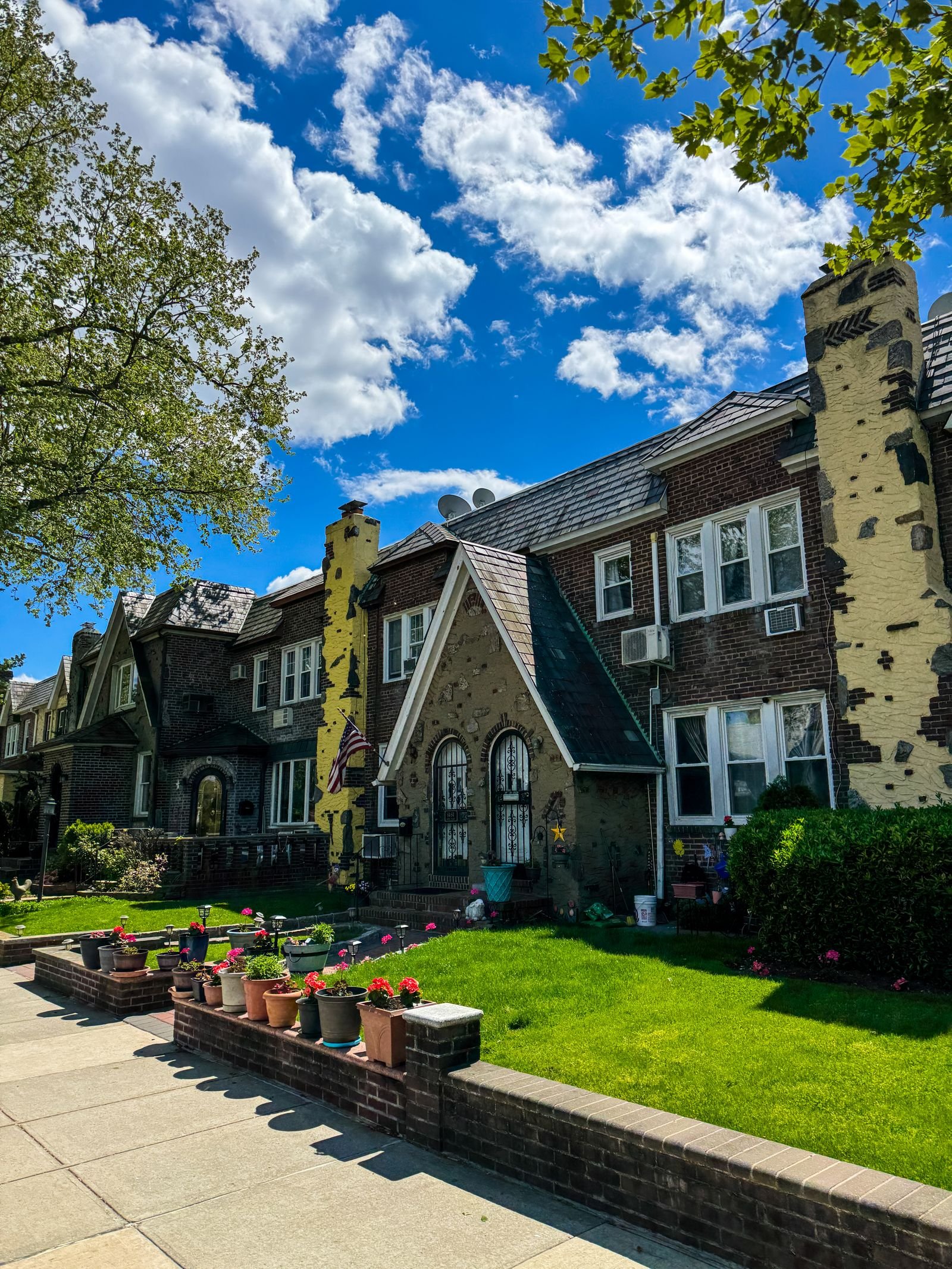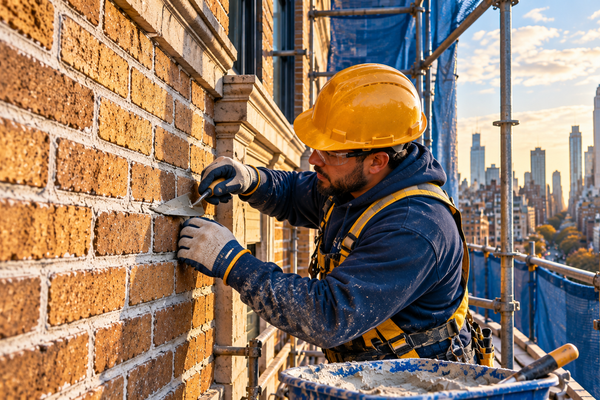
As masonry contractors in New York working in Flushing, we see two distinct kinds of brickwork. Around Downtown Flushing and Kissena Boulevard, pre-war apartment buildings and co-ops present tall brick facades, shared party walls, parapets and entry steps that have weathered many winters. In Murray Hill and Auburndale, 1920s-to-1940s single-family homes show garden walls, chimneys, porches and retaining walls built with the same softer historic brick, often shaded by mature street trees. Mortar matching matters most on softer historic brick. A mortar that is too hard or too dense can trap moisture and force the brick face to spall, while a compatible lime-rich mix moves with the wall and lets it dry. That is why we start by checking the existing mortar, the brick type and how water is reaching the wall, rather than choosing a mix from a bag and hoping it blends.
Most Flushing masonry work starts with joints and surfaces that have been letting water in for years. Brick repointing removes failed mortar and replaces it with a mix matched to the original brick, which matters on pre-war facades where a hard modern mortar can do more harm than the weather did. Where bricks themselves have cracked, spalled or lost their faces, we replace them with units chosen for size, color and texture so the repair does not stand out as a patch. Chimneys take the hardest weather on the building, so chimney repair and rebuilding is a frequent job here, from crown and cap repairs to rebuilding a leaning stack. Entry steps and garden walls are rebuilt through custom masonry steps and entryways work and retaining walls and masonry planters that hold back soil without trapping water behind them. Finally, masonry waterproofing and sealants help keep repaired walls dry, but only after the joints, flashing and drainage that caused the dampness have been put right.

Flushing masonry fails most often the same way: water gets in, winter freezes it, and the joints widen a little more each year. Shaded north walls and garden walls under street trees stay damp longer, so they spall and grow moss while a sunny facade nearby still looks sound. Parapets and chimneys, which are exposed on every side, crack first, and a small stain on an interior wall can mean a joint, a cap or a flashing problem several feet away. We therefore look at the whole water path — roof edges, caps, joints, sills and ground drainage — before pricing a repair, and we price only the work the building needs. If you are comparing contractors, see all the areas we serve, and read about our wider work as masonry contractors in New York. Star Construction INC has served New York City homes and apartment buildings since 2018, and every Flushing visit starts with a free, no-obligation estimate.
Our clients value the consistency, structural precision, and long-term performance we deliver on every project, from initial planning through final execution.


 Trustindex verifies that the original source of the review is Google.
 Trustindex verifies that the original source of the review is Google.
 Trustindex verifies that the original source of the review is Google.
 Trustindex verifies that the original source of the review is Google.
Contact us now to discuss your project and receive a no-obligation quote from our experts.
Every project is handled through a defined process that ensures accuracy, efficiency, and long-term structural performance from start to finish.
We begin by reviewing site conditions, understanding project objectives, and identifying structural requirements to establish a clear and practical direction before any work begins.
A detailed execution plan is developed, including material selection, sequencing of work, and coordination of labor to maintain consistency and avoid delays during construction.
Work is carried out using proven installation methods, with attention to structural integrity, proper reinforcement, and adherence to safety and quality standards.
A final walkthrough is conducted to verify workmanship, resolve any outstanding details, and ensure the completed project meets performance expectations and durability standards.
In Flushing, the masonry itself is often the straightforward part; the coordination around it is what keeps a job on schedule. Pre-war apartment buildings and co-ops need board and manager approval, shared-wall access and work-hour rules respected, while larger facade or chimney work may need NYC permits depending on the scope. We plan that sequence before work starts, so owners and managers know what is happening, when, and what approval is still needed.
Some masonry repairs need no permit, while larger structural, parapet or facade work in New York City may. We confirm which applies to your scope before work begins, so the job is not paused partway through for paperwork that should have been sorted first.
For co-ops and apartment buildings, we work with the board and building manager on approvals, alteration requirements, access to shared walls and roofs, and work hours, so residents are not surprised by scaffolding, noise or closed entrances.
In occupied buildings, we sequence the work so entrances, stairwells and shared spaces stay usable for as much of the job as possible. Facade, parapet or chimney work is broken into sections, and access, scaffolding and noisy phases are planned around residents’ daily routines and building rules, with advance notice of any temporary disruption.
Repointed joints and replaced bricks are matched in color, texture and mortar tone to the surrounding wall, so repairs blend in rather than standing out as patches. The site is left tidy at the end of each day, with debris cleared and shared areas kept clean, so the building looks cared for while the work goes on.
It depends on the scope: the wall area, how deep the joints need to be raked out, whether bricks need replacing, and how much access or scaffolding is involved. A small garden wall and a full pre-war apartment facade are very different jobs, so we price repointing after walking the wall and measuring the affected area. Request a free, no-obligation estimate and we will give you a written scope for the work your building actually needs.
Chimneys take the worst of the weather: they stand exposed above the roof, so rain enters failed joints and flashing, freezes in winter, and gradually loosens bricks and mortar. A chimney that leans, sheds bricks, or shows a cracked crown has usually been taking on water for years. We inspect the crown, flashing, flue and brickwork to find whether repointing and repairs will stabilize it or whether partial rebuilding is the safer scope.
Often, yes. Much of Flushing’s pre-war and 1920s-to-1940s brick is softer than modern brick and was laid with lime-rich mortar. A hard, dense modern mortar can trap moisture and cause the brick face to spall, while a compatible lime-rich mix moves with the wall and lets it dry. Before repointing, we check the existing mortar and brick so the new mix matches the original in strength and appearance.
It depends on the work. Minor repointing and like-for-like repairs often need no permit, while larger structural, parapet or facade work in New York City may. Co-op and apartment buildings may also need board approval even when no city permit is required. We confirm which applies to your scope before work begins, so the job is not paused partway through for paperwork.
Yes. Much of our Flushing masonry work is on co-ops and apartment buildings, from pre-war buildings around Downtown Flushing and Kissena Boulevard to smaller walk-ups in Murray Hill and Auburndale. We work with the board and building manager on approvals, alteration requirements, access to shared walls and roofs, and work hours, and we phase facade, parapet or chimney work so entrances and shared spaces stay usable for as much of the job as possible. Larger facade or chimney work may also need NYC permits depending on the scope, and we confirm that before work begins. Request a free, no-obligation estimate and we will review what your building needs and what approvals apply.