
Flat Roof Maintenance in NYC: The Short Answer
A flat roof in New York City needs checking twice a year — in spring and autumn — plus after major storms: clear drains and scuppers, check seams and flashing, look for ponding water that stands more than 48 hours, and inspect parapet joints. Most flat-roof leaks are maintenance failures, not age alone, and catching them early is far cheaper than interior repair.
The Twice-a-Year Rhythm — Plus After-Storm Checks
New York’s seasons are hard on flat roofs: freeze-thaw opens seams in winter, summer heat and UV age membranes, and autumn leaves choke drains before the first freeze. That is why the calendar matters more than the roof’s age. A spring check catches winter damage before spring rains; an autumn check clears debris before snow and ice. After any major storm, add a targeted check for displaced strainers, wind-lifted flashing, and new ponding. Owners who keep this rhythm rarely face surprise leaks: small failures are found while they are still cheap to fix.
Drains, Scuppers and Internal Drains: NYC Types
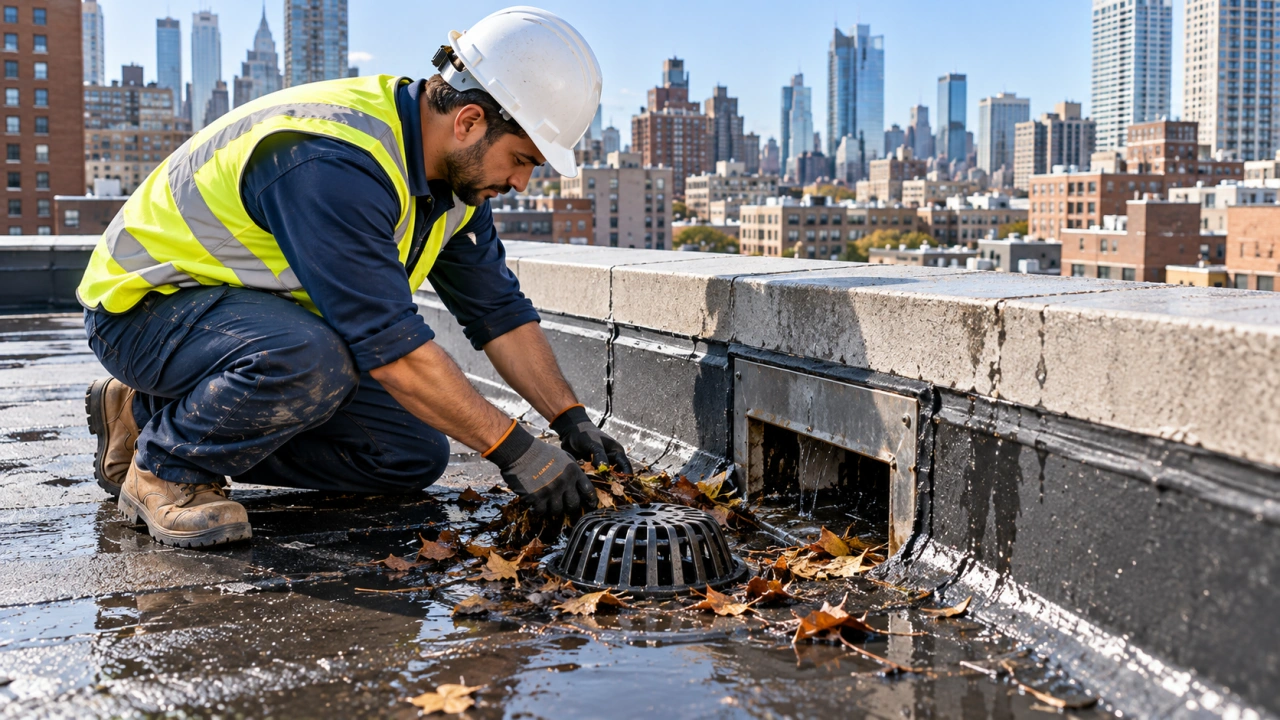
Most NYC flat roofs drain in one of three ways, and each fails differently. Roof drains with strainer baskets sit at low points and pipe water down through the building; when baskets clog with leaves or debris, water backs up across the whole field. Scuppers are openings through the parapet that spill water into leaders; they clog with leaves and ice, and their metal throats corrode where they meet masonry. Internal drains run inside walls — a clog there can show up as a leak floors below the roof. On every check, clear each strainer by hand, confirm scuppers are open all the way through, and watch water flow during rain where it is safe. A drain that gurgles or leaves a silt ring needs attention before the next storm, not after it.
Seams, Patches and Membrane Checks by Material
A flat roof is only as watertight as its seams, and each membrane material ages in its own way. Walk the field slowly and judge what you find by the material under your feet.
EPDM (rubber membrane)
EPDM shrinks as it ages, pulling at seams, flashing, and parapet terminations. Look for lifted seam tape, shrinkage lines near walls, and a chalky surface. Small seam failures can be re-taped by a roofer, but a membrane that has pulled from a wall needs professional re-termination.
TPO (thermoplastic membrane)
TPO seams are heat-welded, so a good seam looks smooth and uniform. Watch for welds split open, especially at T-joints where three sheets meet, and for punctures from foot traffic or dropped tools. A brittle surface showing scrim is near the end of its service life.
Modified bitumen
Modified bitumen roofs are built in plies with torch-applied or self-adhered laps. Check for laps that have opened, granule loss exposing the bitumen beneath, and blisters where moisture is trapped between plies. Alligator cracking means the surface is aging and needs a coating or overlay assessment.
Built-up roofing (BUR)
Traditional tar-and-gravel BUR shows its age through displaced gravel, bare patches, and ridges or splits over the felts. Keep gravel evenly spread, and flag splits longer than a few inches, since splits in BUR tend to run.
PVC
PVC is heat-welded like TPO but more chemically sensitive: plasticizer migration makes older PVC brittle, and asphalt or incompatible sealants can damage it. Look for cracked welds and shrinkage at perimeters. If you are unsure what membrane you have, a roofer can identify it before repair.
Whatever the material, never coat or patch with an incompatible product — the wrong coating can void a warranty. When seams keep failing, a full assessment by roof repair and installation contractors in New York can tell you whether repair or replacement is the honest answer.

Ponding Water: The 48-Hour Rule
A flat roof is not perfectly flat — it is built with a slight pitch toward drains — but settlement, crushed insulation, or a clogged drain can leave standing water. The rule is simple: if water still stands 48 hours after the rain stops, it is ponding, not drainage. Ponding accelerates membrane aging, adds dead load, and breeds the silt that clogs drains further. Mark ponded areas with chalk, note depth and size, and photograph them after rain. Shallow, isolated ponding is often fixed by clearing a drain or adding a tapered cricket; widespread or deep ponding points to a pitch or insulation problem that needs a roofer’s survey. Never drill a hole to drain a ponded area — it creates a leak by design.
Parapet, Flashing and Coping Joints
In New York, parapets are where flat roofs fail most often. The parapet wall moves with temperature and wind while the membrane does not, so the joint between them works constantly. Check coping stones or metal caps for open joints, cracked mortar, and caps that have shifted or gone missing. Look at the base flashing where the membrane turns up the parapet for splits and separation, and probe sealant joints at corners — dried or missing sealant is an open invitation to water. Stains on the top floor’s exterior walls often trace back to a parapet joint, not a field leak. Cracked, leaning, or bulging parapet masonry is a structural concern, not a maintenance item, and belongs with parapet wall repair and installation contractors in New York, who can judge whether repointing, rebuilding, or bracing is required.

Rooftop Equipment, Penetrations and Access Rules
Every vent pipe, HVAC curb, skylight, hatch, and antenna base is a hole in the waterproofing, sealed with flashing that moves, shrinks, and ages. Check vent-pipe flashing boots for cracks, HVAC curb corners for gaps, and skylight domes for failed gaskets. Never let a trade screw a new mount through the membrane without a proper flashing detail — most “mystery leaks” start with an unflashed screw. Access rules matter too: in co-op and condo buildings the roof is usually common property, so shareholders need board or managing-agent permission before stepping onto it, and work often must be done by the building’s roofer to protect warranties. Commercial tenants should check their lease — roof access and drain responsibility are frequently landlord items.
What Owners Can Check vs. What Needs a Roofer
Owners and building staff can safely handle the visual parts: clearing strainers and scuppers, photographing ponding and seam problems, checking parapet joints, and keeping the log. Leave the rest to a roofer. Call a professional now for any of these red flags: active dripping or spreading ceiling stains; a sagging or spongy area underfoot; a seam or flashing split open to the weather; a drain backing up into the building; storm damage with displaced membrane or coping; or parapet masonry that is cracked, leaning, or shedding pieces. Roof work at height carries fall risk — a roofer carries the insurance and fall protection for it. The same routine applies across the metro area, including properties served by roof repair and installation contractors in Yonkers, NY, where freeze-thaw and leaf fall follow the same calendar.
Printable-Style Seasonal Checklist and Maintenance Log
Print this section, tick each item, date it, and file the photos with it.
Spring checklist
- Clear all drains, strainers, scuppers, and gutters; confirm water flows freely.
- Walk seams and patches for winter splits, lifted edges, and blisters.
- Check parapet coping joints, base flashing, and sealant at corners.
- Note ponding 48 hours after rain; photograph and measure it.
- Inspect equipment flashings and hatch seals.
Autumn checklist
- Clear leaves and debris from drains, scuppers, and valleys before the first freeze.
- Re-check seams and flashing after summer heat and UV.
- Confirm coping caps are secure and sealant joints are full.
- Schedule any repair before snow, ice, and freeze-thaw arrive.
After-storm checklist
- Check for displaced strainers, wind-lifted flashing, and new ponding.
- Look for debris dams at drains and scuppers.
- Photograph new damage for the building’s insurance file.
Simple maintenance-log format
Date | Inspector | Weather | Items checked | Problems found | Action taken | Photos filed (Y/N) | Next check due. One line per visit is enough — the unbroken record also supports warranty claims and resale disclosures.
What Flat Roof Maintenance Costs in New York
Costs vary with roof size, access, membrane type, and how long problems have been left, so treat these as general New York market ranges only, not quotes. A routine twice-a-year maintenance visit for a typical small-to-mid-size flat roof commonly falls in the low hundreds to around a thousand dollars per visit, depending on size and access. Drain servicing, resealing a flashing joint, or re-taping a short seam are usually smaller jobs within that range, while a partial re-flash, a tapered cricket, or a coating can run into the low thousands. Full membrane replacement is a different scale entirely, priced per square foot after survey. Any figure given without an on-site inspection is a guess: a roofer will walk the roof, identify the membrane, and price the actual scope first. Buildings with a documented routine almost always spend less, because their problems are caught as repairs, not emergencies.
Star Construction serves building owners across the five boroughs and nearby suburbs — see our service areas to confirm coverage — and a documented routine is the cheapest leak insurance a flat roof can have.
Frequently Asked Questions
How often should a flat roof be inspected in NYC?
Twice a year — in spring and autumn — plus after major storms. Spring catches winter damage, autumn clears debris before snow and ice, and after-storm checks catch wind-lifted flashing and new ponding early.
How long can water stand on a flat roof before it is a problem?
More than 48 hours after rain stops is the practical threshold. Water standing longer is ponding: it ages the membrane, adds dead load, and clogs drains with silt. Mark the area, photograph it, and have the drainage problem assessed.
What is the most common cause of flat roof leaks in New York?
Maintenance failures, not age alone — clogged drains and scuppers, open seams, and failed parapet flashing cause most leaks. Regular clearing and seam checks prevent most of them — the twice-a-year routine matters more than the roof’s age.
Can building owners inspect a flat roof themselves?
Owners can handle visual checks, drain clearing, and photography where access is safe and permitted. In co-op and condo buildings, roof access usually needs board or managing-agent permission, and repair or seam work belongs to a professional roofer.
When should I call a roofer immediately for a flat roof?
Call now for active dripping or spreading ceiling stains, a sagging or spongy roof area, an open seam or flashing split, a drain backing up into the building, storm-displaced membrane or coping, or cracked, leaning, or shedding parapet masonry.