
Our concrete repair and installation crews in Jerome Park work the ground every resident walks. In front of the pre-war apartment buildings and brick multi-family houses, the concrete run is a public trust: sidewalk flags carrying thousands of footsteps a day, stoops climbing to raised entrances, curbs and aprons where private lots meet streets that fall toward the reservoir. Because these streets are hilly, grades matter — a flag poured a quarter inch wrong sends water toward a cellar instead of the street, and a settled apron turns a driveway entrance into a puddle. We level, patch, and replace with that in mind, matching existing work where it is sound and rebuilding what is spent, and we keep the building’s entrance safe and passable while the work is under way.
Concrete repair and installation covers the flatwork that carries a building’s daily life — and in Jerome Park that flatwork works harder than in most neighborhoods. Sidewalk flags in front of apartment buildings see constant foot traffic; stoops take the wear of every resident, delivery, and stroller; curbs and aprons absorb the bump and splash of street traffic on hilly roads. Repair means restoring what is sound: grinding a lifted edge, lifting a settled flag, patching a spalled surface, repointing the joints of a stoop. Installation means replacing what is spent or building new — a full sidewalk run, a rebuilt stoop, a new apron graded to the street — poured on a proper base with control joints that let the slab move without cracking. Where a concrete driveway installation meets the sidewalk, the two are planned together so the grades agree and water runs to the street, not into the building. The honest question on every slab is whether repair will genuinely last or whether replacement is the cheaper sentence — and we answer it slab by slab, in the open, before any work is quoted.

If the sidewalk in front of your Jerome Park building has lifted flags, a trip edge, or a violation notice with a deadline, do not wait for the next inspection to make it worse. Star Construction INC walks the run with you, flags every slab that needs work and every one that can honestly be saved, and prices the repair or replacement plainly before anything is poured. The neighborhoods we serve are listed on our service areas page. Request a free, no-obligation estimate and we will tell you, slab by slab, what your Jerome Park concrete actually needs.
Our clients value the consistency, structural precision, and long-term performance we deliver on every project, from initial planning through final execution.

 Jav V
Trustindex verifies that the original source of the review is Google.
Got my bathroom remodel Team was professional on time Thank you Ever fernando Perez saldañaCrear Word
 LUIS CAYOi hire them for my home project. and everyting went smoothly. no delays
 Shahid IqbalVery reliable contractor. They did exactly what they promised and the quality was excellent. Would definitely recommend.
Contact us now to discuss your project and receive a no-obligation quote from our experts.
Every project is handled through a defined process that ensures accuracy, efficiency, and long-term structural performance from start to finish.
We begin by reviewing site conditions, understanding project objectives, and identifying structural requirements to establish a clear and practical direction before any work begins.
A detailed execution plan is developed, including material selection, sequencing of work, and coordination of labor to maintain consistency and avoid delays during construction.
Work is carried out using proven installation methods, with attention to structural integrity, proper reinforcement, and adherence to safety and quality standards.
A final walkthrough is conducted to verify workmanship, resolve any outstanding details, and ensure the completed project meets performance expectations and durability standards.
Good concrete work in Jerome Park is judged by what does not happen: nobody trips on the flags in front of your building, no violation notice arrives, no stoop settles toward the cellar, no apron ponds against the garage door. That quiet record comes from work done properly the first time — bases compacted, grades set to the street, joints cut where the slab needs to move, and finishes that grip in January. The sections below describe what that means for each part of a building’s concrete run.
In New York City the sidewalk in front of a property is the owner’s responsibility, and the Department of Transportation enforces it. A flag lifted a half inch by a root, a corner settled after a utility cut, a spalled section outside an apartment entrance — any of these can draw a DOT violation removal notice, which gives the owner a deadline to cure the condition and then pass re-inspection. The work that cures it is usually straightforward sidewalk repair and replacement: the defective flags are cut out and repoured, or ground and lifted where the defect is small enough for that to be honest, with grades restored so water runs to the street. The trap is cosmetic patching that hides the trip edge for a season and fails the re-inspection; we fix the slab, not the photograph of it.
Jerome Park’s street trees are part of the neighborhood’s character — and the main reason its sidewalk flags heave. A root grows under a flag, lifts it a half inch, then an inch, and the trip edge grows with it. The honest fixes depend on the root and the slab: grind the edge when the lift is small and the root can be managed, lift and re-bed the flag when the slab is sound, or cut the flag out and repour it where the root has made the section unusable. What does not work is cutting a major root to save a slab — the tree dies and the next storm takes it down — so we plan the repair around the tree, and where a masonry contractor in Jerome Park is already working on the building’s stoop or retaining wall, the concrete and masonry repairs are sequenced together so one crew’s trench is not another crew’s surprise.
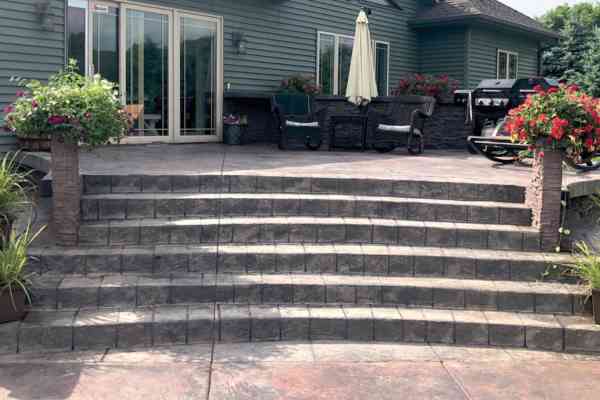
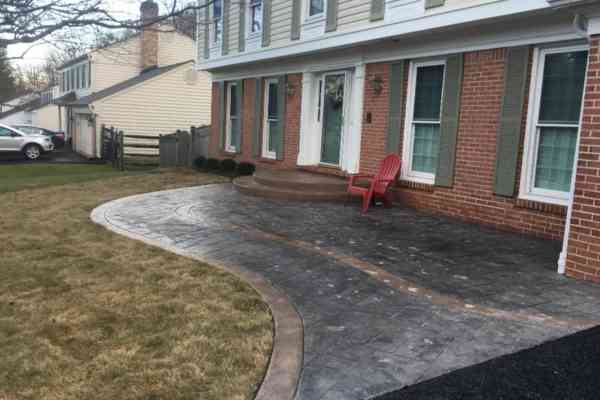
The threshold of a Jerome Park building takes more abuse than any other piece of concrete on the lot. Concrete steps and staircases at raised entrances carry every foot, every delivery dolly, and every winter’s salt; they crack at the nosing first and settle at the base where runoff collects. Curbs and aprons take the street side: the apron is where the driveway meets the road, and where a bad grade ponds water against the garage or sends it down the walk. Concrete patios and walkways behind and beside the building round out the run — the rear walk to the yard, the pad under the trash area, the path to the basement entrance. Rebuilding a stoop means a proper footing and a drain at the base; repouring an apron means matching the street grade, not the old slab’s mistake.
Not every damaged slab needs to come out, and not every slab should be patched. Scaling — the surface flaking off in sheets after winters of salt and freeze-thaw — is judged by depth: light scaling can be ground or overlaid, but deep scaling means the surface is gone and concrete resurfacing and repairs or full replacement is the honest call. Settlement is judged by grade: a slab that has sunk a half inch but still drains can be lifted; one that now sends water at the building cannot be saved by patching. The freeze-thaw cycle that does most of this damage is described in our article on freeze-thaw masonry damage — water enters a crack in autumn, freezes and expands in January, and repeats until the crack is a failure. We walk each slab with the owner and sort them in the open: save, repair, or replace, with the reason stated for each.
Yes, in New York City it is. The property owner is responsible for maintaining the sidewalk adjoining their property — keeping it in good repair, clear of trip hazards, and safe for pedestrians. That applies whether the building is a single-family home, a small multi-family house, or a large apartment building, and it applies to the flags in front of the building even though the sidewalk itself is public. The practical consequence is that a lifted flag or broken section is the owner’s repair, not the city’s, and ignoring it risks both a liability claim from a fall and a DOT violation notice with a deadline.
A DOT sidewalk violation notice identifies the defective conditions — lifted flags, trip edges, broken sections — and sets a deadline by which the owner must have them repaired. The practical sequence is simple: have the run inspected, get the defective flags repaired or replaced to the city’s standard, and then arrange the re-inspection that clears the violation. Doing the work properly the first time matters, because a cosmetic patch that fails re-inspection costs a second round of work and leaves the violation open. If the notice lists many flags, it is worth pricing the whole run rather than spot-fixing one flag at a time.
Often, yes — it depends on how far the root has lifted the flags and whether the slab itself is still sound. If the lift is modest, the edge can be ground down to remove the trip hazard, or the flag can be lifted, the root managed, and the flag re-bedded level. If the root has cracked the slab or lifted it so far that grinding would leave it too thin, the honest fix is to cut the section out and repour it, grading it around the root. What we do not recommend is cutting a major structural root to save a slab: it destabilizes the tree and creates a bigger problem in the next storm.
Yes, within limits. Concrete repair — grinding, lifting, patching, and repointing stoop joints — can be done through most of a New York winter, since it does not depend on a fresh pour curing. New concrete pours need temperatures that let the mix cure rather than freeze: a pour in deep cold requires blankets, accelerators, and careful timing, and a contractor who promises a mid-January pour with no cold-weather plan is not being honest. The practical approach in winter is staged work: make the sidewalk safe and violation-compliant now, and schedule major new pours for the first mild spell.
It depends on the scope. Work on the sidewalk itself — the public walk in front of the building — generally involves the city’s DOT permit process, since the work touches public infrastructure and may require a sidewalk opening or construction permit. Work wholly on the lot, such as a rear walk or a stoop rebuild behind the property line, is usually simpler. Because the rules turn on exactly where the work sits, it is worth confirming the permit position for your specific run before the first flag comes out; we flag it at the estimate stage so there are no surprises.