
Tuckahoe’s concrete works harder than it looks. The village’s front walks carry every visitor, its entrance steps climb to raised doors, and its short driveways fit a century-old lot pattern that leaves no room for error in grade or drainage. Much of it is old concrete now — poured before modern base and joint practice, lifted by street-tree roots, scaled by river-valley winters. Our concrete repair and installation contractors assess before quoting, slab by slab, and tell you plainly which pours have finished their service and which can be brought back.
Request a free, no-obligation estimate and we will walk every slab with you — walks, steps, driveway and patio — and explain which is which before any work is quoted.
Concrete repair in Tuckahoe means judging each slab on its own evidence: what has settled, what has scaled, and what the base beneath it is doing. The repair menu runs from grinding a lifted edge and lifting a settled slab to concrete resurfacing and repairs for a worn but sound surface, and finally to section replacement where the slab itself is spent.
New installation follows the same honesty: base corrected and compacted, joints placed where the concrete wants to crack, grades set so water runs to the street rather than the house. A pour that skips the base will look fine for a season and fail by the second winter; one built on a proper base holds for decades.

If you are looking for concrete contractors in Tuckahoe, NY, start with a walk of every slab rather than a price. At Star Construction INC, we measure the run, read the settlement and scaling, and explain what can be saved and what must be replaced — before quoting.
We have repaired and installed concrete across the New York area since 2018, and the areas we serve are listed on our service areas page. Request a free, no-obligation estimate and we will walk every pour with you before quoting anything.
Our clients value the consistency, structural precision, and long-term performance we deliver on every project, from initial planning through final execution.


 Trustindex verifies that the original source of the review is Google.
 Trustindex verifies that the original source of the review is Google.
 Trustindex verifies that the original source of the review is Google.
 Trustindex verifies that the original source of the review is Google.
Contact us now to discuss your project and receive a no-obligation quote from our experts.
Every project is handled through a defined process that ensures accuracy, efficiency, and long-term structural performance from start to finish.
We begin by reviewing site conditions, understanding project objectives, and identifying structural requirements to establish a clear and practical direction before any work begins.
A detailed execution plan is developed, including material selection, sequencing of work, and coordination of labor to maintain consistency and avoid delays during construction.
Work is carried out using proven installation methods, with attention to structural integrity, proper reinforcement, and adherence to safety and quality standards.
A final walkthrough is conducted to verify workmanship, resolve any outstanding details, and ensure the completed project meets performance expectations and durability standards.
Tuckahoe concrete divides itself by where it sits and how it is used. These four — the walks and steps, the driveways, the patios, and the repair-or-replace judgment — decide whether concrete work lasts or merely looks fresh. Here is how we approach each.
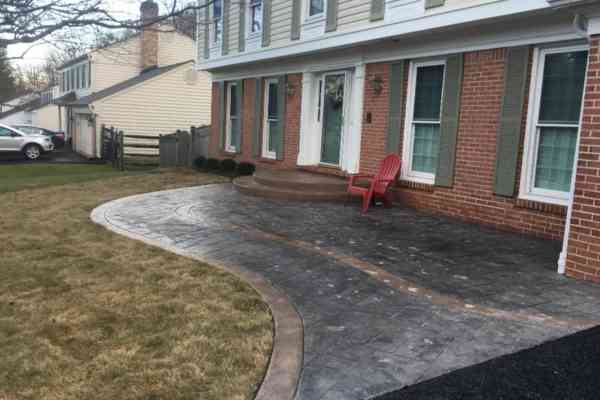
The front walk and the entrance steps are the village’s most-used concrete: every visitor, every delivery, every trip to the station crosses them. On Tuckahoe’s compact lots they are also short runs, which means every defect is visible and every trip edge matters. Root lift at the street trees, settlement at the stoop, and steps whose treads have scaled or loosened are the usual findings — and each has an honest fix, from grinding and lifting to section replacement.
Where the steps are masonry rather than poured concrete, the repair belongs to the mason’s trade: our masonry contractors in Tuckahoe rebuild raised entrances in brick and stone, while our concrete steps and staircases work covers poured steps, treads and cheek walls. Either way, the step is judged as a structure, not a surface.
Tuckahoe driveways are short runs on compact lots, and short runs forgive nothing: the grade must fall to the street in a few feet, the apron must meet the road cleanly, and there is no spare width to absorb a mistake. Most village driveways fail at the apron or at the garage threshold, where settlement has reversed the drainage and water now runs toward the house instead of away from it.
Our concrete driveway installation work starts with the grade, not the pour: base corrected, drainage confirmed, and the apron detailed to the street. Where the existing driveway is sound but tired, resurfacing or section replacement may honestly serve better than a full tear-out — and we will say so.
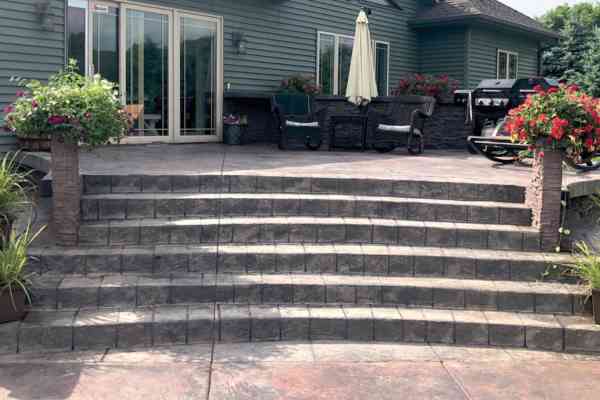
Tuckahoe’s back gardens are small, and their concrete is correspondingly modest: a patio slab, a garden path, a pad for the bins or the grill. Small does not mean simple — a patio that ponds water against the house wall, or a path that has heaved at a root, does the same damage as a larger failure, just closer to the foundation. The work here is measured in slabs, not truckloads, and priced that way.
We pour patios and paths with the same base and joint discipline as a driveway, scaled to the job: compacted base, control joints where the slab wants to crack, and a finish that sheds water away from the house. A small patio done properly outlasts a large one done carelessly, and the village’s compact gardens reward the careful job.
Settlement and scaling are judged slab by slab, because two slabs of the same age on the same lot are rarely in the same condition. A slab that has settled evenly can often be lifted back to grade; one that has cracked through, or scaled deeply across its face, has usually finished its service. The honest answer is sometimes ‘replace this one, save the next three’ — and that answer is cheaper than either extreme.
Winter is the judge that matters most here: water trapped in a cracked or unsealed slab freezes, expands and widens the damage a fraction each year, which is why our freeze-thaw damage discussion matters for concrete as much as for brick. Sealing, jointing and drainage are the defenses that slow that cycle — and they are specified slab by slab, not sold as a blanket.
Three honest options, in order of cost: grinding the lifted edge down where the lift is small and the slab is otherwise sound; lifting the settled slab back to grade where the slab itself is intact; or replacing the affected section where the slab has cracked through or the root has destroyed its base. What does not work is ignoring it — roots keep growing, and a trip edge only gets taller. We also discuss the root itself: cutting a street-tree root needs care and, where the tree is village-owned, coordination, so the fix does not create a second problem.
It depends on what has failed. Steps whose treads have scaled or whose nosings have chipped can usually be repaired — resurfaced, patched, or capped — while steps that have settled, cracked through, or lost their bearing need rebuilding. The test is structural: if the step is sound beneath the surface damage, repair; if it rocks, leans or has broken through, rebuild. We show you which yours is before quoting, because a repaired step that should have been rebuilt is money spent twice.
Concrete can be poured and repaired in a Westchester winter, with conditions: the ground must not be frozen, the mix and the curing must be protected from freezing temperatures, and some finishes are better left to milder weather. Emergency repairs — making a walk safe, stopping water — proceed in most weather; planned pours are scheduled around the forecast, and deep-winter work is often staged so the concrete cures rather than freezes. A contractor who promises a winter pour without mentioning protection is one to question.
Yes, new concrete benefits from sealing, and the interval depends on exposure: a driveway or walk that takes traffic and weather typically needs resealing every two to three years, while a sheltered patio may hold longer. Sealing slows water entry, salt damage and freeze-thaw scaling — it does not make concrete invulnerable, and it does not rescue a slab whose base has already failed. We specify the sealer and the interval for each slab rather than selling a single schedule for the whole lot.
Work wholly on your own lot — a walk, a patio, a driveway section — is usually the simplest category, though the village can confirm the requirement for a specific job. Work at the public walk, the apron or the road edge generally needs village coordination, and any work that changes grades toward the street or a neighbor’s lot deserves a conversation first. We will tell you which yours is before work starts, so approval is never an afterthought.