
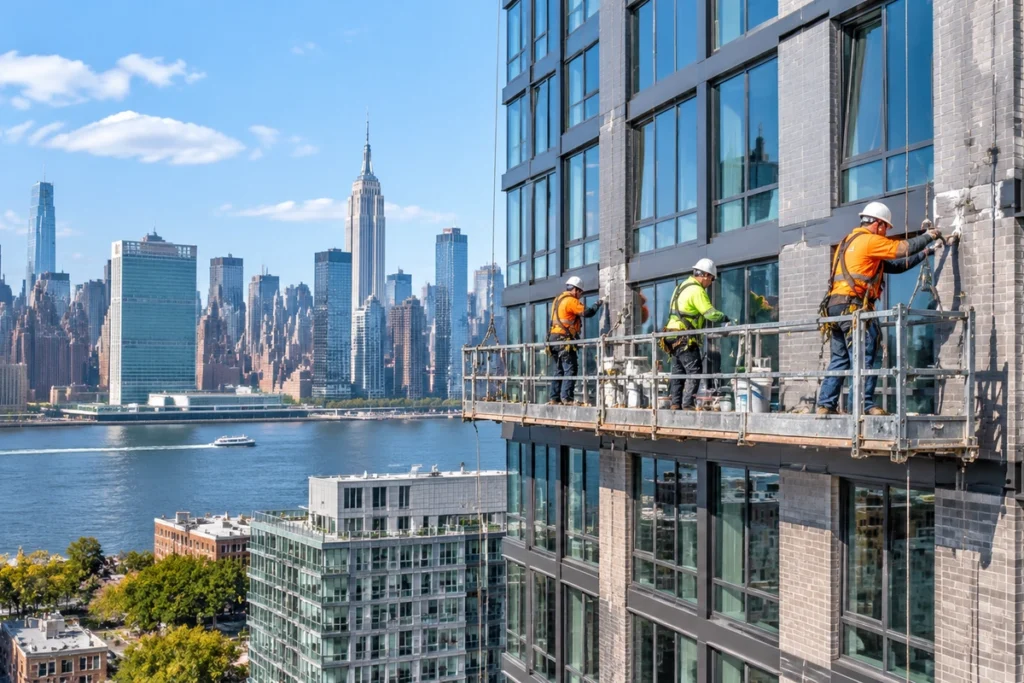
Local Law 11 — the Facade Inspection & Safety Program — requires every New York City building over six stories to have its exterior walls inspected by a Qualified Exterior Wall Inspector (QEWI) once every five years, with the report filed with the Department of Buildings. The rule turns on height, not age, which is why Long Island City’s modern towers are fully inside it: glass, panel, concrete and brick-veneer facades are inspected to the same standard as pre-war masonry, and their weak points differ — sealant and caulking joints that age out, concrete spalling at slab edges, balcony and anchor conditions, water entry at transitions. Star Construction INC, serving New York since 2018, is the repair contractor for that work in LIC. We cure the conditions your building’s report cites and coordinate with your QEWI until the amended report can be filed; inspections and filings remain your QEWI’s by law, and we never blur that line. Cycle 10 is underway: your sub-cycle is set by your block number, Sub-cycle 10A closes 21 February 2027, and SWARMP conditions left open from Cycle 9 reclassify as UNSAFE on that date.
Local Law 11 — the Facade Inspection & Safety Program — requires every New York City building over six stories to have its exterior walls inspected by a Qualified Exterior Wall Inspector (QEWI) once every five years, with the report filed with the Department of Buildings. The rule turns on height, not age, which is why Long Island City’s modern towers are fully inside it: glass, panel, concrete and brick-veneer facades are inspected to the same standard as pre-war masonry, and their weak points differ — sealant and caulking joints that age out, concrete spalling at slab edges, balcony and anchor conditions, water entry at transitions. Star Construction INC, serving New York since 2018, is the repair contractor for that work in LIC. We cure the conditions your building’s report cites and coordinate with your QEWI until the amended report can be filed; inspections and filings remain your QEWI’s by law, and we never blur that line. Cycle 10 is underway: your sub-cycle is set by your block number, Sub-cycle 10A closes 21 February 2027, and SWARMP conditions left open from Cycle 9 reclassify as UNSAFE on that date.

Every successful build begins with proper evaluation, planning, and method selection to ensure structural stability and long-term performance.
Facade sealant and caulking joint renewal on tower facades for Long Island City towers.
Concrete spall repair at slab edges and balconies for Long Island City towers.
Brick veneer and panel-facade condition repairs cited in FISP reports for Long Island City towers.
Balcony-edge and anchor-related condition correction for Long Island City towers.
Waterproofing repairs at facade transitions and joints for Long Island City towers.
Parapet, coping and roofline condition repairs for Long Island City towers.
SWARMP and UNSAFE condition correction for Long Island City towers.
Sidewalk shed and public protection for facade work for Long Island City towers.
The deadlines in a FISP report do not bend for new buildings: UNSAFE conditions must be corrected within 90 days of filing, late filings draw $1,000 per month, failure to file costs $5,000 per year, and uncorrected UNSAFE conditions can reach $25,000 in penalties. Long Island City condo boards and rental owners send us the report first — the review is free. We match each cited condition to its repair, evaluate the facade access the tower requires, and return a written, no-obligation quote your board or asset manager can act on, sequenced so your QEWI verifies corrections and files the amended report within two weeks of completion. High-rise work is a logistics exercise as much as a masonry one — rigging, protection and resident coordination are planned into the quote, not discovered during it.
Send your FISP report for a free review — or call for a free estimate and written quote.
Our clients value the consistency, structural precision, and long-term performance we deliver on every project, from initial planning through final execution.


 Trustindex verifies that the original source of the review is Google.
 Trustindex verifies that the original source of the review is Google.
 Trustindex verifies that the original source of the review is Google.
 Trustindex verifies that the original source of the review is Google.
Contact us now to discuss your project and receive a no-obligation quote from our experts.
Every project is handled through a defined process that ensures accuracy, efficiency, and long-term structural performance from start to finish.
We begin by reviewing site conditions, understanding project objectives, and identifying structural requirements to establish a clear and practical direction before any work begins.
A detailed execution plan is developed, including material selection, sequencing of work, and coordination of labor to maintain consistency and avoid delays during construction.
Work is carried out using proven installation methods, with attention to structural integrity, proper reinforcement, and adherence to safety and quality standards.
A final walkthrough is conducted to verify workmanship, resolve any outstanding details, and ensure the completed project meets performance expectations and durability standards.
Long Island City boards choose Star Construction INC because we keep the program’s one critical distinction exact: your QEWI inspects and files, we repair — coordinating with that QEWI from evaluation to amended filing so nothing is corrected twice or to the wrong standard. We review FISP reports free, quote every condition in writing with no obligation, arrange the sidewalk protection high-rise facade work requires, and we have served New York since 2018 — which in LIC means a contractor as comfortable with sealant joints, slab-edge spalls and tower access logistics as with the brick and parapet work older buildings cite.
Free report review — send your FISP report; we confirm cited conditions and your cycle deadline.
Site evaluation — facade access, rigging and protection planned around the tower’s conditions.
Written quote — each cited condition matched to a priced repair, no obligation.
QEWI coordination — sequence agreed with your QEWI before rigging or sheds go up. Repairs + protection — public protection in place; SWARMP/UNSAFE conditions corrected. Close-out support — corrections ready for your QEWI’s amended filing within two weeks.
Recent masonry, roofing, concrete and renovation work completed for residential and commercial properties across New York.
Yes — FISP turns on height, not age. Any building over six stories files, and newer towers commonly draw findings on sealant joints, slab edges and balconies within their first cycles. Your sub-cycle follows your block number; Sub-cycle 10A closes 21 February 2027.
Failed caulking and sealant joints, concrete spalling at slab edges, balcony and anchor findings, and water entry at facade transitions — different from pre-war masonry findings, and all standard repair scopes for us.
No — inspections and filings are legally reserved to a QEWI. We perform and coordinate the repairs your QEWI documents, through to the amended filing.
Access is planned at evaluation — suspended scaffolding or other rigging suited to the tower — and public protection is arranged as part of the same contract, so the logistics are priced into your written quote from the start.
A free report review and a written, no-obligation quote answering your FISP report line by line — every cited condition matched to its repair — so the board votes on exact scope and figures.