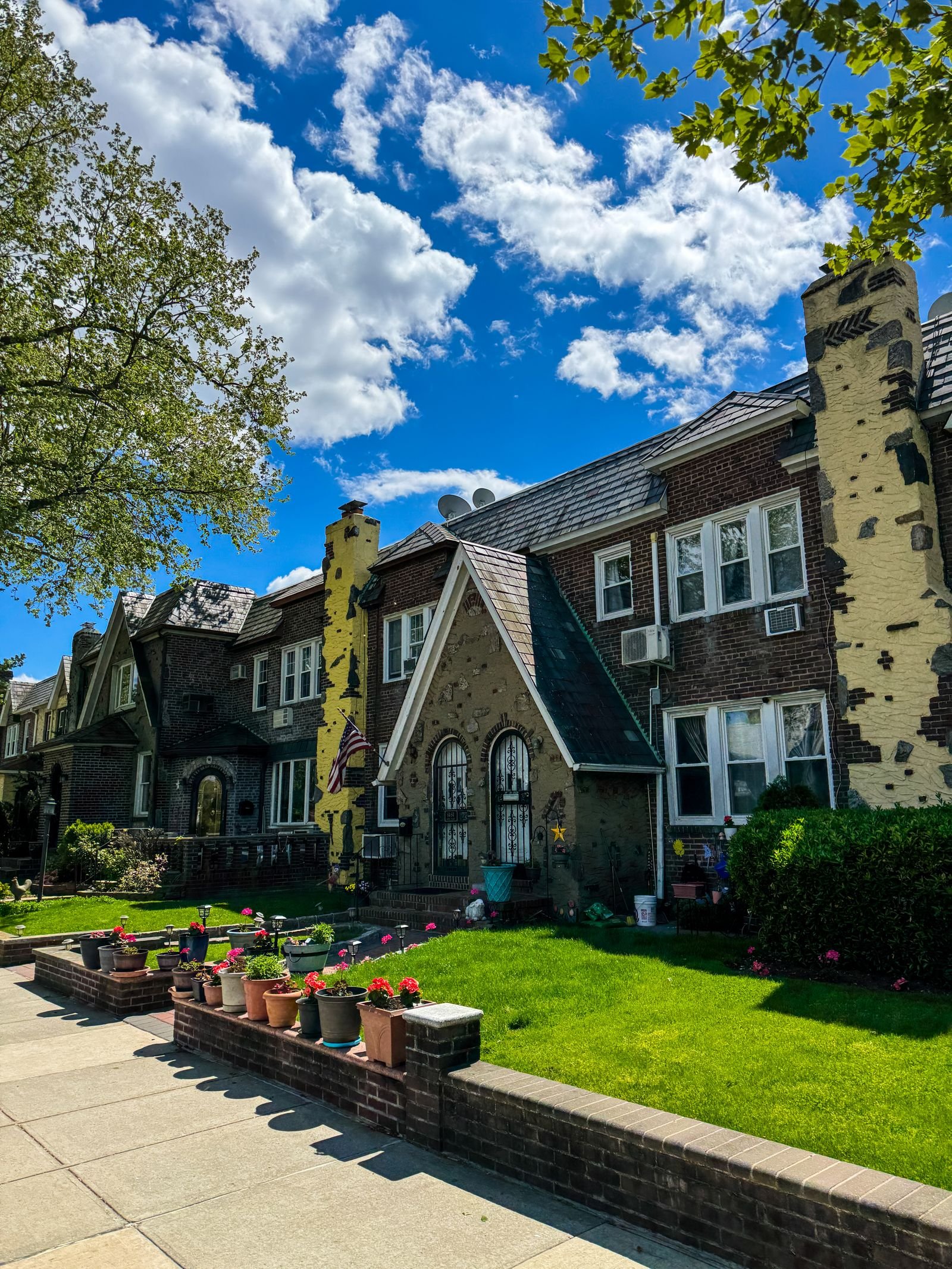
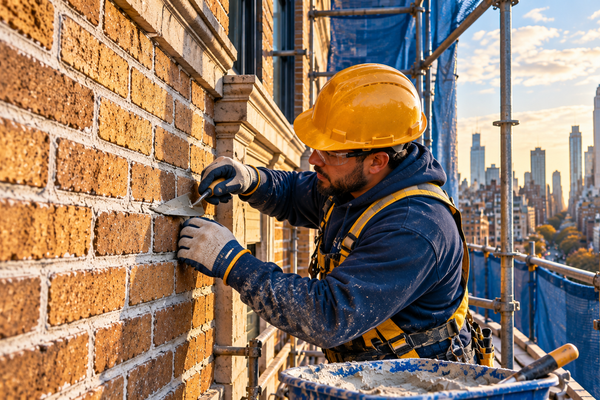
Harlem’s brownstone rows are the neighbourhood’s signature — the long stoops of Strivers’ Row and the Mount Morris Park Historic District, the carved lintels and cornices that give each block its rhythm. Brownstone is a soft, layered sandstone, and it forgives nothing: hard modern mortar traps moisture behind the face until it spalls, and aggressive cleaning strips the surface that took a century to patinate. That is why our approach starts with reading the stone — its colour, its bedding, the way it has weathered — before any repair is specified.
As masonry contractors in New York, we repair brownstone facades and stoops in kind: mortar matched softer than the stone itself, patching compounds matched in colour and texture, and replacement stone cut to the original profiles. Sills, lintels and cheek walls get the same treatment, because water entering at one failed joint travels through the wall and shows up somewhere else entirely.
The same discipline applies to the brick pre-war apartment houses along Harlem’s avenues, where brickwork and repointing keeps walls weather-tight, and to parapet wall repair at the roofline, where failed coping and flashing let water into the top of the wall. Every job begins with an inspection of the whole elevation, not just the defect you noticed first.
Harlem’s winters work on masonry in a particular city rhythm: snow piled against wall bases by plows, meltwater running down facades from roof edges and fire escapes, then a hard overnight freeze that drives the water deeper into every open joint. Brick, mortar and stone all absorb water; when it freezes it expands, and a wall that freezes and thaws dozens of times between November and March gradually breaks down from the inside out. The damage concentrates where water lingers: parapet tops, chimney crowns, the joints below window sills, north-facing walls that never dry, and the base of walls where snow sits all winter. Our guide to freeze-thaw masonry damage explains the cycle in full and the signs to catch early. The practical defence is the same as everywhere: sound joints, coping and flashing that shed water clear of the wall, and gutters and leaders discharging away from the masonry. Caught early, repointing alone stops most freeze-thaw damage; left alone, it becomes spalled brick and leaning garden walls.

Harlem’s masonry extends well beyond the house walls. The stoops are the most-used masonry in the neighbourhood — stone treads, cheek walls and railings carrying a century of feet — and they fail at the joints first: treads rocking, cheek walls cracking where the footing has settled, coping stones loosened by freeze-thaw. Custom masonry steps and entryways work restores them properly: footings corrected, treads reset or replaced, cheek walls rebuilt to match the original stone or brick. The same care goes to garden walls, areaway walls and the low retaining walls terracing the hillside streets, and to chimney repair and rebuilding where crowns and upper courses have weathered worst. Star Construction INC has worked on homes across the New York area since 2018. Request a free, no-obligation estimate and we will inspect, photograph and explain the options. You can see the areas we cover on our service areas page.
Our clients value the consistency, structural precision, and long-term performance we deliver on every project, from initial planning through final execution.

 Jav V
Trustindex verifies that the original source of the review is Google.
Got my bathroom remodel Team was professional on time Thank you Ever fernando Perez saldañaCrear Word
 LUIS CAYOi hire them for my home project. and everyting went smoothly. no delays
 Shahid IqbalVery reliable contractor. They did exactly what they promised and the quality was excellent. Would definitely recommend.
Contact us now to discuss your project and receive a no-obligation quote from our experts.
Every project is handled through a defined process that ensures accuracy, efficiency, and long-term structural performance from start to finish.
We begin by reviewing site conditions, understanding project objectives, and identifying structural requirements to establish a clear and practical direction before any work begins.
A detailed execution plan is developed, including material selection, sequencing of work, and coordination of labor to maintain consistency and avoid delays during construction.
Work is carried out using proven installation methods, with attention to structural integrity, proper reinforcement, and adherence to safety and quality standards.
A final walkthrough is conducted to verify workmanship, resolve any outstanding details, and ensure the completed project meets performance expectations and durability standards.
Beyond the brownstones, Harlem’s brick pre-war apartment houses line the avenues and side streets — six and seven stories of brick that have carried a century of tenants, weather and settlement. Their mortar joints are the first thing to go: a hundred freeze-thaw winters open them, water gets behind the face, and the brick starts to spall. Repointing is the repair that stops that cycle, but only when the mortar is matched to the original in strength, colour and joint profile. A mortar harder than the brick forces the brick to take the movement, and the brick loses. We cut failed joints back to sound mortar, match the mix, and repoint in the original profile, so the repair disappears into the wall and the wall can breathe again. Where brick has already spalled or cracked through, individual units are cut out and replaced with matching brick rather than patched over — a patch over a failed face fails with it. After repointing, masonry waterproofing and sealants can be applied where the wall needs extra protection, but never as a substitute for sound joints.
We test the existing mortar’s composition, colour and texture before mixing anything, then match it so the new joints read as part of the original wall — not as a patchwork of repairs.
Stair-step cracks following the joints usually mean settlement or thermal movement; vertical cracks running through the brick itself need a closer look. We read the pattern before recommending anything, because the crack tells you the cause.
A brick that has lost its face keeps absorbing water no matter what is smeared over it. Failed units are cut out and replaced with brick matched in size, colour and texture.
Joints are cut back to a proper depth, cleaned, and repointed in the original profile, then left to cure properly. Shallow smears over failed mortar are not repointing, and they do not last.
Brownstone is a soft, layered sandstone, not a fired brick. It absorbs water readily, and its surface layer can delaminate and spall when trapped moisture freezes or when hard modern mortar forces movement into the stone. Repairs use soft, compatible mortars and stone matched to the original, and cleaning is gentle — aggressive pressure washing or sandblasting strips the stone’s face permanently. Ordinary brick tolerates harder mortars and more aggressive methods; brownstone does not.
Yes, in most cases. A stoop that has settled because its footing has moved is usually rebuilt on a proper footing, with treads reset or replaced and cheek walls rebuilt to match the original stone or brick. Where only the joints or individual treads have failed, a partial rebuild may be enough. Cost depends on the extent of the rebuild and the stone chosen; we quote after inspecting the footing, not just the surface.
Look for mortar joints that are recessed, sandy to the touch, cracked along their centres, or missing in places; water staining below sills; and bricks whose faces are starting to flake. If you can rake loose mortar out of a joint with a key, the joint is overdue. A walk-around in autumn catches the joints that will take water all winter.
Repointing and rebuilding need mortar to cure, and fresh mortar must not freeze before it sets, so the coldest spells are not suitable for pointing work. Milder winter days can work with protection and suitable mixes, and inspection, planning and interior-facing preparation go ahead any time. We schedule pointing for conditions that let the mortar cure properly rather than risking a repair that fails by spring.
It depends on the scope. Structural work generally requires NYC Department of Buildings permits, and buildings in historic districts such as Mount Morris Park can also need Landmarks Preservation Commission approval for visible exterior changes, including changes to stone or mortar colour. Cosmetic repointing in kind usually does not. We confirm what your building needs before work starts so approvals are in hand.