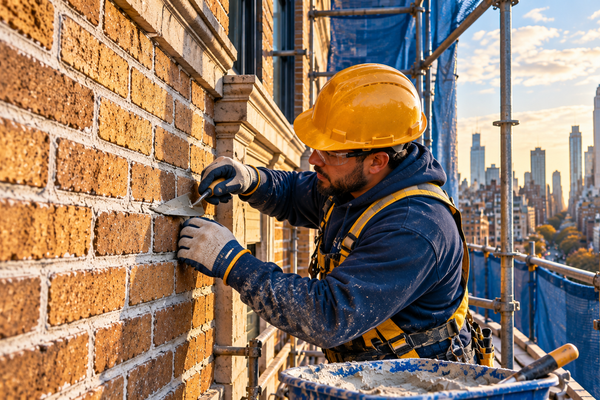
Star Construction INC has worked on masonry across the New York area since 2018, and Long Island City asks for the full range of that experience in a few square miles. At street level the work is the patient craft of the old industrial buildings: repointing in lime mortar, replacing spalled brick with units that belong to the era, and sealing the joints where a century of weather has opened them. Our masonry contractors in New York bring that same approach to every LIC building, whatever its age.
Above the podium line the work changes character but not discipline. Terrace and planter walls, parapet caps and podium facades on the towers need waterproofing details that hold under East River wind and driving rain, and repairs planned so residents and management are inconvenienced as little as possible. Where a terrace leaks, our masonry waterproofing and sealants work traces the entry point before anything is sealed, and where a parapet has moved or opened, our parapet wall repair team assesses whether repointing and new coping will hold or the wall needs rebuilding.
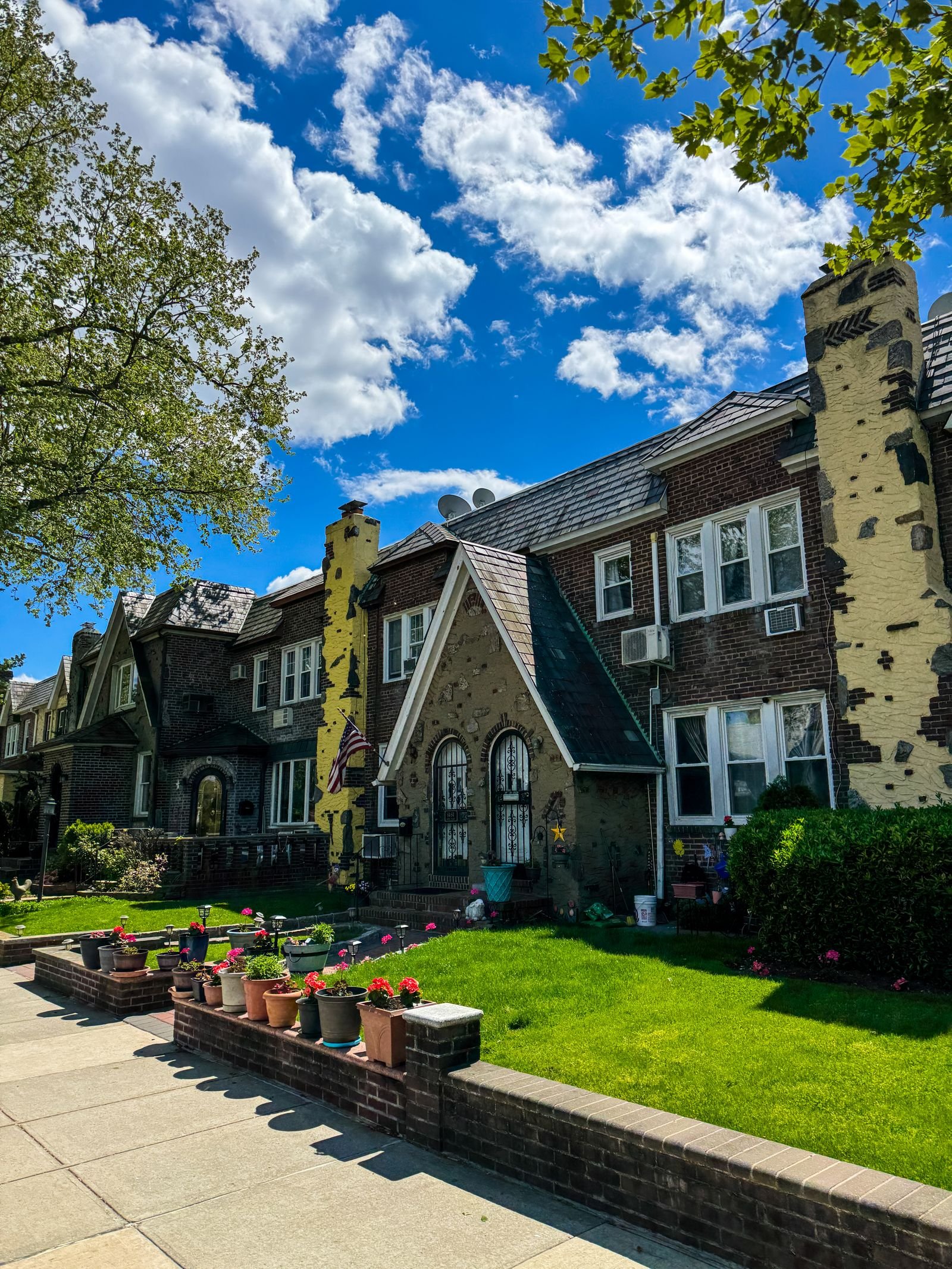
At ground level again, the low-rise pockets of Dutch Kills and the older side streets need the quieter masonry: stoops, steps, garden walls and driveways. Our custom masonry steps and entryways work and retaining walls and masonry planters are built to the same standard as the tower work — level, drained and matched to what is already there.
Masonry restoration in Long Island City starts with diagnosis, because the two building stocks fail differently. On the converted industrial buildings, the usual story is lime mortar that has weathered out of its joints over a century, sometimes worsened by later hard-cement patches that crack the softer brick around them. On the towers, the story is more often water: failed membrane and flashing details at terraces and parapets, planter walls that hold moisture against the structure, and podium facades that take wind-driven rain on every elevation.
A restoration scope therefore follows the building, not a template. It may mean raking out failed joints and repointing in a lime mortar matched for strength and colour — work our brickwork repointing team does across the city — or it may mean rebuilding a parapet course, renewing coping and flashing, and re-waterproofing a terrace assembly. Where stone or veneer is part of the elevation, decorative stone and veneer repairs are matched to the existing units rather than replaced wholesale.
In every case the sequence is the same: inspect, photograph, explain the options and the order of work, then repair the cause before the surface. A wall that looks repaired but still takes water is not repaired at all, and on a tower that water reaches someone’s home.

If you own, manage or live in a Long Island City building and the brickwork is opening, the terrace is leaking or the parapet needs attention, the first step is a conversation, not a commitment. Tell us what you are seeing — stains, cracks, loose coping, water after storms — and we will arrange an inspection, photograph what we find and explain the options in plain language, including where a smaller repair will genuinely hold.
You can see all the areas we serve on our service areas page, and read more about our wider masonry work from our masonry contractors in New York page. Star Construction INC has served homes and buildings across the New York area since 2018. Request a free, no-obligation estimate today and we will walk the building with you before any work begins.
Our clients value the consistency, structural precision, and long-term performance we deliver on every project, from initial planning through final execution.


 Trustindex verifies that the original source of the review is Google.
 Trustindex verifies that the original source of the review is Google.
 Trustindex verifies that the original source of the review is Google.
 Trustindex verifies that the original source of the review is Google.
Contact us now to discuss your project and receive a no-obligation quote from our experts.
Every project is handled through a defined process that ensures accuracy, efficiency, and long-term structural performance from start to finish.
We begin by reviewing site conditions, understanding project objectives, and identifying structural requirements to establish a clear and practical direction before any work begins.
A detailed execution plan is developed, including material selection, sequencing of work, and coordination of labor to maintain consistency and avoid delays during construction.
Work is carried out using proven installation methods, with attention to structural integrity, proper reinforcement, and adherence to safety and quality standards.
A final walkthrough is conducted to verify workmanship, resolve any outstanding details, and ensure the completed project meets performance expectations and durability standards.
Long Island City’s buildings reward a contractor who reads the building before quoting: its age, its materials, its exposure and its management rules. These are the four kinds of work our LIC masonry projects most often involve, and how we approach each one.
The converted warehouses and factories of Long Island City were built with brick meant to last and lime mortar meant to move. A century of weather, and sometimes decades of well-meaning but hard Portland-cement patching, leaves joints open, faces spalled and walls taking water. The repair starts with understanding what is already there: the brick’s hardness and colour, the mortar’s composition, and where the wall is actually failing versus where it only looks tired.
We rake out failed joints by hand where the brick is soft, repoint in a lime mortar matched for strength and colour, and replace only the units that have genuinely failed — sourcing replacements that belong to the era rather than the nearest modern equivalent. Our brickwork repointing work on these buildings is deliberately quiet: when it is done well, the wall reads as one wall again, and the next inspection finds joints that are tight and dry.
On the residential towers of Court Square and Hunters Point, masonry lives where the weather is worst: parapet caps at roof level, terrace walls and planters open to the sky, podium facades facing the river wind. Failures here are usually water failures — membranes and flashings that have reached the end of their life, coping that has loosened, joints that have opened under thermal movement — and the damage shows up far from its source, as a stain on a ceiling below or damp inside a planter wall.
Tower work is planned around the building as much as the wall: access agreed with management, protection for residents and passers-by, and sequencing that keeps terraces usable wherever possible. Our parapet wall repair and masonry waterproofing and sealants work is scoped from a full inspection of the assembly — brick, mortar, coping, flashing and the roof junction — so the repair addresses the entry point, not just the stain.
Long Island City winters are hard on masonry. Water enters a joint or a hairline crack in autumn, freezes and expands through the cold months, and by spring the joint has opened wider and the brick face has started to spall. Each cycle makes the next one worse, which is why a small crack left through one winter often becomes a repointing job the next, and a repointing job left through several winters becomes a rebuild. The river wind drives rain into elevations that would stay dry inland, so east-facing walls and parapets take the worst of it.
The defence is timing and material: repoint before the water has a full winter to work, use mortar that breathes and moves with the wall rather than trapping moisture behind a hard skin, and keep copings, flashings and drainage details doing their job. Our guide to freeze-thaw masonry damage explains the cycle in more detail, and our inspections in autumn are planned around catching the joints that will not survive another winter intact.
Away from the towers, Dutch Kills and the older low-rise streets hold the neighbourhood’s quieter masonry: front stoops and garden steps, low retaining walls, driveway edges and the small brick outbuildings behind the houses. These are the walls residents touch every day, and they fail in familiar ways — steps settling where drainage has undermined the base, retaining walls leaning where water has built up behind them, mortar washing out of joints that were never properly drained.
The work here is as careful as the tower work, at a different scale: rebuilding on a properly drained footing, matching brick and mortar to the house rather than the catalogue, and leaving edges and joints that will hold through winters of salt and freeze. Our custom masonry steps and entryways and retaining walls and masonry planters work is finished to be walked on, leaned on and lived with — and to look as if it had always been there.
Masonry is a maintenance item, not a fit-and-forget one, but a formal written plan is not a legal requirement for most buildings. What every Long Island City building benefits from is a simple rhythm: a visual check each spring, repointing of opened joints before winter, and copings, flashings and drains kept clear so water never gets the chance to sit against the wall. That rhythm catches small failures while they are still small.
For taller buildings, inspections also run on the facade inspection programme’s five-year calendar, and any repairs it calls for must be completed within the period the report states. After an inspection we can set out a sensible maintenance rhythm for your building — what to watch, what to do first, and what can wait — and a free, no-obligation estimate will explain what actually needs doing and in what order. The cost of any work depends on the scope found on inspection.
Look for mortar joints that are cracked, crumbling or sitting recessed behind the brick faces, bricks with spalled or flaking faces, white salt staining, or damp patches inside near the wall. A simple test tells you a lot: if a key or screwdriver easily rakes loose mortar out of a joint, that joint has failed. On older converted buildings, also watch for hard cement patches from earlier repairs cracking the softer brick around them.
If you are unsure, an inspection with photographs will show exactly which joints have failed and which are still sound. Repointing should only ever be quoted for the areas that need it — a whole elevation is not automatically required because one section has opened up. The cost depends on how much jointing has failed and how high or awkward the access is.
Terrace and planter walls sit in the worst spot on a tower: they hold soil and water against masonry, and they are exposed to weather on both faces. Water usually enters through failed coping joints, cracked mortar, or a waterproofing membrane that has failed behind the planter, then travels inside the wall and appears as a stain or damp patch below or inside the home. Soil piled above the flashing line, or drains that are blocked, makes it worse.
The fix has to address the entry point — coping, joints, membrane and drainage — not just the stain it leaves behind. That is why terrace leaks are diagnosed from the outside first: the visible damp inside is rarely where the water actually got in. The cost depends on how much of the assembly has failed and whether the membrane itself needs replacing.
Yes, with limits. Mortar must be kept above freezing while it cures, so winter work is scheduled around the forecast, with frost protection and temporary cover on exposed elevations. Repointing and small repairs can usually go ahead on milder days, and emergency work — a loose coping stone, an open joint letting water in — should not wait for spring.
Some work needs dry, warmer conditions and may be better deferred: terrace waterproofing and membrane work, for example, cannot be done properly in rain or freezing temperatures. Winter also slows the pace, which is worth knowing when a timeline is quoted. The cost depends on the scope, the access and the protection the conditions require.
It depends on the work. Cosmetic repointing and like-for-like repairs usually need no permit. Structural work — rebuilding a parapet, replacing a lintel, altering a wall — generally requires filings with the Department of Buildings, and your contractor should say so before work starts rather than after.
Buildings in the facade inspection programme follow its five-year calendar, and repairs called for by an inspection report must be completed within the period the report states. Landmarked buildings and buildings in historic districts can also need Landmarks approval for visible changes. The cost of any work depends on the scope found on inspection and the approvals it requires.