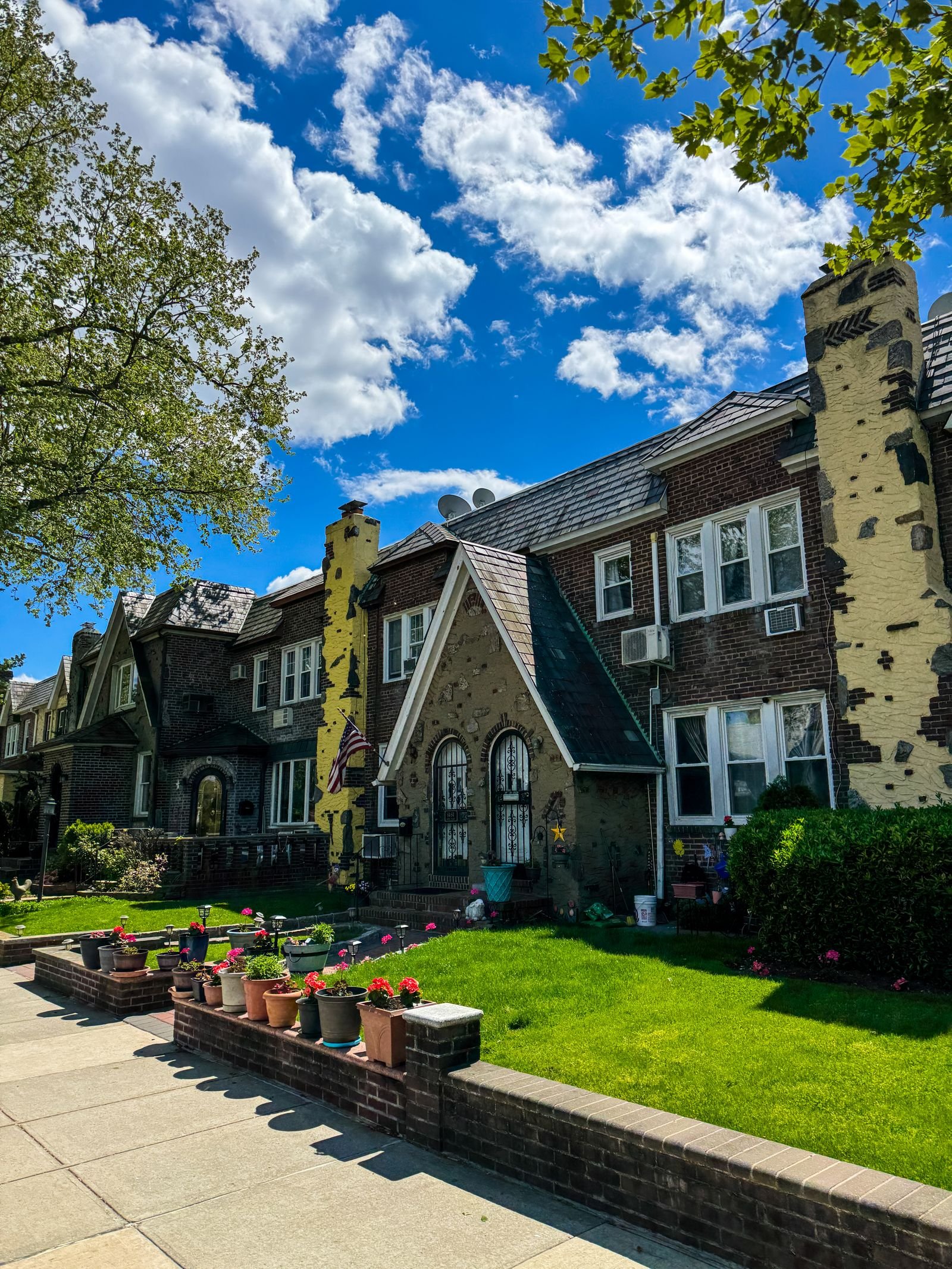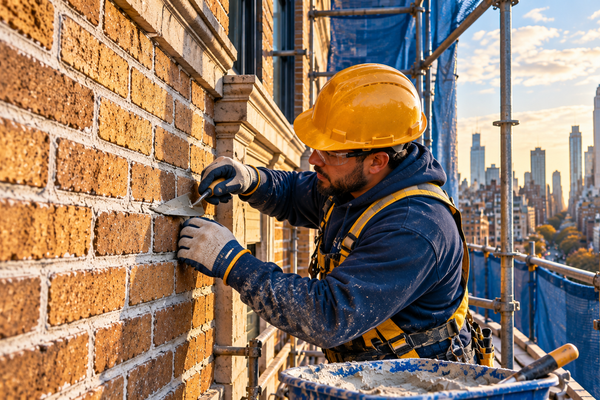
As masonry contractors in New York working across Westchester, we start every Mamaroneck job by reading the original work. The shore homes of Orienta and Shore Acres were built with their faces to the weather — brick and stone walls, broad chimneys, garden walls stepping down toward the water — while the houses along the Post Road and through the village carry the same traditional materials in a more sheltered setting. Both settings ask the same questions: which joints have worn back to the point of holding water, which bricks have begun to spall, and which walls are still sound enough that careful brick repointing with a matched mortar is all they need. Some walls here need more than repointing. A chimney that has lost its crown wash, a garden wall leaning off its footing, a stone foundation letting water through at the base — these are rebuilds or structural repairs, and we say so before quoting rather than dressing them up as pointing jobs. Where the wall is sound but wet, masonry waterproofing that still lets the wall breathe can be the right answer. Either way, the repair is matched to the house: same mortar character, same brick and stone, same joint profile, so the work disappears into the original wall.
Repointing sounds simple — take out the failed mortar, put new mortar in — but on a Mamaroneck house the mix is the whole job. The village’s older walls were laid in softer, lime-rich mortar that flexes with the seasons and lets moisture move out of the wall. Point those joints with a hard modern cement mortar and the joint stops being the sacrificial layer: moisture stays trapped, the brick face takes the freeze-thaw pressure instead, and the wall spalls faster than it would have with the old mortar left alone. That is why a shore home is the worst place for a generic pointing mix. We test the existing mortar’s composition, colour and texture before mixing anything, then match a softer, lime-based mortar to it and tool the joints to the original profile. The result is a repair that weathers at the same rate as the wall around it and stays invisible from the street. Sound brick repointing is the single most valuable repair a Mamaroneck wall can get: it stops water at the surface, protects the brick behind it, and buys the wall decades. Where bricks themselves have already spalled or softened beyond saving, we cut them out and replace them with matching units rather than smearing over them, because a brick that has lost its face will keep absorbing water no matter what is spread across it.

Mamaroneck’s masonry extends well beyond the house walls. Stone steps climb from the street to front doors across the village, garden walls terrace the sloping lots, and chimneys stand exposed to the same wind and salt as the walls — often more, because a chimney is weathered on every side at once. Steps that rock underfoot, a garden wall bowing along its length, a chimney crown cracked and shedding its wash: these are the jobs that get worse fastest when they are left, because every open joint is an invitation to water and frost. Small failures can often be answered with repointing and new coping or a rebuilt crown. Larger ones — a chimney stack that has lost its bond, a garden wall whose footing has washed out — need partial or full rebuilding, and the work follows that read. That is true of parapet walls at the roof edge too, which fail the same way for the same reasons. Our chimney repair and rebuilding work follows the same rule as everything else on this page: we say plainly which one your chimney needs before quoting. See all the areas we serve, and if you are comparing options, remember that Star Construction INC has been working on homes in the New York area since 2018.
Our clients value the consistency, structural precision, and long-term performance we deliver on every project, from initial planning through final execution.

 Jav V
Trustindex verifies that the original source of the review is Google.
Got my bathroom remodel Team was professional on time Thank you Ever fernando Perez saldañaCrear Word
 LUIS CAYOi hire them for my home project. and everyting went smoothly. no delays
 Shahid IqbalVery reliable contractor. They did exactly what they promised and the quality was excellent. Would definitely recommend.
Contact us now to discuss your project and receive a no-obligation quote from our experts.
Every project is handled through a defined process that ensures accuracy, efficiency, and long-term structural performance from start to finish.
We begin by reviewing site conditions, understanding project objectives, and identifying structural requirements to establish a clear and practical direction before any work begins.
A detailed execution plan is developed, including material selection, sequencing of work, and coordination of labor to maintain consistency and avoid delays during construction.
Work is carried out using proven installation methods, with attention to structural integrity, proper reinforcement, and adherence to safety and quality standards.
A final walkthrough is conducted to verify workmanship, resolve any outstanding details, and ensure the completed project meets performance expectations and durability standards.
Mamaroneck’s weather is not harsher than inland Westchester in any single way — it is harsher in combination. Salt rides the breeze off the Sound and settles into brick and mortar; wind-driven rain pushes it deep; then sun and wind dry the surface, and the salt crystallises inside the pores, prying at the material from within. The cycle repeats all year, and each repetition leaves the joint a little weaker and the brick face a little softer. Add winter freeze-thaw masonry damage — water in the joints freezing, expanding and widening every hairline crack — and a shore wall ages noticeably faster than the same wall five miles inland. The signs are easy to miss at first: a white bloom of efflorescence, mortar that sands away under a fingertip, a brick edge that has started to round. They are the wall telling you, early, that it needs attention.
The white bloom on a shore wall is salt left behind when water evaporates out of the masonry. A faint bloom on a new wall is usually harmless, but a heavy, recurring bloom on an older Mamaroneck wall means water is moving through it constantly, carrying salts from the mortar and the shore air with it. The answer is not a coating: it is finding where the water enters and stopping it, then letting the wall dry. Coatings that seal the salt inside only move the damage deeper, which is why any masonry waterproofing used here must still let the wall breathe.
A Mamaroneck wall does not get wet evenly. The elevations facing the Sound and the prevailing wind take rain driven hard into the joints, while sheltered elevations stay comparatively dry. A wall that is saturated for days after every storm is a wall whose joints have opened enough to hold water — and saturated brick is exactly what winter frost attacks. Repointing the windward elevation first, and renewing the flashing and coping that shed water clear of the face, is often the highest-value repair on a shore house. Stone and veneer facings need the same care: decorative stone and veneer installation near the water must be detailed so wind-driven rain cannot sit behind the facing.
Winter at the shore is a freeze-thaw machine: mild days melt snow and rain into every open joint, and the night freeze expands that water by roughly a tenth, prying the joint wider. A wall that never fully dries between cycles — and a shore wall often does not — can freeze and thaw dozens of times in a single season. The damage shows first as mortar loss, then as spalled brick faces, and it moves fastest on chimneys, parapets and garden walls that are exposed on every side. The defence is the same as everywhere else, only more urgent: sound joints, shed water, and repairs made before winter, not after it.
Coping stones, sills, steps and garden walls are the horizontal surfaces where shore weather collects: salt spray settles, rain sits, ice forms. A coping stone that has cracked along its layers, a sill that has split, a step tread that rocks — each is a small failure that lets water into the wall below. Near the water these details deserve as much attention as the walls themselves, and on sloping shore lots the retaining walls and masonry planters that terrace the ground toward the Sound are part of the same system: when their joints open, the soil and water behind them start to push. We repair these the same way as the walls — matched materials, joints tooled to the original profile, water detailed away.
Look for mortar joints that are recessed, sandy or cracked; brick faces flaking or spalling; white efflorescence that keeps coming back; and damp patches or blown plaster on the inside of an exterior wall. On shore homes, check the windward elevation and the chimney first — they weather fastest. If you are unsure, an inspection will tell you whether the wall needs repointing, local brick replacement or a rebuild, and what can simply be watched.
Salt carried on the breeze settles into brick and mortar, and each wet-dry cycle leaves crystals in the pores that pry the material apart from within. Over time the mortar erodes, the brick face softens and spalls, and joints open enough to hold water — which then makes winter freeze-thaw damage worse. The effect is gradual but relentless, which is why shore walls need their joints checked more often than inland walls.
Yes. We test the existing mortar’s composition, colour and texture before mixing anything, then match a softer, lime-based mortar to it and tool the joints to the original profile. The repair weathers at the same rate as the surrounding wall and stays invisible from the street. What damages an old wall is the opposite: a hard modern cement mortar that traps moisture in the softer historic brick.
It depends on the scope. A single elevation or a chimney can often be repointed in a few days; a full house takes longer, and a wall that also needs brick replacement or rebuilding takes longer still. After inspection we give a realistic timeframe for your house specifically, rather than a generic promise, and the cost depends on the scope of the work.
Most like-for-like repair work, such as repointing, does not usually require a permit, but larger structural work, rebuilds and work in certain areas of the village may need village or town approval. We will tell you honestly what your job needs before work begins, so there are no surprises.