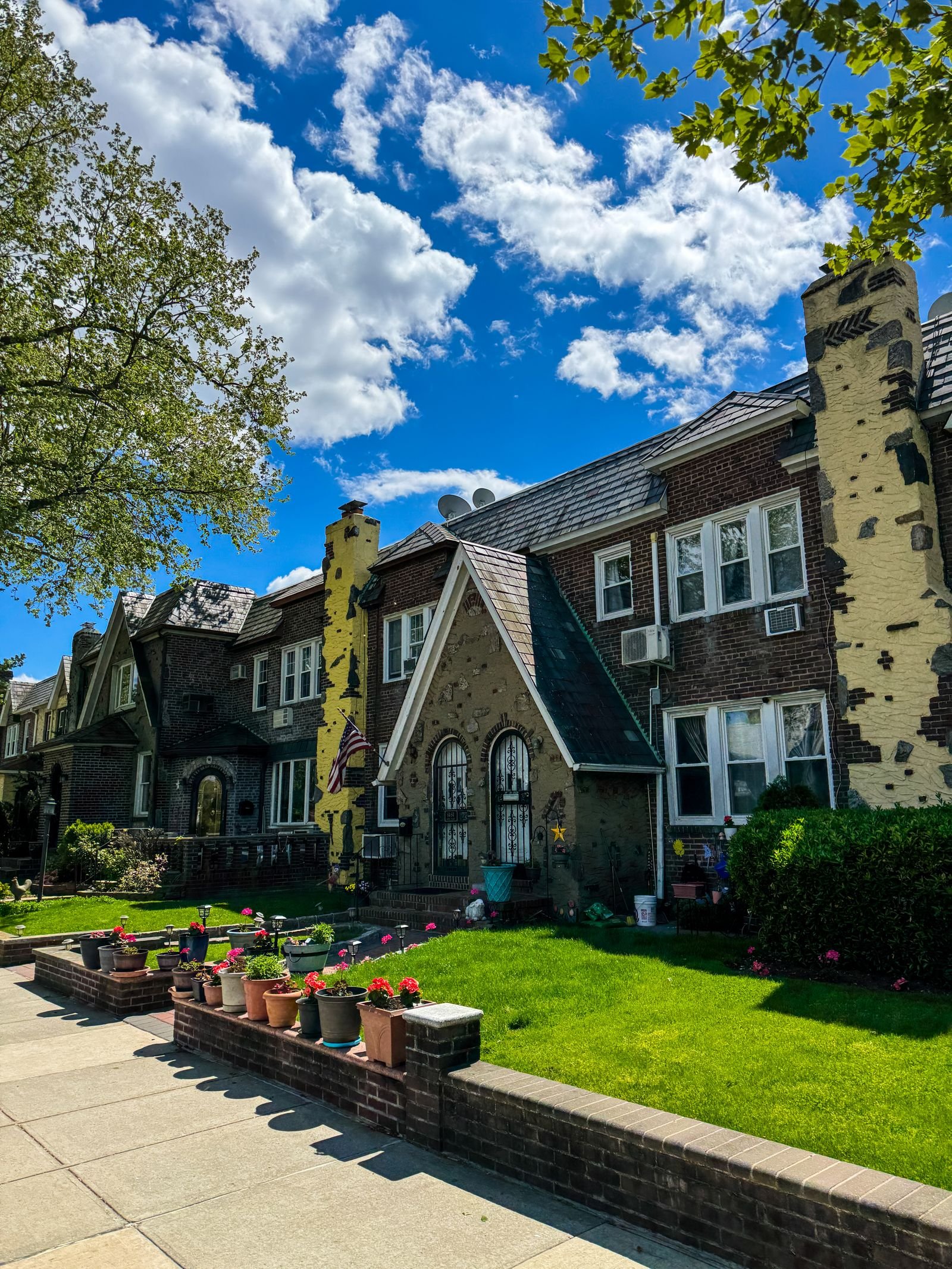
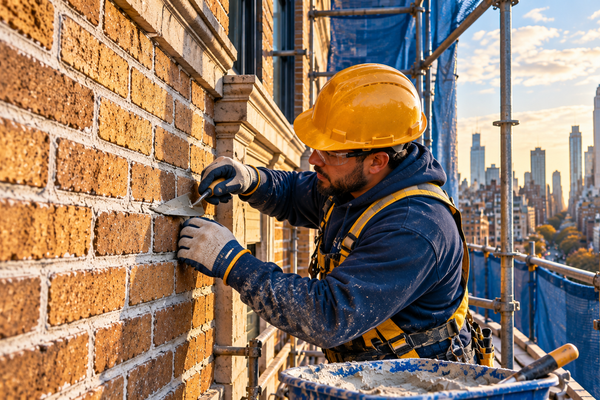
Manhattan’s masonry is the city’s oldest working fabric: brick laid when the avenues were new, brownstone fronts carved for townhouse rows, limestone trim on pre-war apartment buildings, and parapets that have stood over a century of winters. Our masonry contractors repair that fabric in kind — matched mortar, matched stone, and details rebuilt the way they were built.
Pointing is the core of the work. When mortar joints open, water enters the wall, and every freeze widens the damage; our brickwork repointing contractors cut out failed mortar to sound depth and repack it with a mix matched to the original in strength and color, so the joint stays the wall’s sacrificial layer. The same discipline governs chimney stacks, where our chimney repair and rebuilding contractors rebuild crowns, repoint joints, and renew flashing, and the areaway and retaining walls and masonry planters that hold back the front gardens of raised townhouses.
Star Construction INC has repaired masonry across the New York area since 2018. Request a free, no-obligation estimate and we will inspect the elevation, explain what is surface and what is structure, and quote the repair honestly.
Masonry work is the construction, repair, and restoration of brick, stone, and block. In Manhattan that work covers the full life of a building’s exterior: repointing mortar joints, replacing damaged brick and stone units, rebuilding parapets and chimney stacks, repairing brownstone and limestone, and rebuilding the stoops and areaway walls that frame a townhouse entrance. It also covers the structural side — load-bearing brick walls, foundation masonry, and the garden and retaining walls that shape a property’s grade.
What makes Manhattan masonry different is density and age. Buildings stand wall to wall, so water that enters one elevation affects its neighbors, and repairs must be staged around occupied homes and businesses. The materials are old — soft brick laid with lime-rich mortar, brownstone that delaminates in layers, limestone that sugars with age — and each demands its own repair: mortar softer than the brick it beds, patching compounds matched to the stone, and details rebuilt rather than covered over. Done properly, masonry repair is invisible; the wall simply reads as it always did, and the water stays outside.

If you are searching for trusted masonry contractors near you in Manhattan, start with an inspection, not a quote. At Star Construction INC, we walk the elevation with you, photograph what we find, and explain which repairs are urgent, which can be phased, and which are cosmetic. Our masonry contractors in Manhattan have worked on townhouses, pre-war apartment buildings, and taller buildings across the borough since 2018, and we price the preparation and the repair honestly, in writing, before work begins.
Request a free, no-obligation estimate today. The areas we cover are on our service areas page.
Our clients value the consistency, structural precision, and long-term performance we deliver on every project, from initial planning through final execution.

 Jav V
Trustindex verifies that the original source of the review is Google.
Got my bathroom remodel Team was professional on time Thank you Ever fernando Perez saldañaCrear Word
 LUIS CAYOi hire them for my home project. and everyting went smoothly. no delays
 Shahid IqbalVery reliable contractor. They did exactly what they promised and the quality was excellent. Would definitely recommend.
Contact us now to discuss your project and receive a no-obligation quote from our experts.
Every project is handled through a defined process that ensures accuracy, efficiency, and long-term structural performance from start to finish.
We begin by reviewing site conditions, understanding project objectives, and identifying structural requirements to establish a clear and practical direction before any work begins.
A detailed execution plan is developed, including material selection, sequencing of work, and coordination of labor to maintain consistency and avoid delays during construction.
Work is carried out using proven installation methods, with attention to structural integrity, proper reinforcement, and adherence to safety and quality standards.
A final walkthrough is conducted to verify workmanship, resolve any outstanding details, and ensure the completed project meets performance expectations and durability standards.
Manhattan rewards one masonry discipline at every scale, from a townhouse stoop to a tower parapet: diagnose by material, repair in kind, and waterproof the details. The four sections below follow that discipline through the work Manhattan buildings actually need.
Pointing is where most Manhattan masonry budgets are spent, and where most of the value is. Pre-war brick was laid with soft, lime-rich mortar that was designed to weather before the brick did; a century later, those joints are recessed, cracked, or sandy, and the wall is drinking rain. Our crews cut failed mortar out to sound depth — roughly twice the joint’s width — clean and dampen the joint, and pack in new mortar matched to the original in strength, sand, and color, then tool it to the original profile. The repair disappears into the wall, and the water stays out.
Facade masonry goes further: replacing spalled and cracked units, rebuilding sections where stepped cracking shows movement, and renewing the flashing lines and lintels that keep water from sitting in the wall. Manhattan’s winters punish shortcuts — freeze-thaw damage widens every crack it finds — so we judge each elevation honestly: what can be pointed, what must be rebuilt, and what can wait.
Brownstone is Manhattan’s signature masonry — and its most misunderstood. The stone is a soft sandstone, laid in layers that peel and delaminate when water gets behind the face. Sound stone can be patched in kind: the failed layer is cut back to solid material, and a patching compound matched in color and texture is built up and tooled to the original profile. Stone that has lost its face entirely is cut out and replaced with matching brownstone, carved to the original detail. The wrong repair — a hard cement smear over a soft stone face — traps moisture and speeds the failure it was meant to fix.
Limestone plays a quieter role on Manhattan facades: trim, lintels, sills, and entry surrounds. It sugars and erodes with age, and its repair follows the same rule — clean gently, patch in kind, replace only what is spent. Our brownstone facade restoration work follows that discipline, and on landmarked and period facades the goal is the same: restore the original appearance in matching materials, with no change to the building’s character.
Parapets are the most weather-beaten masonry on any Manhattan building: a low wall rising past the roofline, taking wind, rain, and freeze on three sides at once. Its failures start at the top — a coping stone loosened by freeze and thaw, a flashing line opened a quarter inch, mortar joints turned to funnels — and announce themselves below as ceiling stains and bubbling plaster. Repair means working the whole assembly: repointing and rebuilding the wall where it has failed, resetting coping with proper through-wall flashing, and sealing the roof edge behind it, so the stain does not come back next season.
Stoops and areaway walls take a different beating: foot traffic, street salt, and the daily wetting of a city sidewalk. Treads wear and spall, cheek walls crack, and areaway walls bow where soil and water press from behind. We rebuild treads and walls in matching brick and stone, reset railings on sound footings, and correct the drainage at the base of the run, so the entrance that greets visitors is also the entrance that sheds water properly.
Manhattan’s taller buildings live under a different regime. Buildings over six stories fall under the city’s Facade Inspection and Safety Program (FISP): a Qualified Exterior Wall Inspector (QEWI) inspects the facades on a cycle and files the report with the Department of Buildings. Star Construction performs repairs only — we do not inspect or file — but the repair scopes that follow those reports are our work: parapet rebuilding, facade masonry and repointing, coping and flashing renewal, and the correction of conditions the inspection flagged.
That division of labor matters for owners and boards: the QEWI’s report sets the scope, and our crews execute it, coordinated around occupied buildings, sidewalk sheds, and the access the work requires. Repairs are phased honestly — conditions that affect safety first, the rest in planned order — and documented as they are completed, so the building’s file stays clear.
Look at the joints: mortar recessed well back from the brick face, cracked, crumbling, or sandy to the touch, damp appearing indoors after rain, and early stepped cracks at corners all say the joints have stopped sealing the wall. On a Manhattan building, also watch for spalled brick faces and staining below parapets — both point to water entering through failed joints or coping. A mason’s inspection confirms how deep the failure goes and whether pointing alone will do, or whether units and flashing need work too.
Usually, yes. Sound brownstone is patched in kind: the failed layer is cut back to solid stone, and a patching compound matched in color and texture is built up to the original profile. Stone that has lost its face or delaminated deeply is cut out and replaced with matching brownstone carved to the original detail. Full replacement of a brownstone front is rare and expensive; most fronts are saved section by section. Cost depends on how much stone is spent and how much carved detail must be reproduced.
FISP is New York City’s Facade Inspection and Safety Program. Buildings over six stories must have their facades inspected on a cycle by a Qualified Exterior Wall Inspector (QEWI), who files the report with the Department of Buildings. The report lists conditions that need repair, and contractors carry out those repair scopes — parapet rebuilding, facade masonry, coping and flashing work. Star Construction performs repairs only; we do not inspect or file. If your building has an open FISP condition, the repair scope and its timing come from the filed report.
Many repairs can — parapet stabilization, caps, and urgent weather-tightening proceed in most weather — but mortar work needs temperatures that let mortar cure rather than freeze, so deep-winter repointing is often staged: make the wall weather-tight now, complete the mortar work in the first mild spell. Brownstone patching follows the same rule, since patching compounds also need proper curing conditions.
In general New York City terms, structural work, parapet rebuilding, and facade work on taller buildings generally involve Department of Buildings permits and approvals, and occupied-building work may need additional coordination. Like-for-like repointing and small repairs are usually simpler. Your contractor should explain what your building’s work requires before quoting, since the answer depends on the building’s height, the scope, and whether the work changes structure or appearance.