
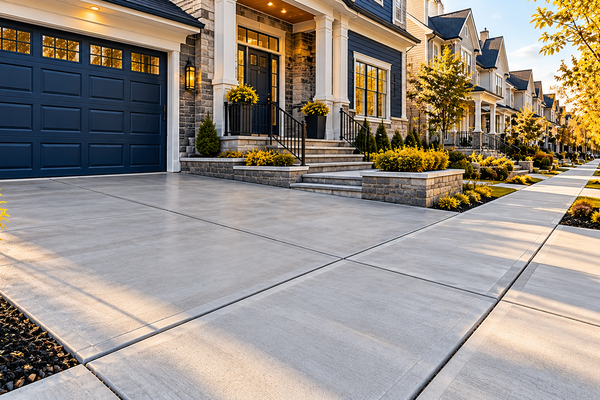
Every sidewalk in Harlem belongs to a maintenance story. Under New York City’s rules, the owner of the adjoining property — not the city — must keep the sidewalk in good repair, and the Department of Transportation inspects it, issues violations for defects, and can repair the worst cases itself and bill the owner. As sidewalk and driveway contractors working across the city, we see the same defects on Harlem’s avenues and brownstone blocks again and again.
The defect list is short and familiar. Flags lifted by the roots of the street trees that shade so many Harlem blocks; sections cracked by freeze and thaw or settled where the ground beneath has washed out; trip edges where one flag now sits higher than its neighbour, especially along the brownstone areaways where the pavement meets steps and railings. Tree root sidewalk damage repair is its own discipline: the root cannot simply be cut away without harming the tree, so the repair has to work around the root — grinding, partial replacement, or a new flag laid to a level the root can live with.
The honest starting point is an inspection of every flag, not a quote for the whole run. Some sections can be ground level or patched; others need partial or full replacement, and we say which before quoting. You can see the areas we cover on our service areas page, and Star Construction INC has worked on homes across the New York area since 2018.
Not every damaged flag needs to come out. Where a flag has lifted only slightly, grinding the raised edge down can remove the trip hazard and restore a level surface without disturbing the pavement around it. Where a slab is cracked but still sound and well supported, a patch can hold for years — though patching over a slab that is still moving underneath only postpones the real repair.
Individual flags that are broken, settled or undermined are replaced one by one: the damaged flag is cut out, the base beneath it is checked and re-compacted, and a new flag is poured to match its neighbours. This is the right answer for most of the flags on a Harlem pavement — the defect is local, so the repair is local.
Full replacement is for the stretches where the pavement has failed as a system: sections that have settled together, flags broken across their whole run, or slabs sitting on voids where the ground beneath has gone. Sidewalk repair and replacement in that case is a fresh build — excavation, a properly compacted base, and a pour that is given the curing time it needs. The honest read is the whole point of the inspection: we will tell you which flags can be saved and which cannot, and quote each option plainly, rather than selling replacement for everything.
One caution that applies to all four options: a repair that ignores what is underneath — a root still pushing, a base still washing out — will fail again in the same place. That is why the base and the cause are part of every repair we quote, not an extra. Where the damage is a crack in a sound slab rather than a failed flag, concrete crack repair may be the proportionate answer, and we will say so when it is.

Replacement starts before any demolition: we measure and photograph the whole run, flag by flag, and agree the scope in writing — which flags come out, which stay, and what the finished levels will be. On a Harlem pavement that survey also includes the question that does not arise on newer streets: what lies underneath. Vaults and coal chutes run under some of the neighbourhood’s older sidewalks, and a flag that sits over a vault is not demolished the way an ordinary flag is — the vault’s structure has to be understood and protected, or the replacement designed around it. Finding that out during the survey is cheap; finding it out under a jackhammer is not.
With the scope agreed, the DOT permit is arranged — sidewalk work in New York City generally requires one, and it is handled as part of the project, not left to the owner. Demolition follows, then the base: excavation to the right depth, a compacted sub-base, and forms set true to the levels of the surviving flags and the kerb. The pour is concrete to the city’s standard, finished, jointed and given its curing time before it is walked on.
For the owner, the disruption is short. A typical run of flags is a day or two of work, and the new pavement is walkable within 24 to 48 hours of the pour, weather permitting. What takes longer is the paperwork around it — permits, and a dismissal inspection where a violation notice is open — and both are part of the job, not an afterthought. Where the replacement also involves the driveway apron or the kerb cut at the street, driveway installation and resurfacing is the trade that handles that junction, and the two are sequenced together so the street edge finishes in one piece. And where the work touches the wider concrete of the property — stoops, areaways, cellar floors — our concrete repair and installation contractors in Harlem carry that part of the job, so the pavement and the building meet properly.
Our clients value the consistency, structural precision, and long-term performance we deliver on every project, from initial planning through final execution.

 Jav V
Trustindex verifies that the original source of the review is Google.
Got my bathroom remodel Team was professional on time Thank you Ever fernando Perez saldañaCrear Word
 LUIS CAYOi hire them for my home project. and everyting went smoothly. no delays
 Shahid IqbalVery reliable contractor. They did exactly what they promised and the quality was excellent. Would definitely recommend.
Contact us now to discuss your project and receive a no-obligation quote from our experts.
Every project is handled through a defined process that ensures accuracy, efficiency, and long-term structural performance from start to finish.
We begin by reviewing site conditions, understanding project objectives, and identifying structural requirements to establish a clear and practical direction before any work begins.
A detailed execution plan is developed, including material selection, sequencing of work, and coordination of labor to maintain consistency and avoid delays during construction.
Work is carried out using proven installation methods, with attention to structural integrity, proper reinforcement, and adherence to safety and quality standards.
A final walkthrough is conducted to verify workmanship, resolve any outstanding details, and ensure the completed project meets performance expectations and durability standards.
A DOT sidewalk violation notice is not a fine, and it is not the end of the story — it is a list. The notice names the property and lists the defects flag by flag, and the owner is expected to arrange a compliant repair within the period the notice states. Once the work is done, a dismissal inspection confirms the defects are cured. Owners who want help with that sequence often look for DOT violation removal support: inspection, compliant repair, and the dismissal inspection at the end. The four points below are what every Harlem owner should understand before the clock starts running.
Start by reading the notice itself, not by guessing at the pavement. The notice lists the defects flag by flag — lifted sections, cracked flags, trip edges — and names the section of sidewalk they sit on. Walk the pavement with the notice in hand and match each item to the actual flags before assuming the scope: some items may already have been ground or patched, some may have worsened since the inspection, and knowing which is which is what makes the repair quote honest.
The notice gives a stated period within which the owner must arrange a compliant repair, and the clock runs from the notice date, not from when the work feels convenient. Starting early matters: permits take time, scheduling takes time, and a repair rushed at the deadline is where corners get cut. Treat the notice as a project with a deadline, and the first step — an inspection and a quote — costs nothing and takes a few days, not weeks.
The repair must meet the city’s standard: the right materials, levels and joints, flags laid true and trip-free, so that the follow-up inspection can dismiss the violation. A patch that looks tidy but sits proud of its neighbours, or a replacement laid to the wrong level, will not clear the notice — it will simply earn a second visit. This is why the inspection comes before the quote: the work has to be specified to pass, not just to look done.
If nothing is done, the city may repair the defects itself and bill the owner for the work — and the bill is rarely cheaper than arranging the repair yourself. Worse, while the notice sits open, the owner remains liable for trip-and-fall claims on the defective flags. An open violation is not a paperwork problem to postpone; it is an open risk on the pavement in front of the building, and it only grows more expensive with time.
Under New York City’s rules, the property owner maintains the sidewalk adjoining the property — the city inspects it and issues violations for defects, but the duty to keep it safe and in good repair sits with the owner, not the city. That is why a lifted flag or a trip edge in front of a Harlem brownstone or apartment building is the owner’s repair to arrange, and why an open defect can leave the owner liable if someone trips on it.
Read the notice first: it lists the defects flag by flag. Arrange a compliant repair within the stated period — an inspection and a quote are the first step, and starting early leaves time for permits and scheduling. Once the repair is complete, a dismissal inspection clears the notice. If nothing is done, the city may repair the defects itself and bill the owner, and the liability for the defective flags stays with the owner in the meantime.
Sometimes, and the inspection decides which. A small lift can be ground level, a sound but cracked slab can be patched, and a single broken or settled flag can be replaced on its own. Full replacement is for the stretches where the pavement has failed as a system — sections settled together, flags broken across their run, or slabs over voids. An honest contractor will tell you which flags can be saved and which cannot before quoting, rather than selling replacement for everything.
For the owner, the disruption is short: a typical run of flags is a day or two of work, and the new pavement is walkable within 24 to 48 hours of the pour, weather permitting. The overall timescale depends on the size of the run, the permit, and whether anything unexpected — a vault, a coal chute, a washed-out base — is found underneath. Where a violation notice is open, allow time for the dismissal inspection after the work as well.
Yes — sidewalk work in New York City generally requires a DOT permit, and it is normally arranged as part of the project rather than left to the owner. Minor work such as grinding a trip edge may not need the same permitting as a full replacement; your contractor should confirm what applies to your job before work starts.


