
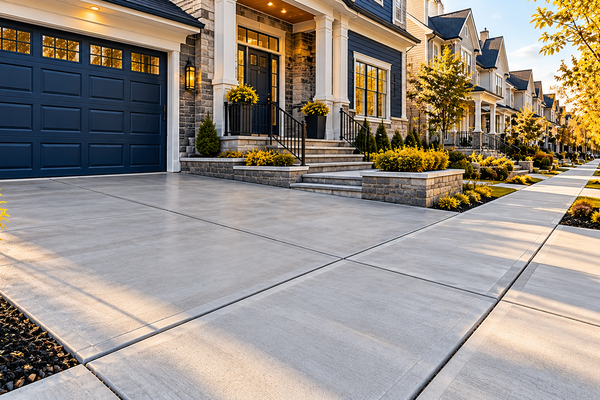
Our sidewalk and driveway contractors in Hastings-on-Hudson work the run as a whole — the stepped walk from the street, the apron where it meets the road, and the driveway climbing behind it — because on a hillside these are one drainage system, not three separate pours. Before any slab is priced, we walk the slope it sits on: where the water runs in a hard rain, where the street trees have lifted the walk, and how the grades carry a pedestrian safely down a hill that ices in January.
The village’s walks fail in the slope’s own ways. Our sidewalk repair and replacement work handles the stepped runs flight by flight, while tree root sidewalk damage repair deals with the slabs the canopy has lifted, and concrete crack repair closes the cracks that let water and frost into the slab. On the driveway side, our driveway installation and resurfacing work — including asphalt driveway repair where asphalt is the honest material — is graded for the hill first and finished second, so the new surface drains to the street rather than toward the house.
Where a walk or driveway meets the concrete of a patio, terrace or steps, we plan it alongside our concrete repair and installation contractors in Hastings-on-Hudson, so the whole property’s concrete shares one drainage logic. Star Construction INC has served Westchester homeowners since 2018, and every Hastings sidewalk and driveway job begins the same way: a measured walk of the run, an honest assessment of which slabs can be saved, and a free, no-obligation estimate before any work is quoted.
Sidewalk and driveway construction on a Hastings hillside is concrete work governed by grade. A sidewalk here is not a flat strip: it is a stepped run of slabs, flights and landings that must stay safe and walkable on a slope, shed water without sending it toward a foundation, and hold its levels through winters of freeze and thaw. A driveway is the same problem at a larger scale — a surface that must carry cars up a grade, drain to the street, and stay sure-footed in ice. Both are built from the base up: excavation, a compacted and drained base, forms set to the grade, and joints cut where the slab needs to move.
Repair follows the same logic in reverse. A lifted slab is judged by its cause — root, settlement or undermined base — before any fix is chosen, because grinding a slab that is still moving, or patching a slab whose base has washed away, buys a season and charges twice. Replacement, when it is the honest answer, means taking the failed section out, correcting the base and the grade, and pouring a section that matches its neighbors in finish and level. On a stepped hillside run, that matching matters twice: every new slab must meet the flights above and below it at a safe, even step.
For Hastings homeowners the practical point is that the walk, the apron and the driveway are one system. Poured and graded together, they drain as one; repaired piecemeal without regard to grade, they fight each other every winter.

If you are searching for reliable sidewalk and driveway contractors in Hastings-on-Hudson, start with the walk, not the quote. A contractor who has not measured the run — the flights, the landings, the apron angles, the way water moves across the slope — cannot tell you honestly which slabs can be saved and which must be replaced. That measurement is the service: it turns a guess into a plan, with grades, drainage and joints agreed before any concrete is ordered.
Star Construction INC has served Westchester homeowners since 2018, and our Hastings sidewalk and driveway work follows one rule — grade and drainage first, finish second, and the whole run planned as one system. Whether the job is a stepped walk, a steep driveway, an apron at a difficult street angle or a slab-by-slab repair program, we explain what the hill is doing to each surface and price the work honestly, with no obligation. See the full range of areas we cover on our service areas page, then request a free, no-obligation estimate and we will measure the run with you.
Our clients value the consistency, structural precision, and long-term performance we deliver on every project, from initial planning through final execution.

 Jav V
Trustindex verifies that the original source of the review is Google.
Got my bathroom remodel Team was professional on time Thank you Ever fernando Perez saldañaCrear Word
 LUIS CAYOi hire them for my home project. and everyting went smoothly. no delays
 Shahid IqbalVery reliable contractor. They did exactly what they promised and the quality was excellent. Would definitely recommend.
Contact us now to discuss your project and receive a no-obligation quote from our experts.
Every project is handled through a defined process that ensures accuracy, efficiency, and long-term structural performance from start to finish.
We begin by reviewing site conditions, understanding project objectives, and identifying structural requirements to establish a clear and practical direction before any work begins.
A detailed execution plan is developed, including material selection, sequencing of work, and coordination of labor to maintain consistency and avoid delays during construction.
Work is carried out using proven installation methods, with attention to structural integrity, proper reinforcement, and adherence to safety and quality standards.
A final walkthrough is conducted to verify workmanship, resolve any outstanding details, and ensure the completed project meets performance expectations and durability standards.
Sidewalk and driveway work on a Hastings hillside pays for itself in the falls it prevents and the winters it survives. A run graded for the slope stays safe underfoot in ice, keeps water away from foundations and cellars, and holds its levels instead of heaving, settling and cracking a season after it was poured. The four sections below follow the work as Hastings homeowners actually meet it: the stepped walks and the duty that comes with them, the root lift and trip edges judged honestly, the steep driveways and their materials, and the drainage that decides whether any of it lasts.
In most Westchester villages the sidewalk in front of a house is the adjoining owner’s to maintain, and in Hastings that duty comes with a slope. The village’s walks step down hillsides in flights and landings, and each flight must hold a safe, even step while shedding water that arrives from uphill. A walk that ponds at a landing, tilts toward a foundation or loses its edge to runoff is not just unsightly — on a hill it is the difference between a safe descent and a fall.
The duty also has a practical edge: a village can require a dangerous walk to be repaired, on a schedule not of the owner’s choosing. The honest approach is to walk the run regularly, note the slabs that are moving, and repair them on your own timetable — section by section where the walk allows it — rather than waiting for a notice to force the whole run at once. Our estimates separate what must be done now from what can wait, so the duty is met without panic.
On a slope, a lifted slab edge is more dangerous than on flat ground, because the pedestrian is already managing a grade. The street trees that shade Hastings walks lift slabs a fraction at a time, and the honest fixes are judged by the lift and the slab’s condition. A small lift — a quarter inch or so — on a sound slab can often be ground down to a safe, even step. A larger lift on a slab that is otherwise sound may be lifted and re-bedded on a corrected base, with the root managed rather than the tree blamed. A slab that is cracked through, tilted past a safe grade or undermined at its edge has finished its service and should be replaced, not ground into a thinner, weaker slab.
What is never honest is the quick cosmetic fix: a skim of material over a moving slab, or a grind that leaves the slab too thin to survive the next freeze. The estimate should name the cause — root, settlement or base failure — and the fix that matches it, because the wrong fix on a hillside walk fails faster than the original problem.
A steep Hastings driveway is a materials question before it is a construction question. Concrete gives a long, stable surface that can be broomed or textured for winter grip, and its joints can be laid to follow the grade; asphalt is more forgiving over a base that moves, and it can be resurfaced rather than replaced when the surface tires. Our guide to driveway materials compared lays out the trade-offs honestly — cost, lifespan, winter behavior and how each material handles a steep grade — but the site decides: a driveway that climbs hard, drains fast and ices early needs the material whose grip and drainage suit that slope, not the one that looks best in a brochure.
Grades are the other half of the decision. A driveway steeper than about one-in-five begins to test tires in ice, and there is an honest conversation to have about whether regrading the approach, easing the worst pitch at the street, or adding a trench drain where runoff concentrates is the right answer before any surface is laid. Resurfacing has its own limit: a surface that is cracked through, tilted past a safe grade or undermined at its edge is not a resurfacing candidate, whatever the material.
Drainage is the trade that decides whether a Hastings walk or driveway lasts, because the hill gives water speed and direction. Every surface in the run must send its water somewhere safe: the walk’s cross-fall to the street side, the driveway’s grade to the road rather than the garage, the apron’s angle so it does not pond where it meets the street, and the landing drains where a flight collects uphill runoff. Water that is allowed to cross a slab, sit against a foundation or undermine a step edge will undo the best pour within a few winters.
The plan therefore starts uphill. A swale, channel drain or regraded apron that intercepts the hill’s water before it reaches the walk is often the most valuable part of the job, even though it is invisible once done. Gutters and downspouts belong in the same conversation: a downspout that discharges onto the walk feeds the very slabs it should protect. Planned as one system — roof water, hill water and surface water each given a path past the house rather than through it — the run stays safe, dry and level for decades.
In most Westchester villages, yes. The sidewalk in front of a home is generally the adjoining owner’s to maintain — keeping it safe, level and passable — even though it sits in the public right-of-way. That means lifted slabs, trip edges and failed sections are the homeowner’s to repair, and the village can require a dangerous walk to be fixed on its own schedule. The practical advice is to inspect the run regularly and repair on your own timetable, section by section where the walk allows, rather than waiting for a notice. If you are unsure where your responsibility ends and the village’s begins — at the apron, at a street tree, at a utility cut — ask the village before the work starts; the answer is usually straightforward.
Often, yes — stepped walks are well suited to sectional repair, because each flight and landing is its own unit. A single failed slab, a settled landing or one washed-out step can usually be taken out and repoured without disturbing the flights above and below, provided the new section is matched in level, finish and step height to its neighbors. The limit is structural: if the base beneath several sections has washed away, or the whole flight has settled out of true, piecemeal replacement stops making sense and the flight should be rebuilt as one. A walk of the run settles which case yours is, and the estimate should price the section, not the whole walk, when a section is all that has failed.
Generally, the homeowner. The apron — the section of driveway between the street and the sidewalk, and often the curb cut itself — is usually the adjoining owner’s to maintain, even though it sits at the public road edge. Work there generally needs village coordination, because it touches the street, the curb and sometimes a street tree or utility line. The practical advice is to confirm the exact boundary with the village before the work starts: who maintains the curb, whether a permit or coordination is needed for the apron pour, and how the new apron must meet the street’s grade. Getting that answer first avoids a repour later.
Resurfacing suits a driveway whose structure is sound — a surface that is worn, lightly cracked or faded, but level and well supported. Grade changes the judgment: on a steep driveway, a resurfaced layer must bond to the old surface under heavier braking and turning forces, and any drainage problem in the original grade will carry straight through the new layer. As a rule, if the driveway is cracked through its full depth, settled out of grade or undermined at its edges, resurfacing is the wrong spend whatever the pitch — replacement, with the grade corrected, is the honest answer. On a steep but structurally sound driveway, resurfacing can work well, provided the drainage and the surface texture for winter grip are part of the job, not afterthoughts.
Work at the public walk generally does, yes — in general village terms. Like-for-like repairs on your own lot are usually simpler, but anything that touches the street, the curb, the apron or the public walk itself generally needs village coordination, and in many cases a permit or an approved plan for the grades. The safe step is to ask before the pour: we flag the coordination question during the estimate walk and help you confirm what the village requires for your specific run, so nothing is discovered mid-project.


