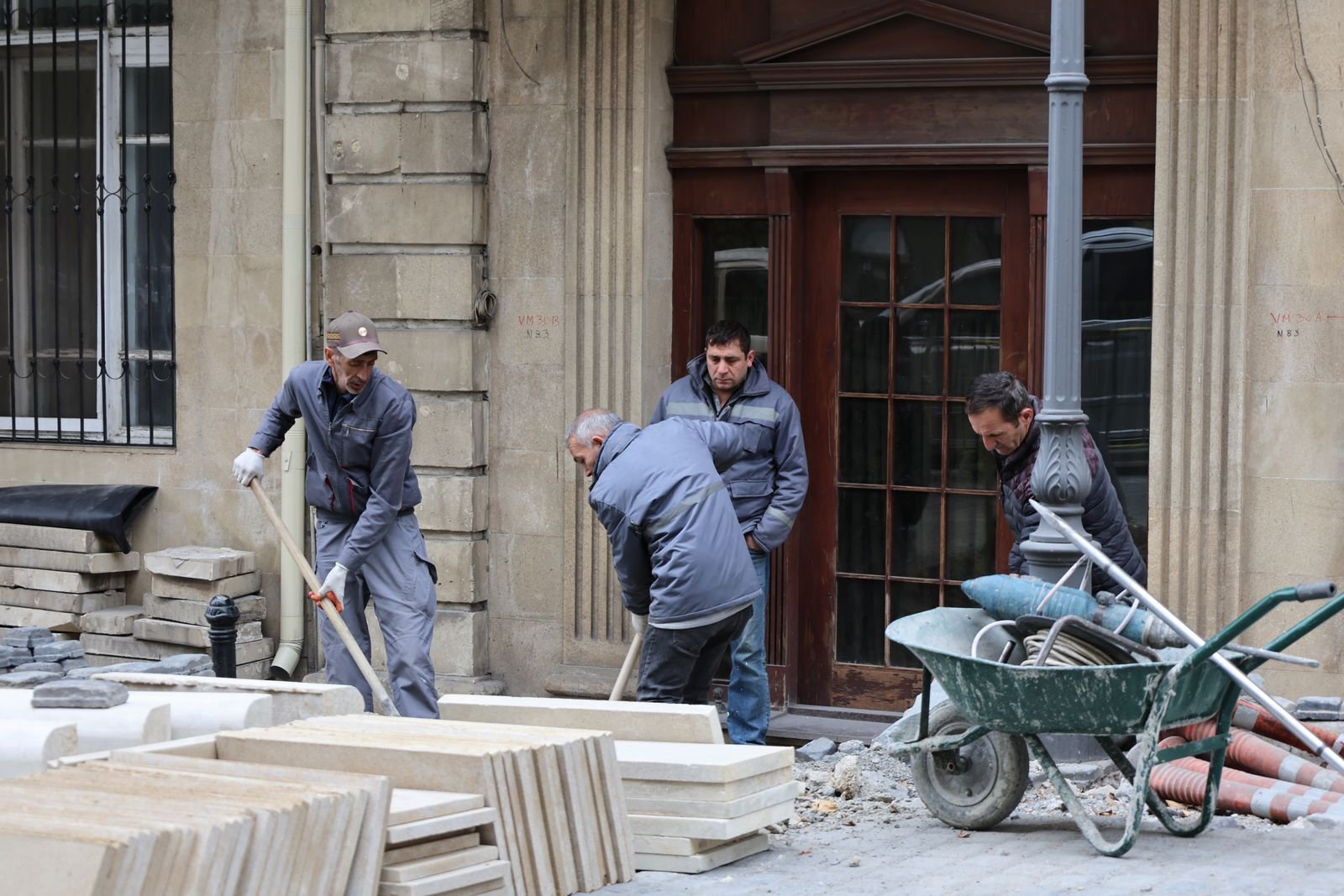

As sidewalk and driveway contractors in New York, we inspect before we quote — every flag walked, every defect marked, every base checked — because a sidewalk that looks like one job from the street is often several smaller jobs once the flags are lifted. Star Construction INC has served New York homes and buildings since 2018, and our sidewalk work in Long Island City covers the neighbourhood’s full range: tower frontages at Court Square and Queens Plaza, the low-rise blocks of Dutch Kills, and the waterfront paths at Hunters Point.
Our scope runs the full sidewalk range. We carry out sidewalk repair and replacement for lifted, cracked or settled flags, DOT violation removal where the city has already issued a notice, tree root sidewalk damage repair where street trees have heaved the walk, and concrete crack repair where the slab is sound but the surface has failed. Driveways get the same discipline: driveway installation and resurfacing for new and worn drives, and asphalt driveway repair where the asphalt has rutted or broken up.
Every job starts with an inspection that separates what can be ground or patched from what honestly needs replacing, so the scope you are quoted is the scope the sidewalk actually needs. Request a free, no-obligation estimate and we will walk the frontage with you, mark exactly which flags need work, and explain the options in plain language.
Sidewalk and driveway work in Long Island City covers everything from a single lifted flag outside a Dutch Kills home to a full frontage outside a tower lobby at Court Square. The work begins with a walk of the whole frontage: each flag checked for trip hazards, cracking, settlement and drainage, each driveway bay checked for rutting, ponding and base failure. What we find decides the scope — and we say so plainly before any price is discussed.
The defects themselves are familiar to any New York sidewalk contractor. Street trees lift flags as their roots spread; a century of settlement drops others; winter freeze-thaw opens joints and spalls surfaces; and heavy foot traffic around the transit hubs wears the busiest stretches fastest. Driveways fail differently: asphalt ruts where cars turn, concrete cracks where the base has thinned, and ponding water sits where the pitch has gone wrong. Each failure has its own honest fix, and forcing the wrong fix onto it only buys a second job.
The third element is what lies beneath. Around the towers, podium drainage and service runs cross the sidewalk zone; on the older industrial-era blocks, vaults and old loading structures sit under the pavement and change how a replacement can be built. We check what is below before we price what is above, so the quote reflects the real job — not the job the surface suggests.

See all the areas we serve on our service areas page, and read about our broader work as sidewalk and driveway contractors in New York. Where a walkway or driveway sits on concrete that is failing more broadly, our concrete repair and installation in Long Island City covers the structural side of the same problem.
Star Construction INC has served New York homes and buildings since 2018. Request a free, no-obligation estimate and we will walk the frontage with you, mark exactly which flags need work, and explain the options in plain language.
Our clients value the consistency, structural precision, and long-term performance we deliver on every project, from initial planning through final execution.

 Jav V
Trustindex verifies that the original source of the review is Google.
Got my bathroom remodel Team was professional on time Thank you Ever fernando Perez saldañaCrear Word
 LUIS CAYOi hire them for my home project. and everyting went smoothly. no delays
 Shahid IqbalVery reliable contractor. They did exactly what they promised and the quality was excellent. Would definitely recommend.
Contact us now to discuss your project and receive a no-obligation quote from our experts.
Every project is handled through a defined process that ensures accuracy, efficiency, and long-term structural performance from start to finish.
We begin by reviewing site conditions, understanding project objectives, and identifying structural requirements to establish a clear and practical direction before any work begins.
A detailed execution plan is developed, including material selection, sequencing of work, and coordination of labor to maintain consistency and avoid delays during construction.
Work is carried out using proven installation methods, with attention to structural integrity, proper reinforcement, and adherence to safety and quality standards.
A final walkthrough is conducted to verify workmanship, resolve any outstanding details, and ensure the completed project meets performance expectations and durability standards.
DOT compliance and lasting concrete start with doing the job right. Here is how we work in Long Island City, from the first inspection to the final walk-through.
In New York City the sidewalk in front of a property is the owner’s responsibility, and in Long Island City that responsibility covers a remarkable variety: tower frontages taking thousands of footsteps a day, low-rise blocks in Dutch Kills where the flags have settled for a century, and waterfront paths at Hunters Point exposed to river weather. The DOT inspects for a familiar defect list — trip hazards where flags have lifted or settled, cracks wide enough to catch a foot, spalled or broken surfaces, and ponding where the pitch has failed.
Two forces do most of the damage here. Street trees heave flags as their roots spread beneath them, lifting corners and cracking slabs along the root line. And settlement — slow, uneven, and often invisible until a flag rocks underfoot — follows a century of ground movement, utility work and old construction. Both are progressive: a lifted flag left alone becomes a broken flag, and a broken flag becomes a violation. The honest response is an inspection that maps every defect before any repair is priced.
A DOT violation notice lists the defects the inspector found and the period within which compliant repair is expected. It is not a fine in itself, but it starts a clock: the owner arranges the repair, and if the city has to step in and do the work itself, it can bill the owner for the cost. The first step is reading the notice carefully — which flags, which defects — and matching the repair to exactly what was cited.
Our DOT violation removal work follows that logic. We walk the cited frontage, confirm each listed defect, and carry out the repair to DOT standard, flag by flag, so the violation can be cleared. Where the notice cites a defect that also has an underlying cause — a root, a drainage fault, a failed base — we say so, because a compliant repair that ignores its cause will be cited again.
Not every damaged flag needs replacing. A flag that has lifted slightly but is otherwise sound can often be ground down to remove the trip hazard. A surface that has spalled or cracked in a limited area can be patched, provided the base beneath it is solid. These smaller repairs cost less, disrupt less, and — where they genuinely fit the defect — last as long as a replacement would.
Partial replacement suits a run where only some flags have failed; full replacement is the honest answer where the whole section has settled, the base has gone, or patching would leave a patchwork that fails again within a season. We explain which option fits each flag and why, in plain language, before quoting — so the scope you approve is the scope the sidewalk actually needs, nothing more and nothing less.
Replacement begins with the inspection, then the saw cuts, the removal of the failed flags, and a look at what is underneath: the base, the drainage, and any services or structures the old pavement hides. Around the towers that means podium drainage and service runs; on the older industrial-era blocks it can mean vaults and old loading structures that change how the new slab is built and supported. We confirm what is below before we pour above.
The new work is then built to last: a sound base, correct pitch so water runs to the street rather than pooling, proper joints for movement, and a finish that matches the surrounding walk. Driveways get the same discipline, with asphalt or concrete chosen for the use the drive will actually see. Before we leave, we walk the finished frontage with you, flag by flag, so you can see exactly what was done and why.
In New York City, the owner of the adjoining property is responsible for maintaining the sidewalk in front of it — keeping it in a safe condition and repairing defects. The DOT inspects sidewalks and issues violation notices for defects such as trip hazards, cracks and broken flags. If you are unsure whether a particular stretch is yours, the violation notice or your property survey will show the frontage boundary.
The notice lists the defects found and the period within which compliant repair is expected. The owner arranges the repair; if the city has to carry out the work itself, it may bill the owner for the cost. The practical first step is to have the cited frontage inspected, confirm each listed defect, and arrange repair to DOT standard — including any underlying cause, such as a tree root or a failed base, so the violation is cleared and does not return. Our DOT violation removal work follows exactly that sequence. Cost depends on how many flags are involved and what lies beneath them.
It depends on the defect. A slightly lifted flag can often be ground down; a limited surface failure can be patched where the base is sound; a run with only some failed flags suits partial replacement. Full replacement is the honest answer where the section has settled, the base has gone, or patching would leave a patchwork that fails again within a season. An inspection of every flag decides which option fits, and we explain the reasoning before quoting.
A small run of flags can often be replaced in a day or two; a full frontage takes longer, depending on its length, what lies beneath the old pavement, and curing time for the new concrete. Permit and scheduling requirements add time before work starts. We give a realistic schedule after the inspection, and explain what it depends on.
Yes — sidewalk work in New York City generally requires a DOT permit, and the work must meet DOT standards so that any violation can be cleared. Structural work below or beyond the sidewalk, such as vault repairs, can involve additional filings. We handle the permit side of the sidewalk work we carry out.