
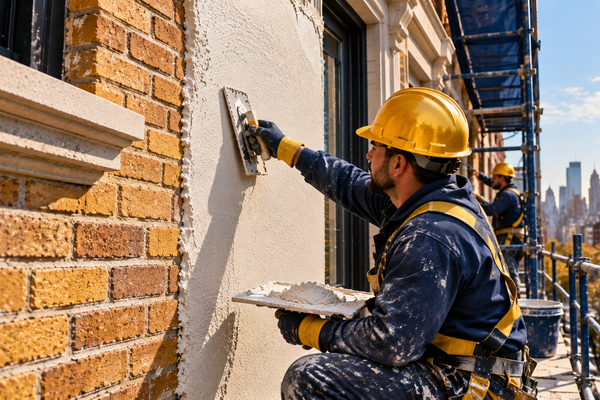
Star Construction INC has been working on homes in the New York area since 2018, and brick and stucco work is at the heart of what we do in Bronxville. As brick and stucco contractors in New York, we bring the same matching discipline to a Bronxville Tudor that we bring to a city apartment building: read the wall first, match the materials, and repair in kind. You can see all the areas we serve, and learn more about Star Construction INC on our homepage.
Bronxville’s brick houses were built with soft brick and lime-rich mortar, and a century of freeze and thaw has worn many joints back to sand. Repointing is the repair that matters most: cutting out failed mortar to a proper depth and replacing it with a mix matched in strength, colour and aggregate, so the joint — not the brick — stays the sacrificial layer. Done well, repointing stops water at the surface and gives a wall decades more life.
Where the damage runs deeper — spalled brick faces, cracked units, leaning garden walls — individual bricks are cut out and replaced with matching units, and structural questions are answered honestly rather than plastered over. Our masonry contractors in Bronxville handle the wider masonry picture, and brick and stucco work sits within it: the same matching discipline, applied to the face of the house.

If you are searching for brick and stucco contractors in Bronxville, you may be looking for one of these services: brick pointing and repointing, stucco repair and application, brick crack repair and replacement, brownstone and historic facade restoration, exterior waterproofing for masonry, stucco skim coating and refinishing, lintel and shelf angle repair, chimney repair and rebuilding, or EIFS stucco systems. Each is a service we carry out in Bronxville as part of the wider brick and stucco contractors in New York offering. You can see all the areas we serve, or return to the Star Construction INC homepage.
Our clients value the consistency, structural precision, and long-term performance we deliver on every project, from initial planning through final execution.

 Jav V
Trustindex verifies that the original source of the review is Google.
Got my bathroom remodel Team was professional on time Thank you Ever fernando Perez saldañaCrear Word
 LUIS CAYOi hire them for my home project. and everyting went smoothly. no delays
 Shahid IqbalVery reliable contractor. They did exactly what they promised and the quality was excellent. Would definitely recommend.
Contact us now to discuss your project and receive a no-obligation quote from our experts.
Every project is handled through a defined process that ensures accuracy, efficiency, and long-term structural performance from start to finish.
We begin by reviewing site conditions, understanding project objectives, and identifying structural requirements to establish a clear and practical direction before any work begins.
A detailed execution plan is developed, including material selection, sequencing of work, and coordination of labor to maintain consistency and avoid delays during construction.
Work is carried out using proven installation methods, with attention to structural integrity, proper reinforcement, and adherence to safety and quality standards.
A final walkthrough is conducted to verify workmanship, resolve any outstanding details, and ensure the completed project meets performance expectations and durability standards.
Bronxville’s brick and stucco fail in familiar patterns, and each pattern has an honest repair. The sections below cover the work we do most on the village’s period homes — repointing, matching, stucco repair and the water investigation that has to come before any of it.
Most Bronxville brickwork does not need rebuilding — it needs repointing. Joints that have gone sandy and recessed are cut out to a proper depth, the wall is cleaned, and new mortar matched to the original is pressed in and tooled to the original joint profile. Spalled or cracked bricks are cut out individually and replaced with matching units, so the repair reads as wall, not patchwork. Our brick pointing and repointing service is the core of this work, and it is also the single best defence against the next winter: sound joints keep water out of the wall in the first place.
On a historic house, matching is not cosmetic — it is structural. Mortar for old brick must be softer than the brick itself, so the joint stays the sacrificial layer: a hard modern mix traps moisture and forces the brick face to spall. We match composition, colour, sand and aggregate, and tool the joint to the original profile, checking small test patches dry before committing to a whole elevation. Stucco gets the same treatment — texture and aggregate matched so a patch does not telegraph through the paint. The test is simple: stand on the sidewalk afterwards and try to find the repair.
Stucco on a Tudor fails where the wall moves or water gets in: hairline cracks at the timber joints, drummy patches where the coat has lost its bond, staining below a failed flashing. Fine, stable hairlines can often be repaired and recoated; wider or drummy areas need the loose material cut back to sound substrate and rebuilt in layers, with texture and aggregate matched to the original. Our stucco repair and application work follows that order — cause first, then patch — because a beautiful patch over a live crack is a crack again within a season.
The most expensive mistake in brick and stucco work is repairing the surface without finding the water. Stains inside, paint failing in one area, mortar washing out on a single elevation — all point to a source: a failed flashing, a coping joint open to the rain, a gutter discharging onto the wall. We trace that source first and fix it as part of the job, including exterior waterproofing for masonry where the wall needs it, so the new pointing and stucco are not asked to survive the same leak that ruined the old. Request a free, no-obligation inspection and we will show you where the water is coming from before we quote the repair.
Look at the joints: mortar that is recessed, sandy, cracked along its centre or falling out in pieces is telling you the repointing cycle is due. Water staining on the brick, damp patches inside on the room side of the wall, and brick faces beginning to flake or spall are later signs. If mortar crumbles when you scrape it with a screwdriver, it has lost its strength. An inspection confirms how much of the wall needs work and whether any bricks need replacing at the same time.
Yes, in most cases very closely. We match composition first — a softer, lime-rich mix for historic brick so the joint stays the sacrificial layer — then colour, sand and aggregate, and tool the joint to the original profile. Small test patches are checked once dry before a whole elevation is committed. Fresh mortar always looks slightly different at first and weathers in; the test of a good match is standing on the sidewalk afterwards and struggling to find the repair.
Usually one of four causes: movement in the wall or timber frame, moisture getting behind the coat, failed detailing where water enters at sills, flashing or timber joints, or simply age. Fine hairlines are often cosmetic and stable; wider cracks, cracks that grow, or areas that sound hollow when tapped mean the coat has lost its bond and water is getting behind it. The cause matters more than the crack itself — patching over a live moisture problem just buys a season before the crack returns.
Small, stable cracks can usually be patched invisibly: the loose material is cut back, the cause is fixed, and the patch is built up in layers with texture and aggregate matched to the surrounding wall so it disappears under paint. When stucco is drummy or cracked across a whole elevation, or the substrate behind it has failed, patching becomes a patchwork and resurfacing that elevation is the honest answer. An inspection — including tapping the wall to find hollow areas — decides which one your wall needs.
Small jobs — a day’s repointing, a local stucco patch — are often finished in a day or a few days. A larger elevation, a chimney rebuild or a wall that needs resurfacing takes a week or more, and matching materials, curing time between stucco coats and the weather all affect the schedule. We give an honest time estimate with the quote and keep you updated if a hidden problem adds to it; cost, as always, depends on the scope of the repair.


