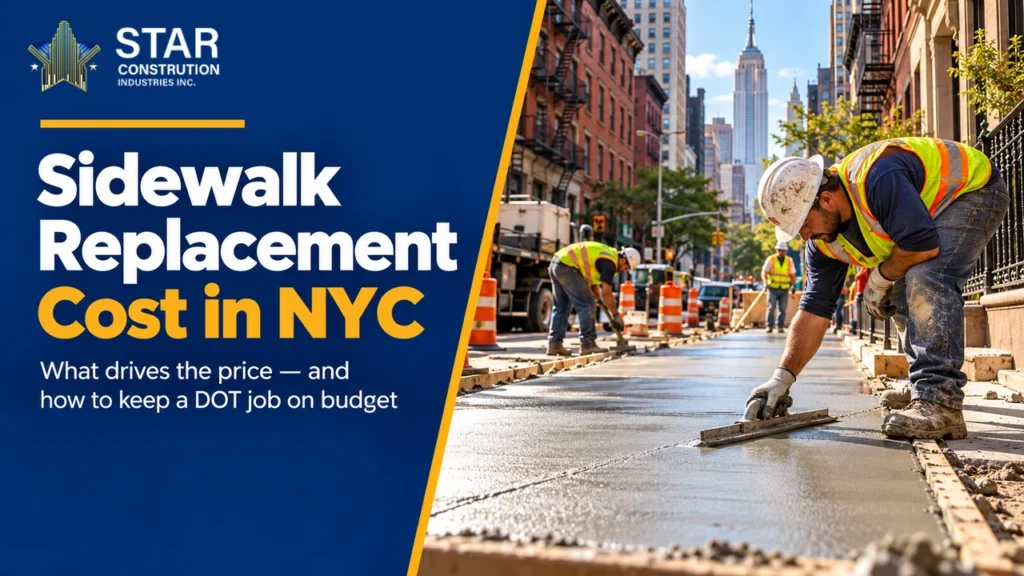
Sidewalk replacement cost in NYC depends on how many flags are damaged, how thick the concrete must be, whether tree roots are involved, and whether the work must clear a DOT violation. If your sidewalk is cracked, lifted by tree roots, or flagged by the NYC Department of Transportation (DOT), the first question is always the same: what will replacement cost? Here is the direct answer. As a general New York market range, full sidewalk replacement typically costs about $15 to $35 per square foot installed, or roughly $400 to $900 for one standard 5-by-5-foot flag. Replacing the full run of sidewalk in front of a typical house often lands between $3,000 and $10,000 or more, depending on length, thickness, and site conditions. Treat these figures as planning ranges, not quotes: your exact price can only be set after an on-site estimate, because permits, roots, and access change the number. This guide explains what drives the price so you can read any estimate with confidence.
Sidewalk Replacement Cost at a Glance
Most NYC sidewalk pricing is built from the same few units, so this table is the fastest way to sanity-check a quote.
| Scope of work | General NYC market range |
|---|---|
| Full replacement, per square foot | $15 – $35 |
| Full replacement, per standard flag (5 ft x 5 ft) | $400 – $900 |
| Typical full frontage, one-family house | $3,000 – $10,000+ |
| Partial repair (patching or grinding), per flag | $150 – $450 |
| Driveway apron or reinforced section, per square foot | $25 – $45 |
These ranges assume licensed and insured work, including demolition, disposal of the old concrete, a compacted base, and standard 4-inch concrete. Work that clears a DOT violation, involves tree roots, or needs thicker reinforced concrete sits at the higher end.
What Drives the Cost of Sidewalk Replacement?
Two sidewalks on the same block can be priced thousands of dollars apart. These are the factors that move the number:
- Total area. Cost follows square footage. A single broken flag is a small job; a full frontage with a driveway apron is a much larger one, although the per-square-foot rate usually improves as the area grows.
- Concrete thickness and reinforcement. Standard pedestrian sidewalk is 4 inches thick. Sections that vehicles cross – driveway aprons and curb cuts – are typically built 7 inches thick with reinforcement, which raises material and labor cost.
- Demolition and disposal. The old flags have to be broken out, loaded, and legally dumped. Thick, reinforced, or double-poured old concrete costs more to remove.
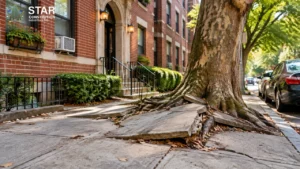
- Tree roots and the base. Roots are the most common cause of lifted flags in residential neighborhoods. Root trimming, root barriers, and rebuilding a washed-out base add work that only shows once the old concrete is up.
- Permits and DOT compliance. Sidewalk work in New York City requires a DOT permit, and work performed to clear a violation must match DOT specifications and pass inspection. Permit, filing, and inspection time are part of a legitimate quote.
- Access and property type. A wide-open frontage on a quiet residential street is faster to work than a tight lot line, a fenced front yard, or a building where material has to be carried by hand.
New York weather plays a role too: freeze-thaw cycles are what crack and heave most sidewalks here, and proper base preparation – not just new concrete on top – is what keeps the replacement from failing the same way.
Sidewalk Replacement Costs by Property Type
One-family houses are the simplest case: a single frontage, usually a handful of flags, and the $3,000 to $10,000+ full-frontage range above is the right planning band. Small jobs still carry minimum charges for mobilization, delivery, and disposal, so replacing one flag alone costs more per flag than replacing ten in the same visit.
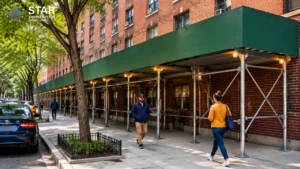
Multi-family and mixed-use buildings typically have longer frontages, more foot traffic during construction, and more coordination with tenants and neighboring properties. The per-square-foot rate is similar, but the total is higher because the area is larger, and pedestrian protection during the work adds setup time.
Corner lots have two frontages instead of one, which roughly doubles the flag count and often adds a curb cut or driveway apron built to reinforced thickness. Owners of corner properties should budget for both sides in a single project rather than pricing one side and being surprised by the other.
Driveway aprons and commercial frontages sit at the top of the range: reinforced 7-inch concrete, heavier loads, and in commercial areas, tighter working windows. The $25 to $45 per-square-foot band for reinforced sections reflects that extra material and labor.
Repair or Full Replacement: Which Do You Need?
Replacement is not always the answer, and a good contractor will tell you when a repair is enough.
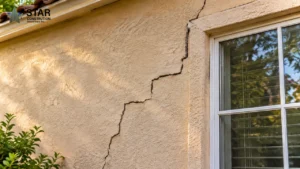
Repair usually works when the damage is limited: surface cracking on an otherwise sound flag, a small trip edge that can be ground down, or one isolated patch where the base is still solid. Repairs are the budget option, commonly in the $150 to $450 per-flag range.
Replacement is the right call when flags are settled, crumbling, or rocking; when cracking runs through most of the flag; when the same section has been patched repeatedly; or when the DOT has cited the condition in a violation. Inspectors judge the finished surface, and a flag that is patched over structural failure will not pass – and will not stay level through another winter.
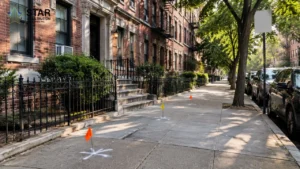
If you are unsure which side of the line your sidewalk falls on, ask for the flags to be mapped and marked, with repair and replacement priced side by side.
How a DOT Violation Changes the Math
In New York City, the property owner – not the city – is responsible for maintaining the sidewalk next to the property, under Section 19-152 of the NYC Administrative Code. When a DOT inspector finds defects such as trip hazards, broken flags, or improper slope, the owner receives a Notice of Violation describing exactly which flags must be fixed.
Ignoring the notice is the expensive path: if the owner does not repair in time, the city can have the work performed and bill the property, with administrative fees added – and the owner loses control of both the contractor and the price. Our NYC DOT sidewalk violation guide walks through the notice, the process, and the dismissal steps in detail.
Clearing a violation means permitted work, built to DOT specification, followed by a dismissal inspection. Contractors who handle this regularly, like our DOT violation removal team, price the job as a complete package – permits, replacement, and inspection – so the violation is closed, not just the concrete replaced.
Permits, DOT Specifications, and the Inspection Process
Every sidewalk replacement in New York City starts with a DOT permit filed before work begins. The permit establishes that the work will follow DOT specifications: the correct concrete thickness, the proper slope for drainage, control joints placed to manage cracking, and a finished surface free of trip hazards. For violation work, the specifications matter even more, because the finished sidewalk must pass a dismissal inspection that compares the completed work against the conditions cited in the notice.
Plan the calendar around inspections, not just the pour. The on-site work for a residential frontage is usually one to three working days, but permit processing, concrete curing, and scheduling the dismissal inspection all add time around it. A contractor experienced with violation work will explain that sequence up front and will keep the paperwork — the permit, the notice, and the inspection result — organized so the violation can be shown as closed. If a quote makes no mention of permits or inspection, it is incomplete for New York City work, whatever the price.
Tree Roots: The Hidden Cost Driver
Tree roots cause more sidewalk damage in New York City than any other single factor, and they are also the factor most likely to change a price after work starts. A lifted flag looks like a surface problem, but the root underneath may be large, may run under several flags, and may belong to a street tree whose roots cannot simply be cut away without harming the tree or destabilizing the soil.
Responsible root work means trimming only what is necessary, rebuilding the base so the new flags sit on compacted, well-drained material, and in some cases installing a root barrier to direct future growth downward rather than under the new slab. Where damage was caused by a city tree, owners of some one- to three-family homes may have options under the city’s Trees and Sidewalks program, which is worth asking about before paying for work the program might cover. Either way, the root question should be answered during the estimate — not discovered after the concrete is already broken out.
What the Replacement Process Looks Like
- Measurement and estimate. The flags are measured, damage and roots are noted, and you receive a written, itemized price for the exact scope.
- Permits. The required NYC DOT sidewalk permit is filed before work begins.
- Demolition. The old flags are broken out and hauled away, and the sub-base is exposed and checked.
- Base preparation. The base is re-compacted and leveled; roots are trimmed where they caused the damage.
- Forms and pour. Forms are set to the correct slope for drainage, and new concrete is poured, finished, and jointed.
- Curing and inspection. The concrete cures, forms are stripped, and – for violation work – a DOT inspection is requested so the violation can be dismissed.
Most residential replacements take one to three working days on site, plus curing time before the sidewalk takes full use.
How to Keep Your Sidewalk Project on Budget
- Replace all bad flags in one mobilization. Doing three flags today and two next year means paying setup, delivery, and minimum charges twice.
- Handle violations promptly. A planned repair is almost always cheaper than a city-performed repair billed back to you.
- Get the quote in writing, itemized by flag. You should be able to see area, thickness, disposal, and permit costs – not a single lump sum.
- Compare scope, not just price. The cheapest quote sometimes leaves out disposal, base work, or the permit – items that reappear later as extras.
- Ask about the base. In neighborhoods with mature street trees – from Bayside in Queens to Riverdale in the Bronx – root and base preparation decide how long the new sidewalk lasts.
When comparing quotes, check the same five items on each one: flag count and area, concrete thickness, disposal, base and root work, and permit and inspection handling. Two quotes that differ on those items are not quotes for the same job, and the lower number is not necessarily the better deal.
Get an Exact Price for Your Sidewalk
Online ranges can plan a budget, but they cannot price your property: flag count, thickness, roots, and permit scope are only visible on site. Star Construction INC provides free, no-obligation on-site estimates for sidewalk and driveway work across New York City – see our sidewalk and driveway services for what a typical project includes, or call (516) 998-4133 to schedule a visit.
Frequently Asked Questions
How much does it cost to replace one sidewalk flag in NYC?
As a general New York market range, replacing one standard 5-by-5-foot flag typically costs about $400 to $900, including demolition and disposal. Small jobs carry minimum charges, so the per-flag price drops when several flags are replaced in the same visit. Your exact price requires an on-site estimate.
Who is responsible for sidewalk replacement in NYC – the owner or the city?
The property owner. Under Section 19-152 of the NYC Administrative Code, owners must maintain and repair the sidewalks adjoining their property at their own cost. Limited exceptions exist for some one- to three-family homes when damage is caused by city trees under the city’s Trees and Sidewalks program.
Do I need a permit to replace a sidewalk in NYC?
Yes. Sidewalk construction and replacement require a permit from the NYC Department of Transportation, and the work must be performed to DOT specifications. When the work clears a violation, the repaired sidewalk must also pass a DOT dismissal inspection.
How long does sidewalk replacement take?
Most residential jobs take one to three working days on site, depending on the number of flags. The concrete then needs curing time before heavy use, and DOT inspection scheduling can add time on violation jobs – your contractor should build that into the timeline.
Can I repair my sidewalk instead of replacing it?
Sometimes. Minor surface cracking and small trip edges can often be patched or ground down for roughly $150 to $450 per flag. But settled, crumbling, or repeatedly patched flags – and most conditions cited in a DOT violation – need full replacement of the affected flags to pass inspection and stay level.
What does a DOT violation dismissal inspection involve?
After the permitted repair work is complete and the concrete has cured, a DOT inspection is requested so the violation can be dismissed. The inspector checks the repaired flags against the conditions cited in the notice — surface condition, slope, and compliance with DOT specifications. Work that was done without a permit, or that does not match the specifications, will not clear the violation, which is why the permit and inspection steps should be part of the original quote.
Can the city replace my sidewalk and bill me?
Yes. If a DOT violation is not repaired, the city can have the work performed and bill the property, with administrative fees added. The owner also loses control over who does the work and what it costs. A planned, permitted repair arranged by the owner is almost always less expensive and less disruptive than a city-performed repair billed afterward.
Do tree roots mean I have to replace the whole sidewalk?
No. Only the flags actually damaged by roots need replacement, but the root itself must be addressed during the job — trimmed where appropriate, with the base rebuilt and, where suitable, a root barrier installed — or the new flags will lift again. If the damage comes from a city tree, owners of some one- to three-family homes should ask about the city’s Trees and Sidewalks program before committing to the full cost.
What should a sidewalk replacement quote include?
A complete quote should itemize the flag count and area, concrete thickness, demolition and disposal, base and root work, and permit and inspection handling. If any of those items is missing, ask about it before comparing prices: the cheapest quote is often the one that left something out, and the missing item usually reappears later as an extra charge.