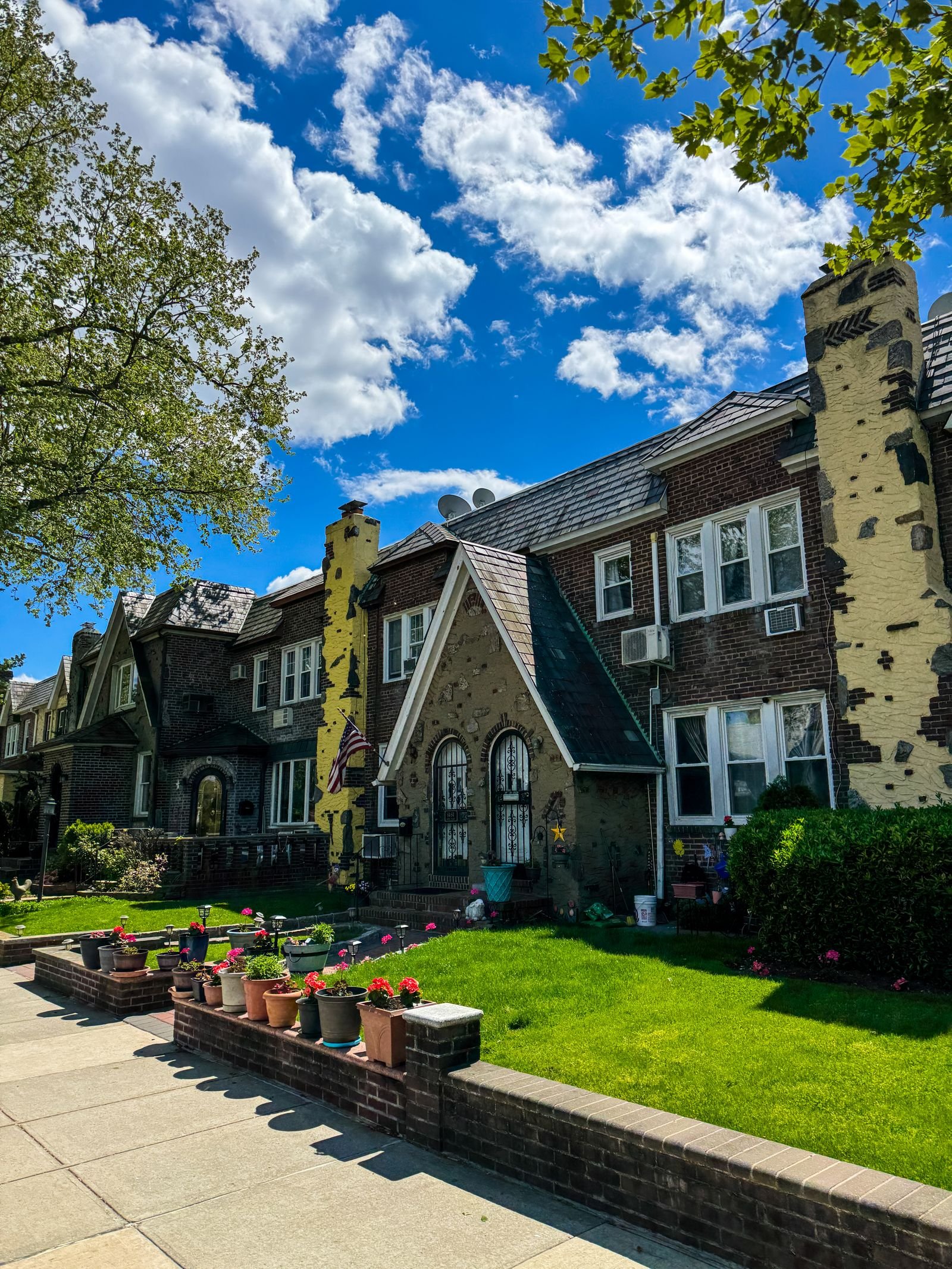
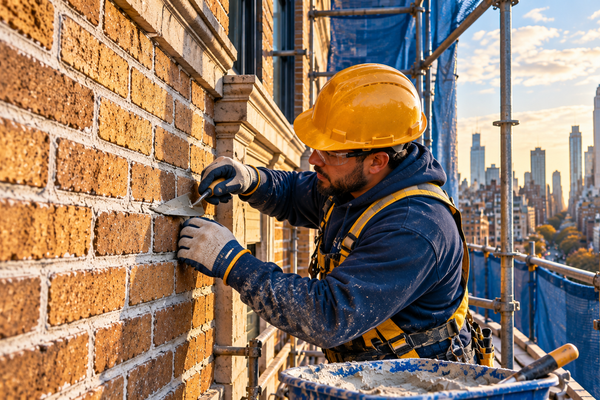
As masonry contractors in New York with deep experience in Queens’ pre-war housing stock, we focus on the brickwork Astoria actually has: soft lime-mortar joints on 1920s-40s walk-ups, hard-fired brick on attached row homes, and tall chimney stacks that take the worst of the weather. Our core services include brick repointing with historically matched mortar, chimney repair and rebuilding from flue to crown, and masonry waterproofing that stops water without trapping it in the wall. Every project starts with a hands-on inspection — we check mortar hardness, brick soundness, flashing, and drainage before recommending anything. That inspection matters because Astoria’s buildings rarely fail in one place. A leaking coping stone can soak a parapet, a failed lintel can open a stair-step crack above a storefront window on Broadway, and a chimney crown that has lost its wash can send water down the flue and into a top-floor co-op. We trace those paths before we quote, so the repair addresses the source rather than the stain it left behind. Around Ditmars Boulevard and Astoria Heights, we work on attached row homes where a shared party wall means mortar and brick choices affect two households, not one, and coordination with neighbors and boards keeps the work orderly. On 30th Avenue, occupied walk-ups and ground-floor shops require phased access, sidewalk protection, and clear communication with supers. We plan for Queens freeze-thaw cycles, using compatible lime mortar and breathable waterproofing that lets a wall dry, rather than sealing moisture inside it.
Masonry restoration is not just patching what you can see. On Astoria’s pre-war brick buildings, we start by identifying the mortar type — most 1920s-40s stock used soft lime mortar that must be matched, not replaced with hard Portland cement that cracks the surrounding brick. We rake out failed joints to the proper depth, repoint with the right mix, replace spalled or shattered brick with period-appropriate units, rebuild deteriorated chimney crowns and flues, and correct the flashing and coping details that let water in to begin with. Where NYC DOB permits are required — for example, on larger facade work or parapet-adjacent repairs — we prepare the filings and coordinate inspections so the job stays compliant from start to finish. Where the work reaches the face of the building, our facade repair and restoration in Astoria covers the same pre-war brick and parapet-adjacent details. We also check sills, lintels, and wall bases along Broadway and 30th Avenue, where splashback and road salt do the most damage.

Property owners, co-op boards, and managers across Astoria call us when brickwork starts showing its age: stair-step cracks in mortar joints, white efflorescence blooming on facades, bricks flaking or popping, chimneys leaning or shedding mortar, and water stains spreading on interior walls after storms. We serve the full neighborhood — from the Ditmars area and Astoria Heights to the 30th Avenue corridor, Broadway, and the streets around Astoria Park and the East River. See all the areas we serve, and if you are comparing masonry contractors in New York, ask how they match historic mortar — it is the detail that separates a lasting repair from a recurring one. Star Construction INC has served New York City since 2018. In Western Queens, that includes brick row homes and multi-family buildings around Steinway as well as Ditmars, where the same soft-mortar and chimney issues show up on occupied walk-ups.
Our clients value the consistency, structural precision, and long-term performance we deliver on every project, from initial planning through final execution.


 Trustindex verifies that the original source of the review is Google.
 Trustindex verifies that the original source of the review is Google.
 Trustindex verifies that the original source of the review is Google.
 Trustindex verifies that the original source of the review is Google.
Contact us now to discuss your project and receive a no-obligation quote from our experts.
Every project is handled through a defined process that ensures accuracy, efficiency, and long-term structural performance from start to finish.
We begin by reviewing site conditions, understanding project objectives, and identifying structural requirements to establish a clear and practical direction before any work begins.
A detailed execution plan is developed, including material selection, sequencing of work, and coordination of labor to maintain consistency and avoid delays during construction.
Work is carried out using proven installation methods, with attention to structural integrity, proper reinforcement, and adherence to safety and quality standards.
A final walkthrough is conducted to verify workmanship, resolve any outstanding details, and ensure the completed project meets performance expectations and durability standards.
Brickwork done right lasts generations; done wrong, it fails in a few winters. Here is what we bring to every Astoria masonry project.
Astoria’s pre-war brick was laid with soft lime mortar. We test existing mortar and match its composition, color, and joint profile, so repointed areas blend in and — more importantly — flex and breathe the way the original wall was designed to. Hard modern mortar on old brick is one of the most common causes of spalling we see in Queens, and it is entirely avoidable.
Chimneys take the worst weather a building sees. We rebuild deteriorated stacks with proper flue liners, crowns with drip edges, and counter-flashing tied into the roofing — details that keep water out for decades. Our chimney repair and rebuilding work follows NYC DOB requirements, including permits where the scope triggers them. If you are weighing a repair against a rebuild, our guide to chimney repair vs rebuild explains the signs that point each way.
Trapped moisture destroys brick from the inside. Our masonry waterproofing uses breathable sealants and corrects the real entry points — failed coping, open joints, bad flashing — instead of just coating over symptoms. The wall stays dry without suffocating, which is exactly what century-old brick needs.
Most of our Astoria work happens on occupied walk-ups and mixed-use buildings. We set sidewalk protection, control dust, keep entrances clear, and coordinate with supers and boards so tenants and storefronts are disrupted as little as possible. When brickwork also needs brick repointing alongside larger repairs, we sequence the work to keep the site safe and the schedule tight.
Repointing costs depend on wall area, mortar condition, building height, and access — a small garden-level patch and a full six-story facade are very different jobs. Most Astoria walk-up repointing projects fall in the low-to-mid four figures, with larger facades running higher. We provide free on-site estimates with exact measurements, so you get a firm price based on your building, not a guess.
It depends on the scope. Straightforward repointing and brick replacement on most Astoria buildings typically does not require a DOB permit, but larger facade alterations, parapet-adjacent work, or jobs on certain building types do. When a permit is required, we handle the filings, plans, and inspections. During your estimate we will tell you plainly whether your project needs one.
Yes — matching is central to what we do. We analyze your existing mortar’s composition and color, then mix repointing mortar to match in strength, texture, and tone. For brick replacement we source period-appropriate units in the right size and color range. The goal is repairs that disappear into the original wall, not patches that stand out.
A leaning chimney usually means deteriorated mortar or a failed flue liner, and it should not be ignored — freeze-thaw cycles widen the damage each winter. In many cases we can rebuild from the roofline up, which solves the structural issue at a fraction of a full rebuild. We will inspect it hands-on and show you exactly what is failing before recommending anything.
A focused repointing job on a garden-level facade often takes two to four days. Full-facade restoration on a six-story walk-up typically runs one to three weeks depending on access, brick replacement volume, and weather. We give you a written schedule with your estimate and keep the site protected and clean throughout — most of our Astoria work happens on occupied buildings.