
Roof work in Village of Pelham is detail work first and surface work second. The village’s colonials and Tudors combine steep shingle pitches with intersecting valleys, chimneys, dormers and, on the grander Tudors, slate — and every junction is a place where water can enter if the flashing is wrong, even when the field of the roof looks sound. Our roof repair contractors in New York approach, adapted here roof by roof, therefore starts with the details: flashing at chimneys and walls, valleys, eaves and penetrations, and only then the shingles or slate that cover the field.
Most Pelham roof problems arrive through those details rather than through the middle of a slope. A valley that was sealed instead of flashed, a chimney flashing that has lifted, a dormer junction that was never properly stepped — each fails quietly for years, and the first sign indoors is often a stain rooms away from the entry point. That is why our roof leak detection work traces water to its entry point before recommending anything, and why a targeted repair is quoted when a targeted repair is the honest answer.
Where the work touches a chimney, the masonry matters as much as the flashing: a flashing cannot seal against brick that is cracked or spalled, so when a chimney needs brickwork before it can be properly flashed, our masonry contractors in Village of Pelham scope is discussed alongside the roof scope, and the sequence is planned so the flashing follows the masonry, not the other way round. The same sequencing applies to roof flashing repair and to gutter and downspout work, which is planned with the roof rather than after it.
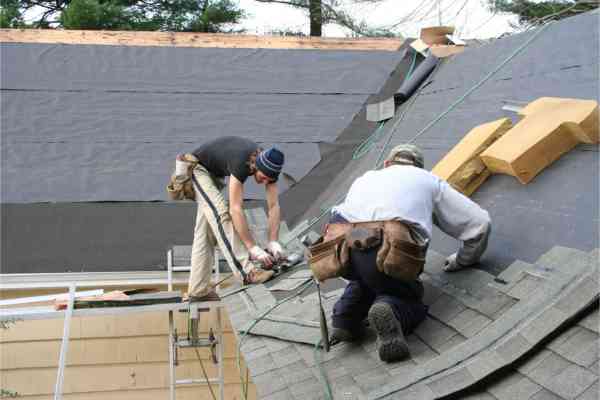
Roof repair is the correction of a specific failure: a lifted or missing shingle, a flashing that has opened, a valley that is channelling water under the covering, a gutter that is backing water into the eaves. It is judged by whether the entry point is found and closed, not by how much of the roof was touched. Roof installation, by contrast, is the replacement of the whole covering system — underlayment, flashing, ventilation and the shingle or slate field — when the existing roof has reached the end of its serviceable life on one or more slopes.
On a Pelham house the two are often in tension. A roof that looks tired from the street may still have years of life on its sheltered slopes and only its south slope or its valleys in trouble, in which case a repair is the honest answer. A roof whose covering is failing across several slopes, whose decking is soft or whose flashing has been patched repeatedly, is a candidate for replacement, even if it is not yet leaking indoors. The distinction is made slope by slope, after walking the roof, and it is the distinction this page is built around.

If you are looking for roof repair contractors in Village of Pelham, request a free, no-obligation estimate from Star Construction INC and we will inspect the roof, photograph what we find and explain it before any work is quoted. The inspection will say which slopes are sound, which details are failing and which, if any, are at the end of their serviceable life, so the quote that follows is for the work the roof actually needs.
Star Construction INC has worked on homes since 2018, and our team also serves other parts of Westchester County — see all the service areas we cover. Whether the job is a single leak, a valley or flashing repair, or a full replacement, the estimate will separate repair from replacement, slope by slope, in plain terms.
Our clients value the consistency, structural precision, and long-term performance we deliver on every project, from initial planning through final execution.


 Trustindex verifies that the original source of the review is Google.
 Trustindex verifies that the original source of the review is Google.
 Trustindex verifies that the original source of the review is Google.
 Trustindex verifies that the original source of the review is Google.
Contact us now to discuss your project and receive a no-obligation quote from our experts.
Every project is handled through a defined process that ensures accuracy, efficiency, and long-term structural performance from start to finish.
We begin by reviewing site conditions, understanding project objectives, and identifying structural requirements to establish a clear and practical direction before any work begins.
A detailed execution plan is developed, including material selection, sequencing of work, and coordination of labor to maintain consistency and avoid delays during construction.
Work is carried out using proven installation methods, with attention to structural integrity, proper reinforcement, and adherence to safety and quality standards.
A final walkthrough is conducted to verify workmanship, resolve any outstanding details, and ensure the completed project meets performance expectations and durability standards.
Choosing a roofer for a Pelham house is choosing an inspection standard. The roof that protects a colonial or Tudor is a system of slopes, valleys, flashings and gutters, and a failure in any one detail can undo a sound field. The sections below describe how we judge each part of that system, so you can see why a repair is recommended in one place, a replacement in another, and nothing at all where the roof is still sound.
Pelham’s roofs are not a single type. The colonials typically carry steep asphalt shingle pitches with gables and dormers, while the grander Tudors add slate, decorative ridges and more complex intersecting planes. Both share the same weak points: valleys where two slopes meet, chimneys that interrupt the field, dormer cheeks and junctions with walls, and eaves where ice can work in a hard winter. A roofer who only looks at the field of the roof will miss the places where Pelham roofs actually fail.
Slate deserves a note of its own. On a Tudor with a slate roof, the slate itself may outlast several generations of flashing, fasteners and underlayment, so the question is rarely whether the whole roof must go. Individual slates can be replaced, flashings renewed and valleys rebuilt while the sound slate remains, and that repair path is usually both cheaper and more in keeping with the house than a wholesale change of material. Where slate has become brittle across a whole slope, or where the decking beneath it has failed, replacement is the honest answer, and it is quoted slope by slope rather than for the house as a whole.
Pitch matters too. Steep pitches shed water well but make inspection and repair slower and more careful, and they put more weather on the south and west slopes than on the shaded north. The inspection therefore records each slope separately — its material, its age, its flashing condition and its exposure — so the recommendations that follow are for that slope, not for an average of the whole roof.
A leak is rarely where the stain is. Water that enters at a valley, a chimney flashing or a dormer junction can travel along rafters, decking and ceilings before it shows, so the stain on a bedroom ceiling may be rooms away from the entry point. Chasing the stain itself — sealing the ceiling, painting over it, or patching the slope directly above it — treats the symptom and leaves the entry open, which is why a leak investigation works backwards: from the stain, along the likely water path, to the detail that could have let it in.
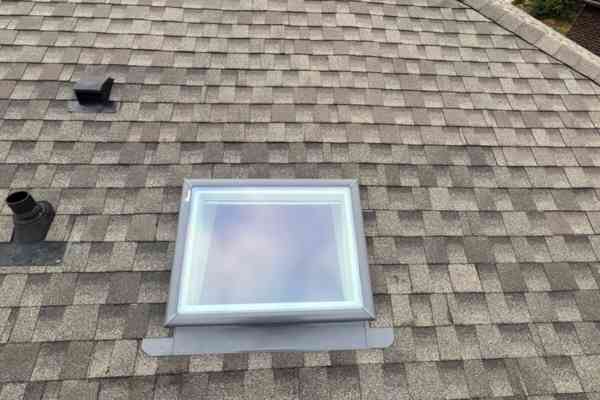
The usual suspects, in order, are flashing, valleys and penetrations. Chimney flashings that have lifted or cracked, step flashings at dormers and walls that were never properly lapped, valleys whose metal has corroded or whose shingles were cut too short, and pipe boots and skylight curbs that have aged out — each is a small detail with an outsized effect. A valley that was sealed with mastic rather than flashed, in particular, can look intact from the street while failing silently for years, and it is one of the first details checked on a Pelham roof.
The evidence indoors matters too. A stain that grows after wind-driven rain points to a different detail than one that appears only with ice dams at the eaves, and a damp patch that follows a chimney line points to flashing or masonry before it points to the field. The inspection report should connect the indoor evidence to the outdoor detail, with photographs, so the repair quoted is for the entry point, not for a guess at it.
Pelham’s tree canopy is a blessing for a street and a slow bill for a roof. Mature trees shade north slopes long after the street has dried, and shade plus damp is exactly what moss and algae need. Moss holds moisture against the covering, lifts shingle edges as it grows and, on slate, works into joints; it does not destroy a roof in a season, but it shortens the life of the covering if it is left year after year, and it hides the condition of the flashing beneath it.
Gutters are the other half of the same bill. Leaves and debris that fill a gutter in autumn will, if not cleared, back water up under the eaves and into the fascia, and a gutter that overflows in a storm is often a gutter that is blocked rather than a gutter that is too small. The inspection therefore includes the gutters and downspouts, not just the roof field: are they clear, are they pitched to drain, are the joints sound, and do the downspouts carry water away from the foundation?
The practical routine is simple and unglamorous: clear gutters and valleys, trim branches that overhang and rub the roof, and treat moss by cleaning it off rather than by pressure-washing it into the covering. That routine, done regularly, is what keeps a Pelham roof’s shaded slopes from ageing years faster than its sunny ones, and it is included in the inspection report as maintenance advice, not as a sales item.
The repair-or-replace decision should be made slope by slope, and it should be written down that way. A slope is a candidate for repair when its covering is generally sound, its flashing can be renewed, its decking is firm and its remaining life is measured in years rather than seasons. A slope is a candidate for replacement when its covering is failing across the slope, its granules or slates are widely lost, its decking is soft, or its flashing has been patched so often that there is no sound detail left to tie into.
Cost follows the same logic, and it depends on scope: the material, the slope, the number of details, the access and the condition of the decking all change the price, so a replacement quote that does not separate those elements cannot be compared with another. A repair that buys a slope five more years is good value; a repair that buys it one winter is not, and the inspection should say which it is, in plain terms, before you are asked to decide.
There is also a middle path that Pelham houses often take: replace the worst slope or slopes now, repair the sound ones, and plan the remainder for a later year. That staged approach keeps the house watertight without forcing a whole-roof decision on a single day, and it is only honest if the report states the remaining life of each slope that is left for later.
Yes, a slate roof can very often be repaired, and on a Pelham Tudor that is usually the first option to consider. Individual slates that have cracked or slipped can be replaced, flashings at chimneys and valleys can be renewed, and valleys can be rebuilt while the sound slate around them remains. Because slate itself is long-lived, the failure is often in the flashing, the fasteners or the underlayment rather than in the slate, and renewing those elements restores the roof without discarding material that still has decades of life.
Replacement becomes the honest answer when slate is brittle across a whole slope, when slates are breaking during ordinary repair work, or when the decking beneath has softened. In that case the quote should be for the slope or slopes that have failed, not automatically for the whole house, and the cost depends on the area, the slate type and the detailing required.
By working backwards from the stain, not by patching above it. Water that enters at a valley, a chimney flashing or a dormer junction can travel along rafters and decking before it shows indoors, so the entry point may be well upslope or sideways from the stain. The inspection therefore starts indoors, noting where the stain is and when it appears — after wind-driven rain, after ice at the eaves, or only in heavy rain — and then moves to the roof to check the details that could feed that path.
On the roof, the check is systematic: flashings at chimneys, walls and dormers, valleys, skylight curbs and pipe boots, in that order of likelihood. Photographs connect the indoor stain to the outdoor detail, and the repair is quoted for the entry point found, not for a general resealing of the area. If the entry cannot be identified with confidence, that is stated plainly, with the next step — such as a controlled water test — rather than a guess dressed up as a repair.
It depends on the shingle, the slope and the exposure, so any single number should be treated as a guide, not a promise. As a practical range, a well-installed asphalt shingle roof in Westchester will often last around twenty to thirty years, with architectural shingles towards the longer end and three-tab shingles towards the shorter. South- and west-facing slopes, which take more sun and weather, usually age faster than shaded north slopes, and a roof whose flashing has failed will fail early regardless of the shingle’s age.
The condition of the roof matters more than its age alone. A twenty-year-old roof with sound flashing, firm decking and only minor granule loss may have useful life left, while a twelve-year-old roof with widespread granule loss, curling and soft decking may not. The inspection report should therefore give a remaining-life judgement slope by slope, and the cost of any replacement depends on the area, the material and the detailing required.
A roof replacement generally does need a permit, in general village terms. Replacing the whole covering system is construction work that changes a major part of the house, and villages typically require an application, a description of the work and the materials, and an inspection at the relevant stage. The exact form and fee are village matters, and they should be confirmed with the village before work is scheduled.
Smaller repairs are a different matter: replacing a few shingles, renewing a flashing or clearing a gutter is normally treated as maintenance and does not need the same approval. The distinction matters for timing, because a replacement that needs a permit cannot start until the permit is in hand, and the estimate should state clearly whether the price includes obtaining the permit or whether that step is handled separately.
Yes, many roof repairs can be done in winter, with limits that should be stated honestly. Emergency work — stopping an active leak, securing lifted shingles, renewing a flashing that is letting water in — can and should be done in cold weather, using materials and methods suited to the temperature. A temporary seal that stops water now can be followed by a permanent repair when conditions allow, and the scope should say which it is.
Full replacements are a different matter in winter. Shingles need warmth to seal properly, adhesives and sealants behave differently in the cold, and snow or ice on a steep Pelham pitch makes the work slower and less safe. A replacement is therefore usually scheduled for milder weather, while winter work focuses on keeping the house dry until then. The cost of winter repair depends on the scope, the access and the urgency, as it does at any time of year.