
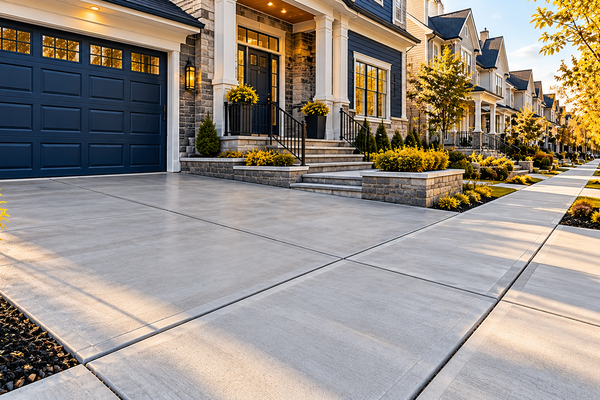
Jerome Park’s sidewalks are working sidewalks. They carry schoolchildren to the reservoir-side streets, commuters to the bus stops, and every delivery and dog-walk the neighborhood makes in a day — and they carry them over concrete that, in front of many of the area’s pre-war apartment buildings, is older than the residents who use it. A sidewalk is not decoration here; it is the first thing a visitor meets at a building and the last thing an owner wants to be liable for. Star Construction has built and repaired walks and driveways across the New York area since 2018, and our sidewalk and driveway contractors bring the same judgment to Jerome Park: inspect the whole run, flag by flag, and tell you which slabs are sound, which can be saved, and which have finished their service.
The job starts with measurement, not demolition. We walk the full frontage — sidewalk flags, curb, apron, and driveway — noting each flag’s condition, each joint’s width, each place where a tree root has lifted a corner or where a winter’s freeze has scaled a surface. The report that follows is plain: a flag-by-flag recommendation, a grade that sends water to the street, and a pour schedule that keeps the building’s entrance usable while the work is done. Where a sidewalk repair and replacement is needed, we match the new work to the old — same flag size, same joint lines, same broom finish — so the repaired run reads as the sidewalk it always was, not a patchwork of different pours.
For owners of the neighborhood’s pre-war apartment buildings and brick homes, the stakes are practical. A trip edge is a liability claim waiting for a pedestrian; a DOT notice is a deadline that does not negotiate; a settled apron is water finding its way toward a foundation. Our crews handle the full run in one mobilization — flags, curb, apron, driveway — so a building’s concrete threshold is fixed as one job, at one grade, in one concrete, instead of being repaired piecemeal over years. And because Jerome Park’s streets run downhill toward the reservoir, we pour with the slope in mind: joints that relieve the grade’s pressure, bases that drain, and finishes that grip in a Bronx winter.
Sidewalk and driveway construction is the trade of the ground a building stands on and the ground its visitors walk over: the public walk, the curb, the apron where a driveway meets the street, and the driveway itself, built as one connected run at grades that drain and joints that move. In New York City the work has a second dimension that does not exist in the suburbs: the sidewalk adjoining a property is the owner’s responsibility to maintain, and the Department of Transportation can require its repair on a notice with a deadline. That makes a Jerome Park sidewalk job part construction and part compliance — the concrete must be right, and it must be right in time.
The work itself is straightforward to describe and exacting to do. A flag is a slab, typically five feet square, poured on a compacted base with joints that let each flag move independently; a run of flags must hold a consistent cross-slope so water sheets to the curb, not toward the building. Sidewalk repair and replacement means judging each flag on its own merits — grinding a lip that is small enough to grind, lifting and re-bedding a slab that has settled evenly, replacing the flags whose bases have failed — and then matching the new work to the old so the walk reads as one pour. Driveway work adds the apron at the street edge, the curb cut, and a grade that lets a car climb a Jerome Park hill without bottoming out and lets water run to the street instead of pooling at the garage.
What separates a good sidewalk contractor from a careless one is mostly invisible: the base. A flag poured on uncompacted fill will settle; a flag poured without drainage will heave in the first hard freeze; a joint sealed with the wrong material will hold water against the slab edge all winter. Our crews excavate to sound material, compact in lifts, and set joint lines that follow the walk’s own logic. The visible part — the broom finish, the tooled edges, the clean joint lines — is the easy part, and it only stays clean when the part underneath was done properly.

If the walk in front of your Jerome Park building has a lifted flag, a DOT notice on the door, or an apron that has settled away from the street, the honest next step is an inspection, not a guess. Our crews measure the whole run, explain which flags can be saved and which must go, and price the repair flag by flag — so a building owner knows exactly what the notice requires and what the walk actually needs, without paying for work the concrete does not yet demand.
We work on the neighborhood’s schedule as much as our own: phased pours that keep an entrance open, barricades and plates that keep a walk passable while new concrete cures, and notice deadlines treated as hard dates, not suggestions. Whether the job is a single trip edge, a full frontage, or a driveway and apron rebuilt to a grade the hill can live with, the approach is the same — honest assessment first, matching materials second, and a finish that holds through Bronx winters. See the full list of neighborhoods we serve on our service areas page, and request a free, no-obligation estimate from Star Construction INC today.
Our clients value the consistency, structural precision, and long-term performance we deliver on every project, from initial planning through final execution.

 Jav V
Trustindex verifies that the original source of the review is Google.
Got my bathroom remodel Team was professional on time Thank you Ever fernando Perez saldañaCrear Word
 LUIS CAYOi hire them for my home project. and everyting went smoothly. no delays
 Shahid IqbalVery reliable contractor. They did exactly what they promised and the quality was excellent. Would definitely recommend.
Contact us now to discuss your project and receive a no-obligation quote from our experts.
Every project is handled through a defined process that ensures accuracy, efficiency, and long-term structural performance from start to finish.
We begin by reviewing site conditions, understanding project objectives, and identifying structural requirements to establish a clear and practical direction before any work begins.
A detailed execution plan is developed, including material selection, sequencing of work, and coordination of labor to maintain consistency and avoid delays during construction.
Work is carried out using proven installation methods, with attention to structural integrity, proper reinforcement, and adherence to safety and quality standards.
A final walkthrough is conducted to verify workmanship, resolve any outstanding details, and ensure the completed project meets performance expectations and durability standards.
A professionally built sidewalk and driveway do more than look tidy — they keep a building compliant, safe, and dry. The benefits below are the ones Jerome Park owners actually feel: a walk that passes inspection without a second visit, a trip edge removed before it becomes a claim, a driveway that drains to the street on a hill, and concrete that survives the freeze-thaw cycle instead of surrendering to it one winter at a time.
In New York City, the sidewalk in front of a property is the owner’s responsibility to maintain, and the Department of Transportation enforces it: a sidewalk inspection that finds a defective flag can produce a violation notice requiring repair within a set period, followed by re-inspection. For a building owner, that turns a sidewalk from a maintenance item into a deadline. Our DOT violation removal work is built around that clock — we assess the cited defects, repair the full flagged area to the standard the inspector will check, and leave the owner with a walk that can be re-inspected without a second round of work. We never promise a dismissal outcome; what we promise is work done to the standard the notice describes, on the schedule it sets.
The same discipline applies before a notice ever arrives. A proactive walk — flag by flag, joint by joint — catches the defects that produce violations: a raised lip at a tree root, a cracked corner, a settled flag at a driveway apron. Fixing those on the owner’s schedule costs less and disrupts less than fixing them on the city’s. For co-op and condo boards, a dated inspection record also answers the question every shareholder eventually asks: what did we know, and when did we act on it.
Tree roots are Jerome Park’s most common sidewalk problem and its most misdiagnosed one. A root lifts a flag slowly, a fraction of an inch a season, until the lip is high enough to catch a shoe — and by then the instinct is to tear the whole run out. The honest answer depends on the root and the slab. A lip of half an inch or less on an otherwise sound flag can often be ground to a safe bevel, a fast repair that leaves the tree and the walk intact. A flag that has settled evenly, or a section where the base has washed out, can sometimes be lifted and re-bedded at grade. And a flag cracked through, or one whose root has grown too large to work around, is a replacement — cut cleanly, root pruned properly, and re-poured on a base that gives the tree room without giving the walk a new trip edge next year.
The same judgment applies to cracks. A hairline crack in a sound flag is a sealant job; a crack that has opened, spalled, or begun to rock underfoot is a slab that has lost its base, and no surface treatment will save it. Our tree root sidewalk damage repair crews assess root and slab together, because fixing one without the other is how the same flag lifts again within two winters. Where concrete crack repair is genuinely enough, we say so and price it as the smaller job it is — the cheapest honest repair is the one that does not have to be done twice.
Jerome Park’s driveways work harder than most: short runs on steep grades, cars turning out of them onto hilly streets, and aprons that take the full weight of traffic crossing from the street to the lot. The material question is real, and it has no single answer — concrete for a long, stable run; asphalt where flexibility and resurfacing matter; pavers where a building wants the look to carry the entrance. Our driveway installation and resurfacing crews grade first and choose second, because on a slope the grade decides whether a material will last: a driveway that drains to the street, holds its edge at the apron, and meets the sidewalk at a clean, level joint will outlast a prettier driveway poured flat.
The apron deserves the same attention as the driveway behind it. It is the part of the run the city sees, the part the plow hits, and the part that settles first when its base was skimped. We pour aprons as part of the whole run — same base, same joint lines, same finish — rather than as an afterthought, and where an older asphalt driveway is sound underneath, asphalt driveway repair can extend its life honestly for years. For owners weighing the options, our driveway materials compared guide walks through concrete, asphalt, and pavers side by side, so the choice is made on cost, lifespan, and maintenance — not on whatever the contractor happens to pour.
Every sidewalk and driveway in Jerome Park is also a drainage decision, because the neighborhood slopes toward the reservoir and water follows the grade whether the concrete planned for it or not. A walk poured flat against a building’s foundation invites water to the wall; a driveway graded toward the garage sends every storm to the door it should never reach. Our crews set grades deliberately: cross-slope on the walk shedding to the curb, driveway fall carrying water to the street, joints and edges that keep runoff in the gutter rather than under the slab. The result is a run that stays dry at the building line and stable under the slab, instead of a walk that looks fine in August and heaves in February.
Drainage is also where sidewalk work meets the rest of a building’s concrete. A settled stoop, a cracked curb, and a walk that ponds are usually one problem expressed in three places, not three separate problems — and fixing the walk without correcting the grade leaves the cause in place. That is why our sidewalk jobs are scoped with the building’s other concrete in view: where the walk meets the stoop and the driveway meets the apron, the grades must agree. For the wider picture of a building’s concrete — stoops, curbs, and aprons as one threshold — see our concrete repair and installation contractors in Jerome Park, who handle the same grades at the building face.
Yes, in New York City the property owner is responsible for maintaining the sidewalk adjoining their property, including keeping it safe, level, and in good repair. That is true whether the building is a single-family home or a multi-family apartment building, and whether the damage was caused by a tree root, a winter freeze, or simple age. The city can inspect the walk and, if it finds defects, issue a violation notice requiring repair within a set period. For co-op and condo buildings, the board carries that responsibility on behalf of the owners, and the cost of the repair is a building expense like any other.
First, read the notice carefully: it identifies the defective flags and gives a deadline for the repair. The work itself is to repair the cited defects to the city’s standard — replace the broken or lifted flags, restore a level walk, and correct the grade — and then have the walk re-inspected. What the notice does not do is promise any particular outcome, and no contractor honestly can: the repair cures the defect, and re-inspection confirms it. The practical advice is to start immediately, because the deadline does not pause for scheduling, and because a contractor booked late may not finish before it expires. If the notice covers only part of a frontage, have the whole run inspected at the same time — the next notice usually covers what the first one missed.
Sometimes, and the number that matters is the height of the lip. A rise of about half an inch or less on a flag that is otherwise sound — not cracked through, not rocking, not undermined — can usually be ground to a safe bevel, which removes the trip hazard without disturbing the tree or the walk. Beyond that height, grinding removes too much of the slab’s thickness and weakens it, so the honest fix is lifting and re-bedding or replacing the flag. A flag that rocks, or one whose crack runs corner to corner, should not be ground at all: the problem is underneath it, and a smooth surface over a failed base is still a failed slab.
Generally, the homeowner: the apron — the section of driveway between the sidewalk and the street, including the curb cut — is part of the property’s frontage, and its upkeep falls to the owner just as the sidewalk does. Work at the road edge usually involves city coordination, because the apron meets the public roadway and the curb, and the curb cut itself is a city-controlled feature. In practice, that means an apron repair is quoted as part of the whole driveway run, with the street-edge work coordinated so the new apron meets the existing curb and gutter cleanly. A contractor who prices a driveway without mentioning the apron is pricing half the job.
Sidewalk work in New York City generally involves the city’s DOT permit process, because the walk sits in the public right-of-way even though the owner maintains it — permits cover the opening of the sidewalk, the protection of pedestrians during the work, and the restoration to the city’s standard. Like-for-like repair of a small section is usually simpler than a full frontage replacement, but neither should start without the permit in hand. A contractor who offers to skip the permit is offering to put the owner at odds with the same agency that issued the notice. For driveways, the curb cut and the apron at the street edge add their own approvals, which is why we scope permits as part of the job, not as an afterthought.


