
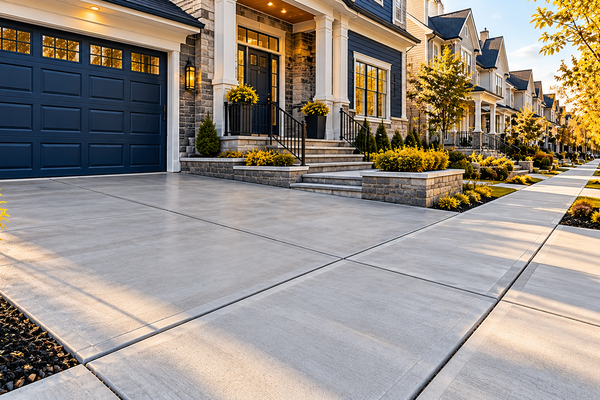
As sidewalk and driveway contractors in New York, Star Construction INC brings the same inspection-first approach to Queens — from a single lifted flag in front of a house to a long sidewalk run in front of a multi-family building. Our services include sidewalk repair and replacement, DOT violation removal, driveway installation and resurfacing, concrete crack repair, tree root sidewalk damage repair and asphalt driveway repair, and every job starts with an inspection of the full run so the scope is honest before any price is quoted.
Concrete is the right material for nearly all of this work in Queens — it matches the borough’s existing sidewalks, holds up under foot traffic and freeze-thaw winters, and can be poured to grades that keep water moving toward the street rather than pooling at the stoop. For wider concrete scopes — stoops, walkways, patios and full flatwork — see our concrete repair and installation contractors in Queens. The areas we cover are listed on our service areas page.
Sidewalk and driveway construction is the building and repair of the hard surfaces that connect a property to the street: the sidewalk flags in front of the building, the driveway that carries cars from the curb to the garage, and the apron where the driveway meets the road. Each element is a concrete slab system — a prepared base, control joints that let the slab move without cracking at random, and a finish that gives grip underfoot and under tire — and each fails in its own way when the base, the joints or the drainage are wrong.
In New York City the stakes are higher than on a suburban lot: the property owner is responsible for the sidewalk adjoining the property, so a lifted flag or a broken section can draw a DOT violation notice. Our DOT violation removal service repairs the flagged defects — replacing broken flags, correcting trip edges and restoring grades — and the city then re-inspects and decides whether the violation is cleared; no contractor can promise a dismissal outcome. Where tree roots have done the damage, tree root sidewalk damage repair addresses the cause as well as the slab, and driveway installation and resurfacing covers the driveway side of the same run.

When you are looking for reliable sidewalk and driveway contractors in Queens, start with an inspection, not a quote over the phone: the scope depends on what the run actually shows — how many flags are broken, how far the roots have traveled, whether the apron has settled. Star Construction INC inspects first, photographs what it finds, and prices the repair that the run genuinely needs, whether that is a partial replacement, a full run, or a driveway resurfacing. Request a free, no-obligation estimate today, and see the areas we cover on our service areas page.
Our clients value the consistency, structural precision, and long-term performance we deliver on every project, from initial planning through final execution.

 Jav V
Trustindex verifies that the original source of the review is Google.
Got my bathroom remodel Team was professional on time Thank you Ever fernando Perez saldañaCrear Word
 LUIS CAYOi hire them for my home project. and everyting went smoothly. no delays
 Shahid IqbalVery reliable contractor. They did exactly what they promised and the quality was excellent. Would definitely recommend.
Contact us now to discuss your project and receive a no-obligation quote from our experts.
Every project is handled through a defined process that ensures accuracy, efficiency, and long-term structural performance from start to finish.
We begin by reviewing site conditions, understanding project objectives, and identifying structural requirements to establish a clear and practical direction before any work begins.
A detailed execution plan is developed, including material selection, sequencing of work, and coordination of labor to maintain consistency and avoid delays during construction.
Work is carried out using proven installation methods, with attention to structural integrity, proper reinforcement, and adherence to safety and quality standards.
A final walkthrough is conducted to verify workmanship, resolve any outstanding details, and ensure the completed project meets performance expectations and durability standards.
Sidewalk and driveway work in Queens pays for itself in three currencies: safety, compliance and curb appeal. A level, well-drained run keeps pedestrians safe, keeps the city off your doorstep, and presents a building that looks cared for. These are the benefits that matter most to the borough’s homeowners and building owners.
In New York City, the sidewalk in front of your property is your legal responsibility to maintain — not the city’s. When DOT inspects and finds defects, the violation notice names the owner and sets the repair in motion; ignoring it does not make it go away, and the city may eventually repair the defects itself and bill the owner. Our DOT violation removal service handles the repair side: we survey the flagged defects, replace or repair the affected flags, and document the finished work so the owner can request re-inspection. The city re-inspects and decides whether the violation is dismissed — that decision is always the city’s, and any contractor promising otherwise should not be believed.
Queens streets are lined with mature trees, and their roots are the single most common cause of lifted sidewalk flags in the borough. Roots spread beneath a slab looking for water and air, thicken season by season, and lift a flag edge until it becomes a trip hazard. Tree root sidewalk damage repair starts with the cause, not just the symptom: whether the slab can be lifted and re-laid, whether the root can be managed without harming a city street tree, or whether a section must be rebuilt with room for the roots. Our guide to tree roots and sidewalk damage in NYC explains who is responsible for what when a city tree is involved.
A trip edge as small as half an inch is enough to send a pedestrian down, and it is exactly the kind of defect a DOT inspector marks. Small lips can sometimes be ground smooth; a flag that has cracked through, settled unevenly or lost its base usually needs sidewalk repair and replacement, and hairline cracking across a slab is handled by concrete crack repair before it opens into a break. The honest test is simple: if the slab is still sound and level apart from the lip, grinding may do; if the slab has moved, cracked or hollowed, replacement is the repair that lasts.
Driveways and aprons take a different kind of punishment: car weight, turning tires, de-icing salt and the freeze-thaw cycle, all on a surface that must also drain toward the street. Driveway installation and resurfacing covers concrete driveways and aprons, while asphalt driveway repair serves the borough’s many asphalt drives — patching, resurfacing or full replacement depending on the base condition. The choice between concrete and asphalt is covered in our comparison of driveway materials, so the decision is made on facts rather than habit.
Start by reading the notice carefully: it lists the defects DOT found and the location of each flagged section. Then get the flagged defects surveyed and repaired — replacing broken flags, correcting trip edges and restoring grades — and keep photographs and paperwork from the repair. Once the work is done, request re-inspection through the city’s process. The city re-inspects and decides whether the violation is dismissed; no contractor can guarantee that outcome, so be wary of anyone who promises one. If the notice is ignored, the city may repair the defects itself and bill the owner.
In New York City, the property owner adjoining the sidewalk is responsible for maintaining it and for the cost of repairs — that is the city’s rule, and it applies whether the property is a single-family house, a two-family home or a multi-family building. The city owns the street trees, but the sidewalk flags beneath them are the owner’s to keep safe. Where a building is a co-op or condo, the cost is typically handled through the building, but the responsibility still sits with the property, not the city.
Sometimes. A small, sound flag with a modest lip can be ground down or ramped to remove the trip edge, and a flag that has lifted slightly may be lifted and re-laid on a corrected base. But grinding cannot fix a flag that has cracked through, settled unevenly or lost its base, and it cannot help where roots will keep pushing. A survey of the flag’s condition — sound or broken, level or settled, root cause addressed or not — decides which repair is honest.
Most residential sidewalk replacements are completed in a few days: the old flags are broken out, the base is prepared, and the new concrete is poured and finished. A short run in front of a house may be done in a day or two; a long run in front of a multi-family building takes longer. Fresh concrete needs time to cure before it can carry foot traffic — usually a day or two — so access is planned around the pour, with a temporary path kept open where possible. The exact schedule depends on the length of the run and the weather.
Sidewalk work in New York City generally requires the proper DOT permits and coordination, because the sidewalk is part of the public right-of-way even though the owner maintains it. Driveway work on private property is usually simpler, but apron work where the driveway meets the street also falls under city rules. A contractor working in Queens should handle the permit side as part of the job — ask how permits are handled before work begins, and be cautious of any contractor who suggests skipping them.


