A sidewalk and driveway in Village of Pelham are one continuous run of concrete, and they fail as one system. The walk in front of the house, the apron where the driveway meets the street, and the driveway itself share the same base, the same winters and the same street trees — and a fault in one part of the run usually tells you something about the rest. As sidewalk and driveway contractors in New York, we have repaired runs of every kind, but the village’s pre-war streets ask for a particular approach: measure the whole run, judge it slab by slab, and replace only what has genuinely failed.
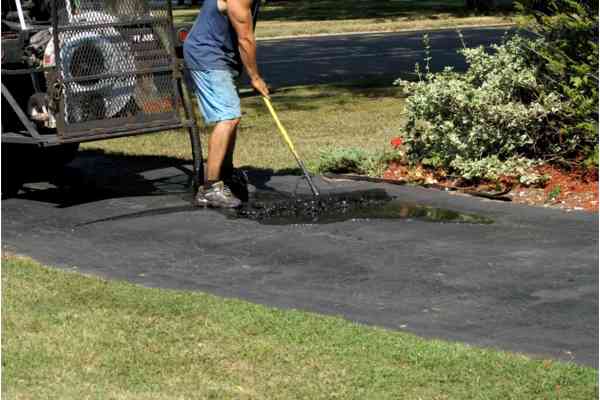
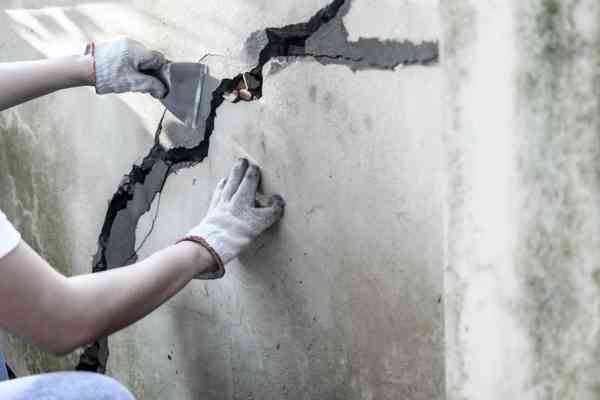
That judgement covers the full range of the work: sidewalk repair and replacement where slabs have settled, cracked or lifted; tree root sidewalk damage repair where the canopy’s roots have done the lifting; concrete crack repair where a crack can still be sealed before water reaches the base; and driveway installation and resurfacing where the driveway itself has worn, rutted or broken up. Where a driveway is asphalt rather than concrete, our asphalt driveway repair service covers the same honest assessment — patch, resurface or replace, judged on the driveway’s actual condition.
We also keep the village side of the work in view. In most Westchester villages the adjoining homeowner maintains the walk that fronts their home, and the village can require a repair to be made; work at the public walk or at the road edge generally needs village coordination. We build that coordination into the schedule, and we price the run as one job — walk, apron and driveway — so the finished work reads as a single, level, well-drained surface rather than a patchwork of different ages.
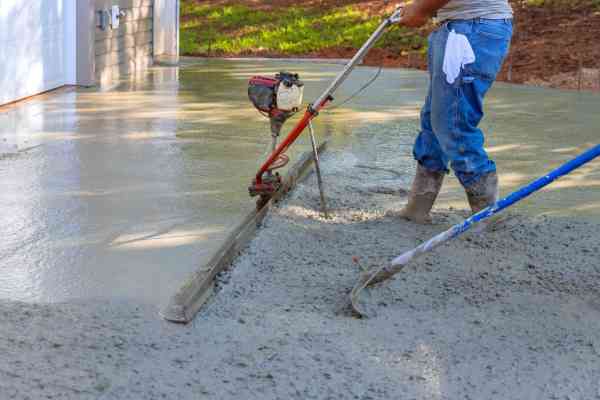
Sidewalk and driveway construction is the building, repair and replacement of the paved run that connects a house to the street: the public walk in front of the home, the apron where the driveway crosses the sidewalk and meets the road, and the driveway itself. It is concrete work first and foremost — slabs poured on a prepared base, jointed so they can move with the seasons, and graded so water runs to the street rather than pooling at the door or seeping toward the foundation.
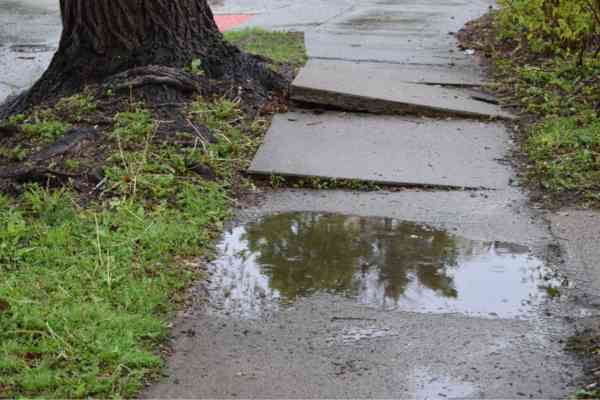
In Village of Pelham, that work is shaped by the village’s age and its trees. Walks laid decades ago have been lifted by roots, cracked by freeze-thaw winters, and patched by successive owners; driveways have been widened, resurfaced and re-graded over the same years. Good sidewalk and driveway work here therefore starts with reading the existing run: which slabs are sound, which have lost their base, where the grade has reversed, and where a root will lift the next slab if it is not dealt with now.
The sections below follow the order of a sound job on a village run: who is responsible for the walk and what a village notice means in practice; the honest choice between grinding, lifting and replacing a lifted slab; the driveway and apron themselves, including the materials question; and the grades and drainage that make the whole run last.

If you are looking for sidewalk and driveway contractors in Village of Pelham, the right first step is a walk of the whole run — not a quote for a single slab. Star Construction INC has been carrying out sidewalk, driveway, concrete and masonry work since 2018, and our approach on a Pelham property is deliberately plain-spoken: we measure the walk, the apron and the driveway, photograph the faults, and tell you which slabs can be ground or lifted, which must be replaced, and what the grades need to be for the new work to drain properly.
That candour matters because sidewalk work is easy to sell badly. Grinding a slab that has lost its base, patching a driveway whose sub-base has failed, or replacing a walk without correcting the grade that ponded water against it are all jobs that will need doing twice. We would rather tell a homeowner that a slab is past saving, or that the apron needs village coordination before work starts, than sell the quick fix and leave the cause in place.
To discuss your walk and driveway, see our service areas or request a free, no-obligation estimate. We will walk the run with you, set out the repairs slab by slab, and price the work honestly — including any village coordination the job needs — so the finished surface is level, well drained and built to last.
Our clients value the consistency, structural precision, and long-term performance we deliver on every project, from initial planning through final execution.

 Jav V
Trustindex verifies that the original source of the review is Google.
Got my bathroom remodel Team was professional on time Thank you Ever fernando Perez saldañaCrear Word
 LUIS CAYOi hire them for my home project. and everyting went smoothly. no delays
 Shahid IqbalVery reliable contractor. They did exactly what they promised and the quality was excellent. Would definitely recommend.
Contact us now to discuss your project and receive a no-obligation quote from our experts.
Every project is handled through a defined process that ensures accuracy, efficiency, and long-term structural performance from start to finish.
We begin by reviewing site conditions, understanding project objectives, and identifying structural requirements to establish a clear and practical direction before any work begins.
A detailed execution plan is developed, including material selection, sequencing of work, and coordination of labor to maintain consistency and avoid delays during construction.
Work is carried out using proven installation methods, with attention to structural integrity, proper reinforcement, and adherence to safety and quality standards.
A final walkthrough is conducted to verify workmanship, resolve any outstanding details, and ensure the completed project meets performance expectations and durability standards.
A sidewalk and driveway run is judged as a whole, and it is repaired as a whole too. The four sections below follow the order we work in on a Pelham property: who is responsible for the village walk and what a repair notice means; the honest choice between grinding, lifting and replacing a lifted slab; the driveway and apron themselves, including the materials question; and the grades and drainage that decide whether the new work lasts. Read together, they are the whole of a sound sidewalk and driveway plan.
In most Westchester villages, the sidewalk in front of a house is the adjoining homeowner’s to maintain, even though the walk itself is a public way. That arrangement surprises some owners, but it is the long-standing practice: the village owns the right-of-way, and the homeowner keeps the walk that fronts their lot safe, level and passable. It means the lifted slab, the cracked panel and the settled corner are the homeowner’s to put right — and the homeowner’s to plan for, before they become someone else’s fall.
A village may also require a repair to be made, in general terms, when a walk becomes a hazard. A notice to repair is not a fine for its own sake; it is a deadline, and it usually arrives with a window in which the work must be done. The practical response is to treat the walk as part of the property’s regular upkeep rather than waiting for the notice: a level walk inspected each spring, with small faults dealt with as they appear, rarely produces either a hazard or a deadline.
When we take on a village walk, we therefore start with the whole frontage, not the single worst slab. The run is measured, each slab is judged, and the repair is planned so the finished walk is continuous, level and properly jointed — and so the homeowner knows, before work starts, which slabs are being replaced and why. The cost depends on how many slabs have failed and how much of the base beneath them has gone with them.
A lifted slab edge is a trip hazard, but it is not automatically a replacement. Three honest fixes exist, and the right one depends on how far the slab has moved, whether its base is still sound, and whether the root that lifted it is still growing. Grinding suits a small lip — typically a modest height difference on a slab that is otherwise sound and stable. The high edge is ground down to a smooth, safe transition, the work takes little time, and the slab stays in place. It is the cheapest fix, and it is the right one when the lift is small and the slab is not still moving.
Lifting — raising a settled or uneven slab by injecting material beneath it, in the manner of mudjacking — suits a slab that is intact but has dropped or tilted because its base has washed out or settled. The slab is brought back toward level without being broken out, and the joint is sealed against further washout. It is honest work when the slab itself is whole and the base can be stabilised, and it costs less than replacement. It is not the answer for a slab that is cracked through, badly spalled, or still being pushed by an active root.
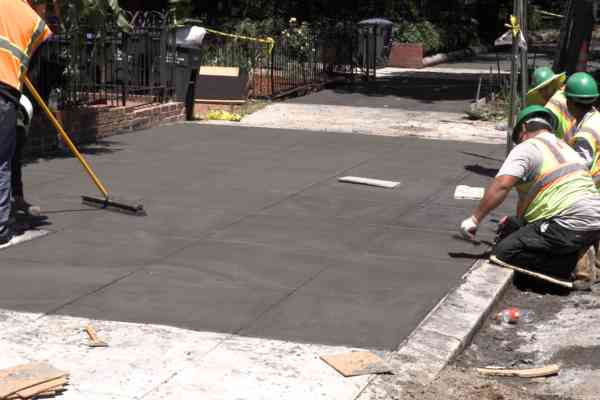
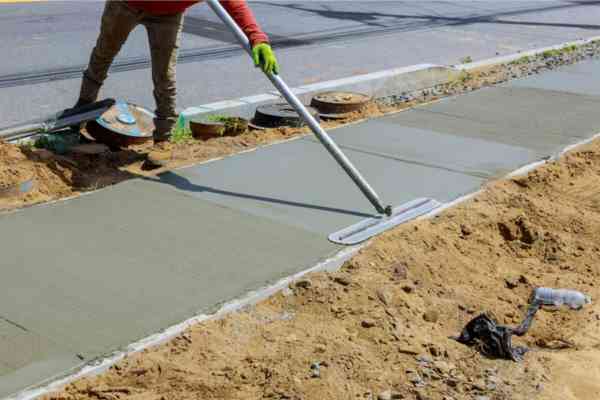
Replacement is the answer when the slab is broken, when its base has failed, when the lift is too great to grind safely, or when the root must be dealt with before a new slab goes down. A replaced section is poured on a properly compacted base, jointed to match the run, and graded to drain — and where a street tree is the cause, the root is managed with the village’s guidance so the new slab is not lifted again within a few seasons. The cost depends on which fix fits each slab, and a run will often mix all three: grind the small lips, lift the sound-but-settled slabs, and replace the ones that are done.
The driveway is the hardest-working part of the run: it carries cars, not footsteps, and it meets the street at the apron, the section most exposed to ploughs, salt and the turning of wheels. A Pelham driveway fails in the ways driveways everywhere fail — ruts where wheels always travel, cracks where the base has thinned, an apron that has broken up at the road edge — but the repair judgement is the same slab-by-slab honesty as the walk: resurface where the base is sound, replace where it has gone, and never dress a failed base with a new surface and call it done.
The materials question comes up on nearly every driveway job, and it deserves a brief, honest answer. Concrete gives a long, rigid surface that suits the village’s pre-war houses and matches the walk and apron in one material; asphalt gives a flexible surface that is often cheaper to lay and simpler to patch, and that suits a driveway whose base is still settling. Neither is universally better — the right choice depends on the driveway’s base, its drainage, its exposure to shade and salt, and what the rest of the property is built from. Our comparison of the options is set out in our driveway materials compared guide, and we talk through the choice on site before quoting, not after. Where the driveway is concrete, the work sits alongside our concrete repair and installation contractors in Village of Pelham service, so walk, apron and driveway can be planned as one concrete job.
The apron deserves its own attention, because it is where the private driveway meets the public street. It takes the worst of the weather and the traffic, and work at the road edge generally needs village coordination before it starts. We build that coordination into the schedule, and we pour the apron to the village’s line and grade so the finished junction is smooth, level and properly drained — no lip for a tyre to catch and no dip for water to sit in. The cost of driveway and apron work depends on the area, the material and how much of the base must be rebuilt.
Every slab in the run has a job beyond carrying weight: it must shed water in the right direction. The grade of a walk and driveway should fall gently and consistently toward the street, so rain and meltwater leave the property rather than pooling at the door, sitting against the foundation, or finding its way toward the cellar. A walk that ponds, a driveway that holds a puddle at the garage, or an apron that dips at the road edge is a grade problem first and a surface problem second — and repaving without correcting the grade only rebuilds the puddle.
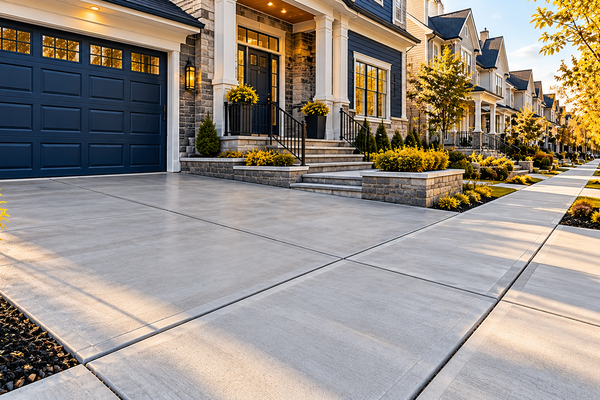
Getting grades right means looking at the whole run before any concrete is poured. The finished heights are set against fixed points — the door threshold, the garage floor, the street gutter — and each section is graded to fall between them without creating a lip at a joint or a low spot where water can sit. Joints are placed where the slab needs to move, and sealed so water cannot wash the base out from beneath. Where the ground falls the wrong way, the correction may be regrading rather than repaving: raising a settled section, rebuilding a base that has washed out, or adjusting the apron so the junction with the street drains cleanly.
The payoff is quiet but decisive. A well-graded run does not pond, does not ice in sheets across the walk in winter, and does not feed water toward the foundation. It also lasts longer, because a base that stays dry stays solid, and a slab that is not undermined by water does not crack and settle. The cost of getting grades right is part of the job, not an extra — and it is the difference between a surface that looks good on the day it is poured and one that is still level and dry years later.
In most Westchester villages, yes — in practice, if not in the letter of every local rule. The walk itself lies in the public right-of-way, but its upkeep — keeping it level, safe and passable — sits with the homeowner whose lot it fronts. That is the long-standing arrangement in villages like Pelham, and it is why a lifted or cracked walk is the homeowner’s to put right even though the public walks on it.
The village can also require a repair to be made, in general terms, when a walk becomes a hazard: a notice to repair sets a window in which the work must be done. The practical course is to treat the walk as ordinary upkeep — a level walk inspected each spring, with small faults dealt with as they appear — rather than waiting for a notice or a fall to force the question. The cost of any repair depends on its scope: how many slabs have failed and how much of the base beneath them has gone with them.
Sometimes — and when it can, it is the simplest and cheapest fix. Grinding suits a small lip on a slab that is otherwise sound and stable: the high edge is ground down to a smooth, safe transition, the work takes little time, and the slab stays in place. It is the right answer when the height difference is modest and the slab is not still moving.
It is not the answer when the lift is large, when the slab is cracked through or badly spalled, when its base has failed, or when the root that lifted it is still growing — in those cases grinding thins a slab that is already failing and the lip will return. Those slabs need lifting, where the slab is intact but has settled, or replacement, where it is broken or its base has gone. The cost depends on which fix fits the slab, and it is judged on inspection, not from the street.
Generally, the homeowner — with a village qualification. The apron is the section of driveway that crosses the sidewalk and meets the street, and like the walk it fronts, its upkeep usually sits with the adjoining homeowner. But because the apron sits at the road edge and in the public right-of-way, work on it generally needs village coordination before it starts: the village sets the line and grade where the driveway meets the street, and the finished junction must drain properly and sit flush with the road.
In practice that means the homeowner pays for the apron and the village has a say in how it is built — which is a sensible arrangement, since a badly built apron affects everyone who uses the street. We build that coordination into the schedule, so the apron is poured to the village’s line and grade and the finished junction is smooth, level and properly drained. The cost of apron work depends on its size, its material and how much of the base beneath it must be rebuilt.
For a typical village frontage, the work itself is usually a matter of days rather than weeks: a day or two to break out the failed slabs and prepare the base, and a day to pour and finish the new sections, with the exact schedule depending on how many slabs are being replaced and whether the base must be rebuilt. Larger runs, or runs that need village coordination at the road edge, take longer — and any honest estimate will give you the schedule for your frontage, not a generic figure.
As for using the walk while the work is going on: during the pour and the curing that follows, the new concrete must be kept clear — usually for at least a day or two before it can take foot traffic, and longer before it can take anything heavier. We plan the work in sections where the frontage allows, so that part of the walk stays usable, and we set out a safe temporary route to the door while the new sections cure. The cost depends on the scope of the replacement, and the schedule is agreed before work starts so you can plan around it.
Work at the public walk generally needs village coordination, in general terms. A like-for-like slab replacement on the walk that fronts your home is often the simpler case, but because the walk lies in the public right-of-way — and because the apron meets the street — the village generally needs to be involved before work starts: to confirm the line and grade, to agree the scope, and to arrange any inspection the work requires.
The practical rule is to settle the question before the first slab is broken. We check what coordination the job needs and build it into the schedule rather than discovering it after the crew arrives, so a village requirement does not become a delay. The cost of the work itself depends on its scope; any village fees or coordination requirements are part of the honest estimate, not a surprise later.