
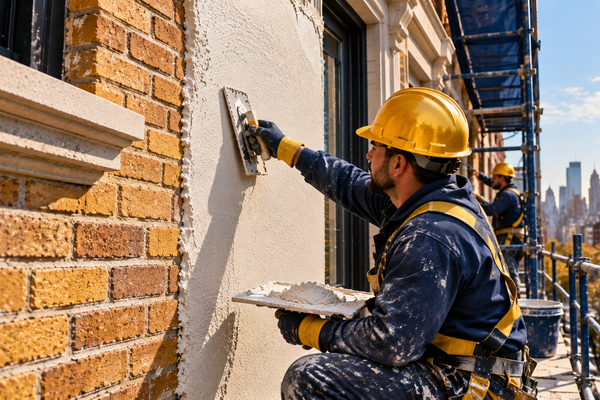
Brick and stucco work in Larchmont starts with a wall assessment, not a quote over the phone. As brick and stucco contractors in New York, we inspect the surface and what lies behind it, test the existing mortar and stucco, and explain which repairs are needed before any work is priced.
We have been working on homes in the New York area since 2018, and Star Construction INC serves Larchmont alongside all the areas we serve, with the same match-first approach on every wall, whatever its age.
Larchmont’s brickwork fails in the joints first: mortar softens, crumbles and recedes behind the face of the brick, and water follows it into the wall. Brick pointing and repointing replaces that failed mortar joint by joint, restoring the wall’s bond and its weather seal, and brick crack repair and replacement deals with the units themselves where they have cracked or spalled.
The second failure is the chimney: crowns crack, caps loosen and the top courses of brick take the worst of the weather, which is why chimney repair and rebuilding is so often part of a Larchmont brick job. We assess the whole wall — joints, units, lintels and chimney — before recommending a scope, so the quote covers the repair the wall actually needs.

If you are looking for brick and stucco contractors in New York for a Larchmont home, we cover brick pointing and repointing, stucco repair and application, brick crack repair and replacement, brownstone and historic façade restoration, exterior waterproofing for masonry, stucco skim coating and refinishing, lintel and shelf angle repair, chimney repair and rebuilding and EIFS stucco systems, as well as related masonry work in Larchmont. Star Construction INC works across all the areas we serve, and every Larchmont job starts with a free, no-obligation estimate.
Our clients value the consistency, structural precision, and long-term performance we deliver on every project, from initial planning through final execution.


 Trustindex verifies that the original source of the review is Google.
 Trustindex verifies that the original source of the review is Google.
 Trustindex verifies that the original source of the review is Google.
 Trustindex verifies that the original source of the review is Google.
Contact us now to discuss your project and receive a no-obligation quote from our experts.
Every project is handled through a defined process that ensures accuracy, efficiency, and long-term structural performance from start to finish.
We begin by reviewing site conditions, understanding project objectives, and identifying structural requirements to establish a clear and practical direction before any work begins.
A detailed execution plan is developed, including material selection, sequencing of work, and coordination of labor to maintain consistency and avoid delays during construction.
Work is carried out using proven installation methods, with attention to structural integrity, proper reinforcement, and adherence to safety and quality standards.
A final walkthrough is conducted to verify workmanship, resolve any outstanding details, and ensure the completed project meets performance expectations and durability standards.
Larchmont brick and stucco fail slowly and then all at once, and both punish guesswork: the wrong mortar damages old brick, and a cosmetic stucco patch over wet substrate peels within a season. Our work is built on matching — mortar, brick, texture and aggregate — so the repair disappears into the wall instead of advertising itself.
Matching is the whole craft on a period home. We test the existing mortar for colour, sand and hardness, then mix a compatible replacement that is softer than the brick it beds, so the joint — not the brick — takes the movement. Brick units are matched for size, colour and texture, and the new joint is tooled to the profile of the original, so the repair reads as part of the wall from the street.
Stucco on Larchmont’s Tudors cracks for a handful of reasons: old movement in the frame, moisture trapped behind the surface, a failed or shifting substrate, and coatings applied over a damp wall. We find the cause before patching, because a patch over a live crack reopens. Small areas are patched and textured to match the surrounding aggregate; where the surface has failed widely, a skim coat and refinish gives a uniform finish that still reads as the original texture.
Water behind brick or stucco changes the job entirely. It shows up as staining, bubbling, efflorescence and paint that will not stay put, and it usually enters at a joint, a flashing or a failed seal rather than through the field of the wall. We trace the entry point, dry the substrate and repair the source before any cosmetic work, because sealing water inside a wall only moves the damage somewhere more expensive.
Every Larchmont brick and stucco job starts with a free, no-obligation estimate visit. We walk the walls with you, photograph the joints, cracks and stains, test the mortar where needed, and explain the options in writing — what can be patched, what needs repointing or resurfacing, and what can honestly wait. Where village approval applies to the work, we flag it before quoting so there are no surprises.
Look at the mortar joints. Repointing is due when mortar is soft, crumbling or recessed behind the face of the brick, when joints are open enough to admit water, or when you can rake mortar out with a key. If the brick itself is sound and the joints are the problem, repointing is usually the right repair; if bricks are spalling or cracking, those units need attention too.
Yes, closely. We test the existing mortar for colour, sand and hardness, then mix a compatible replacement and tool it to the original joint profile. A close match matters for more than appearance: mortar that is harder than the old brick forces movement into the brick and cracks it, so the mix must be right, not just the colour.
The usual causes are building movement, moisture trapped behind the surface, a failed or shifting substrate, and coatings applied over a damp wall. Hairline cracks over old movement are common on older homes and are often cosmetic, but widening, stair-step or damp-stained cracks point to water or movement that should be found before patching.
It depends on the extent of the damage. Isolated cracks and small damaged areas can be patched and textured to blend with the surrounding wall, and a good patch is hard to spot once painted. Where cracking is widespread, the texture has failed across the wall or the substrate is compromised, resurfacing the whole wall gives the uniform finish a patch cannot.
It depends on the size of the job, the condition of the wall, access and curing time. Small repointing or patching jobs often take a few days; larger repointing, chimney work or a full resurface can take one to several weeks. Mortar and stucco need time to cure between stages, so weather and drying time are part of the schedule we agree before work starts.


