
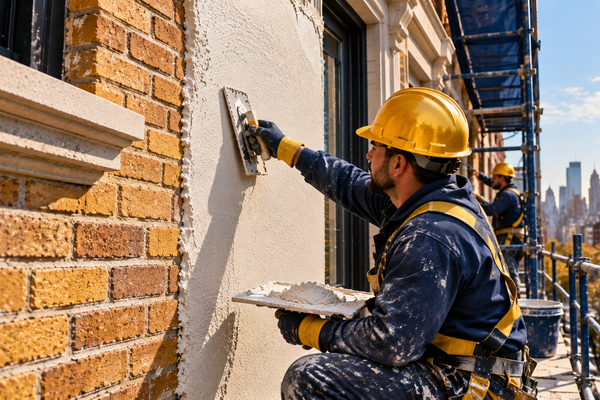
Mamaroneck’s brickwork faces the Sound first. The Tudors and colonials along the shore and the Post Road carry brick a century old, and salt air works the mortar joints harder here than it does inland: joints go sandy and recessed, faces spall where salt crystallises behind them, and chimneys — the tallest, most exposed masonry on the house — weather fastest of all, which is where chimney repair and rebuilding comes in. Our brick and stucco contractors in New York start with the wall itself: the mortar is tested for composition and hardness, the brick for soundness, and only then is a repair specified. Where brick pointing and repointing will cure the problem, that is the quote; where units have failed, brick crack repair and replacement is priced unit by unit. Star Construction INC has been working on homes in the New York area since 2018, and you can see all the areas we serve from this page.
Matching is the whole craft on a period home. A repair that is harder, redder or smoother than the original does not just look wrong — on historic brick it does active harm, because a hard modern mortar forces freeze-thaw and salt pressure into the softer brick face instead of yielding itself. We match mortar by composition and colour, testing the original for lime content and aggregate before mixing, and we match replacement brick by size, colour and texture, drawing on the same regional stocks the house was built from. On Mamaroneck’s Tudors, the same care goes into stucco: the texture and aggregate of the original coat are matched so a patch disappears instead of telegraphing through the paint. Brownstone and historic facade restoration work on the village’s grander homes follows the same rule — renewal in kind, never a harder skin over a softer wall. Where lintel and shelf angle repair is needed above an opening, the steel is treated and the masonry rebuilt around it, not patched over.

Stucco on the Sound fails in its own way. Hairline cracks open over old movement, salt-laden moisture wicks through the coat, and once water is behind the finish, the coat goes drummy — hollow-sounding when tapped — and eventually lets go in sheets. The repair depends on what the tap test and a moisture reading say: a sound coat with hairlines can be sealed and recoated, while a drummy section must come off back to sound material and be rebuilt in coats, not smeared over. Our stucco repair and application work follows that sequence, and where a whole elevation has tired, stucco skim coating and refinishing renews the surface uniformly. If your home wears a synthetic finish rather than traditional stucco, the repair sequence differs — our EIFS stucco systems work covers that system. See all the areas we serve and request a free, no-obligation estimate — Star Construction INC will inspect, photograph and explain the options.
Our clients value the consistency, structural precision, and long-term performance we deliver on every project, from initial planning through final execution.


 Trustindex verifies that the original source of the review is Google.
 Trustindex verifies that the original source of the review is Google.
 Trustindex verifies that the original source of the review is Google.
 Trustindex verifies that the original source of the review is Google.
Contact us now to discuss your project and receive a no-obligation quote from our experts.
Every project is handled through a defined process that ensures accuracy, efficiency, and long-term structural performance from start to finish.
We begin by reviewing site conditions, understanding project objectives, and identifying structural requirements to establish a clear and practical direction before any work begins.
A detailed execution plan is developed, including material selection, sequencing of work, and coordination of labor to maintain consistency and avoid delays during construction.
Work is carried out using proven installation methods, with attention to structural integrity, proper reinforcement, and adherence to safety and quality standards.
A final walkthrough is conducted to verify workmanship, resolve any outstanding details, and ensure the completed project meets performance expectations and durability standards.
Water behind the surface is what turns a small failure into a big repair. On a shore home, a hairline in the stucco or an open mortar joint is not just a blemish — it is an entry point, and once water is behind either material, salt and freeze-thaw do their work out of sight. This is why every Mamaroneck brick and stucco job starts with diagnosis, not decoration, and why the four standards below govern every estimate.
We tap the stucco, read the mortar and take moisture readings before quoting anything cosmetic. A drummy coat or a saturated wall is stripped back to sound material first, and where the issue runs wider than one wall — a chimney, a garden wall, a whole elevation — our masonry contractors in Mamaroneck assess the full system. Covering wet masonry with a fresh coat only hides the problem for a season.
Repointing uses a mortar matched in composition, strength and colour to the original, so the joint stays the sacrificial layer and the brick stays protected. Replacement units are matched by size, colour and texture, and brick pointing and repointing is cut to a proper depth rather than smeared over the old joint.
Failed stucco comes off to sound substrate and is rebuilt in coats with the right texture and aggregate, and exterior waterproofing for masonry is detailed at the joints, sills and flashing lines where shore rain actually enters — because a perfect finish over an unsealed joint fails at the first nor’easter.
Every estimate starts with an inspection, photographs of what we find, and a plain explanation of what is cosmetic, what is weatherproofing and what is structural. Star Construction INC will not sell a full resurfacing for a wall that patching will cure, and you can see all the areas we serve before you decide.
Look at the joints: mortar that is recessed, sandy to the touch or falling out in chunks, and bricks that are spalling at the face, are the classic signs. Hairline cracks alone are not always urgent, but joints open enough to hold water will let salt and frost work behind the brick over a winter. An inspection will tell you whether the mortar is simply worn or whether the wall also has damp behind it — the two problems need different work, and a free estimate will set out which yours is.
Yes, when the match is made deliberately: the old mortar is analysed for its mix, colour and aggregate, and the replacement is chosen to be equal or softer in strength, never harder. On a shore home this matters more than usual, because a hard modern mortar traps salt and water in historic brick and bursts the face. Done properly, a repointed joint weathers in and becomes hard to spot within a season or two.
Most stucco cracking on Mamaroneck homes comes from movement — the building settling, timber framing shrinking and swelling, or old repairs that did not bond — combined with water finding the cracks and widening them through freeze-thaw. Salt air adds its own pressure as crystals grow in the pores of the coat. Fine hairlines are often cosmetic and need sealing; wider cracks, drummy hollow areas or bulging coats mean the coat has parted from its substrate and needs a proper repair.
A single well-executed patch can be nearly invisible when the texture and aggregate are matched and the patch is feathered and finished with the same coat sequence — but a smear over a drummy or damp area will telegraph through paint and fail quickly. If the coat has failed across a whole elevation, or the colour has weathered unevenly, resurfacing that elevation gives a more even result. We will show you both options and their costs, which depend on the wall’s size and condition, before you decide.
A straightforward repointing job on one elevation typically takes a few days, while a single stucco patch can be completed in a day or two, allowing for curing between coats. Larger work — a whole house repointing, a full elevation resurface, or repairs that uncover damp or structural issues — runs into one to three weeks. Scaffolding, weather and the curing time between stucco coats set the pace, and the schedule is agreed in writing before work starts.


