This brownstone facade restoration guide explains how owners of New York’s 19th-century row houses can repair, preserve, and renew their brown sandstone fronts. Brownstone facade restoration is the specialized process of repairing, preserving, and renewing the brown sandstone fronts of 19th-century row houses found across Brooklyn, Manhattan, Queens, and the Bronx. A complete restoration typically includes repointing deteriorated mortar joints, repairing or replacing spalled and cracked stone, restoring stoops, lintels, window sills, and decorative details, and applying breathable waterproofing treatments. Because brownstone is a soft, layered sandstone, successful restoration requires a contractor with specific historic-masonry experience.
What Brownstone Is and Why It Deteriorates
Brownstone is not a distinct geological stone type but a brownish-red sandstone, quarried primarily in New Jersey, Connecticut, and Pennsylvania, that was sawn into thin veneer slabs and applied over a structural brick wall. The rich chocolate-brown color comes from iron oxide in the stone. The problem lies in brownstone’s layered sedimentary structure. Water penetrates the face, and New York’s freeze-thaw cycles do the rest: moisture trapped between the sedimentary layers expands when it freezes, causing the face to flake, peel, and spall. Once the dense outer face is breached, the softer inner layers erode rapidly. A coat of standard exterior paint, a common quick fix, actually accelerates deterioration by trapping moisture inside the wall.
Age alone does not doom a brownstone facade. The worst damage usually traces back to water: failed pointing that lets rain in, a leaking cornice or coping, gutters that overflow onto the wall, or an earlier repair that sealed moisture inside. That is why a good restoration starts with water management, not with cosmetics. Fix the source of the water first, and the stone repairs that follow stand a far better chance of lasting.
What a Complete Facade Restoration Includes
A proper brownstone restoration addresses the entire facade system. For a broader overview of our approach to exterior masonry, see our facade repair and restoration services.
Stone repair versus replacement. Sound but damaged stone can often be saved. Tinted patching compounds formulated for brownstone rebuild surface losses, while dutchman repairs, precisely cut pieces of matching stone set into the original, address deeper damage. Severely deteriorated units must be replaced with new brownstone or a compatible cast-stone substitute.
Repointing. Mortar joints deteriorate faster than the stone itself. Repointing, raking out failed mortar and installing new historically appropriate mortar, is the single most important maintenance task. Hard Portland cement mortars must never be used on brownstone. A proper lime-based mortar, matched in composition and color, is essential.
Stoops, lintels, and decorative elements. The iconic stoop endures abuse from foot traffic and de-icing salts. Window lintels, sills, cornices, and carved details project from the wall and catch water, making them the most vulnerable elements. Each is repaired or replicated to match the original profile.
Waterproofing. After repairs, a breathable penetrating water repellent, never a film-forming sealer, allows the wall to shed liquid water while letting trapped vapor escape.
How to Assess Your Brownstone’s Condition
Walk your facade from sidewalk to cornice and look for spalling and delamination, cracking, bulging, deteriorated mortar, efflorescence, and previous improper repairs. Document everything with photos. If you observe bulging, large cracks, or loose stones, keep the sidewalk clear and call a professional promptly.
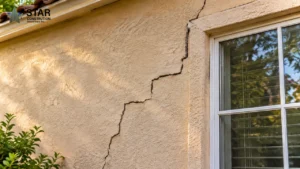
Not every symptom carries the same urgency. Surface flaking and worn pointing are maintenance issues to schedule; they rarely threaten the building, but they will worsen with each winter. Stair-step cracks, a bulging wall face, or a loose lintel or cornice stone are structural warning signs that deserve a prompt professional assessment, because they can indicate movement or a failing bond behind the veneer. Pay special attention to the top of the facade: cornices and cracked parapet walls shed water directly onto the stone below, so damage at the top often explains staining and spalling lower down. Photograph problem areas from the same spots each year so you can show a contractor how quickly a defect is changing.
Restoration Methods in Depth
Patching. For shallow surface loss, a mineral patching compound tinted to match the surrounding stone is built up in thin layers and tooled to the original texture. Good patching is nearly invisible from the sidewalk; poor patching is a hard, flat, wrongly colored rectangle that traps moisture at its edges. The difference is preparation, layering, and color matching in daylight, not just the product used.
Dutchman repairs. When damage runs deeper than a patch can credibly rebuild — a spalled lintel nose, a carved detail, a corner block — a dutchman is cut from matching stone and set into the original with a lime-based mortar joint. The new piece should read as part of the old wall, with matching color, grain, and tooling, rather than as an obvious insert.
Stone replacement. Units that have lost their structural integrity, or whose faces have delaminated through most of their thickness, are replaced with new brownstone where available or with a compatible cast-stone substitute shaped to the original profile. Replacement stone must match in color and weathering behavior, or the facade will look patched for decades.
Cleaning. A restored facade should be cleaned gently, with low-pressure water and soft brushing, and only as much as needed to reveal the stone’s true condition. Aggressive methods such as sandblasting or high-pressure washing erode the dense outer face that protects the softer stone beneath, and chemical cleaners must be chosen for brownstone rather than for brick. If a contractor proposes an aggressive cleaning method, ask what it will do to the stone’s surface before agreeing.
Mortar matching. The mortar matters as much as the stone. A lime-based mix, matched in composition, color, and joint profile to the original, flexes with the wall and lets moisture escape. A hard cement mortar does the opposite: it forces water through the softer stone instead, accelerating spalling around every joint.
Permits and Landmark Considerations in New York
Many brownstone neighborhoods lie within designated historic districts. If your building is a landmark or in a historic district, exterior work generally requires Landmarks Preservation Commission approval before Department of Buildings permits can be issued. Even outside historic districts, facade work typically requires DOB permits. Property owners in Queens may review our facade restoration services in Astoria, NY.
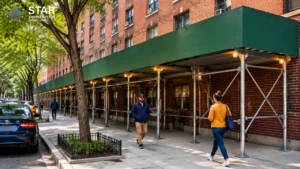
Landmark review is a planning factor, not a reason to postpone needed work. Check your building’s landmark and historic-district status early, before finalizing a scope or a schedule, because the approval step can add weeks to the timeline and may shape material choices, such as mortar composition and replacement-stone profiles. Keep a file of approvals, permits, and the contractor’s material specifications: future owners, and future contractors, will need to know exactly what was done and with what. Sidewalk protection is a separate practical matter — scaffolding or a sidewalk bridge is usually required while work proceeds above a public sidewalk, and the contractor should explain how pedestrian access will be maintained.
Facade Safety Rules for Taller Brownstone Buildings
Most brownstone row houses are four or five stories and sit below the threshold of New York City’s periodic facade inspection program, but taller brownstone apartment buildings can be covered. Buildings over six stories fall under the city’s facade inspection rules, which require periodic professional inspections and the filing of facade condition reports. If your building is in that taller category, a restoration plan should be coordinated with its inspection cycle, so that required repairs and the restoration scope are planned together rather than as two separate projects. Our guide to Local Law 126 parapet and facade inspections in NYC explains how that inspection framework works and what owners of taller buildings should expect.
Brownstone Facade Restoration Costs in the New York Market
Costs vary with facade size, condition, access, and scope. As general New York market planning ranges, not quotes: repointing typically runs $25 to $45 per square foot of wall area; localized patching often $3,000 to $8,000; partial facade restoration commonly $30,000 to $75,000; full restoration can range from $75,000 to $200,000 or more. These are planning ranges only. Exact pricing requires an on-site assessment.
Several factors move a project within, or beyond, those ranges. A tall facade needing full scaffolding and sidewalk protection costs more per square foot than a low front reached from a ladder. The share of stone that must be replaced, rather than patched, is a major driver, because replacement stone and dutchman work are labor-intensive. Prior improper repairs — cement pointing, painted surfaces, failed patches — add removal time before restoration can begin. Hidden deterioration discovered once scaffolding is up can extend both scope and schedule, which is why a responsible proposal explains how unexpected findings will be priced. Landmark review time does not change the masonry price, but it does change the project calendar, and owners should plan financing and tenant or occupant disruption around it.
Where Brownstone Row Houses Define the Streetscape
New York’s brownstone belt stretches across some of the city’s most recognizable neighborhoods. In Brooklyn, Park Slope, Fort Greene, Clinton Hill, Bedford-Stuyvesant, and Brooklyn Heights hold block after block of 19th-century brownstone row houses. Manhattan contributes Harlem, the Upper West Side, and parts of the Upper East Side, while the Bronx and Queens have their own smaller concentrations. Most of these homes were built between the 1840s and the 1890s, when brownstone was the fashionable facade material for the city’s growing middle and upper-middle class. Understanding your home’s age and original construction helps a restoration contractor choose appropriate materials and methods, since building practices shifted across those five decades.
What to Expect During the Restoration Project
A typical brownstone facade restoration follows a predictable sequence. After an initial assessment and written proposal, the contractor obtains required permits and, in historic districts, Landmarks approval. Scaffolding or a sidewalk bridge goes up, protecting pedestrians and giving masons full access to the facade. The crew then rakes out failed mortar, repairs or replaces stone, rebuilds deteriorated elements like stoops and cornices, and finally applies breathable waterproofing. For a standard row house front, active construction often spans several weeks to a few months depending on scope and weather. Throughout the project, a reputable contractor keeps the site clean, maintains sidewalk protection, and communicates about schedule changes. Ask for a written timeline before work begins, but understand that hidden deterioration discovered during the work can extend the schedule.
Maintaining Your Restored Brownstone Facade
Inspect the facade each spring, clean gently with low-pressure water, keep gutters and coping in repair, plan for repointing on a 25 to 50 year cycle, and never paint brownstone. Where brownstone meets brick on side walls, our brick and stucco restoration team applies the same breathable principles.
A simple annual routine protects the investment: walk the facade after winter, note any new cracks or flaking, clear gutters and downspouts before the spring rains, and keep de-icing salts off the stoop where possible. Small pointing failures caught early are a minor repair; the same failures left for five winters become a restoration project. Keep a maintenance log with dates and photographs — it helps the next contractor, and it supports the building’s value when you sell.
Choosing the Right Brownstone Restoration Contractor
Ask prospective contractors: How many brownstone facades have you restored recently? What mortar mix will you use and why? When do you recommend patching versus dutchman repairs versus replacement? How will you match stone color? What breathable waterproofing do you specify? Are you familiar with Landmarks requirements? Which permits will you obtain? What sidewalk protection will you provide? What is the payment schedule and warranty? Can you supply brownstone owner references? We serve owners across our New York service areas and welcome these questions on a site visit.
Watch for warning signs as well: a contractor who proposes cement mortar for brownstone, who wants to paint the facade, who suggests sandblasting, or who prices a full restoration without scaffolding access to inspect the upper facade is signaling a lack of historic-masonry experience. The right contractor will want to see the whole facade up close before quoting, will explain the difference between patching and replacement for your specific stones, and will put the scope, materials, and schedule in writing.
Star Construction Inc has served New York property owners since 2018, bringing specialized historic-masonry expertise to every brownstone facade we restore. Contact us for a free on-site assessment and a detailed written proposal tailored to your building.
Frequently Asked Questions
How long does a brownstone facade restoration last?
A quality restoration with lime-based repointing, sound stone repairs, and breathable waterproofing typically lasts 25 to 50 years before major renewal, assuming routine maintenance and good water management.
Can deteriorated brownstone be repaired, or must it be replaced?
Most deteriorated brownstone can be repaired with patching compounds or dutchman repairs. Full replacement is reserved for units that have lost structural integrity. A skilled contractor retains as much original fabric as possible.
Why should I not paint my brownstone facade?
Standard paint forms an impermeable film that traps moisture, accelerating freeze-thaw spalling. Brownstone must breathe. Paint is among the most damaging treatments for brownstone.
Do I need Landmarks approval to restore my brownstone?
If your building is a landmark or in a historic district, exterior work generally requires Landmarks Preservation Commission approval before DOB permits are issued. An experienced contractor factors approval timelines into the schedule.
How do I know if my brownstone needs restoration or just repointing?
If only mortar joints are deteriorated with sound stone faces, repointing may suffice. Full restoration is warranted with widespread spalling, delaminating faces, cracked units, or deteriorated stoops. An on-site assessment by a specialist will distinguish the scope.
How much does brownstone facade restoration cost in New York?
As general New York market planning ranges, repointing typically runs $25 to $45 per square foot of wall area, localized patching often $3,000 to $8,000, partial facade restoration commonly $30,000 to $75,000, and full restoration can range from $75,000 to $200,000 or more. The final figure depends on facade size, condition, the share of stone needing replacement, access and scaffolding, and any prior improper repairs that must first be removed.
Can I restore only the front of my brownstone, or must the whole building be done?
Most owners restore the street-facing front elevation first, because that is where brownstone veneer, stoops, and decorative detail are concentrated and where deterioration is most visible. Side and rear elevations are typically brick or a mix of materials and are addressed as their condition requires. A contractor should assess all elevations, then phase the work so the most exposed and deteriorated areas come first.
Will Landmarks approval delay my brownstone restoration?
It can add time, so plan for it early. If your building is a landmark or in a historic district, Landmarks Preservation Commission approval generally comes before Department of Buildings permits can be issued, and the review step can add weeks to the schedule. Checking landmark status and starting the approval conversation before finalizing a construction schedule keeps the delay manageable.
What happens if hidden damage is found during restoration?
Hidden damage is common with brownstone, because the veneer hides the condition of the mortar and brick behind it until scaffolding is up and failed material is removed. A responsible proposal explains in advance how unexpected findings will be documented, priced, and approved before additional work proceeds, so the scope can be adjusted without surprises. Photographs and a written change record protect both owner and contractor.